
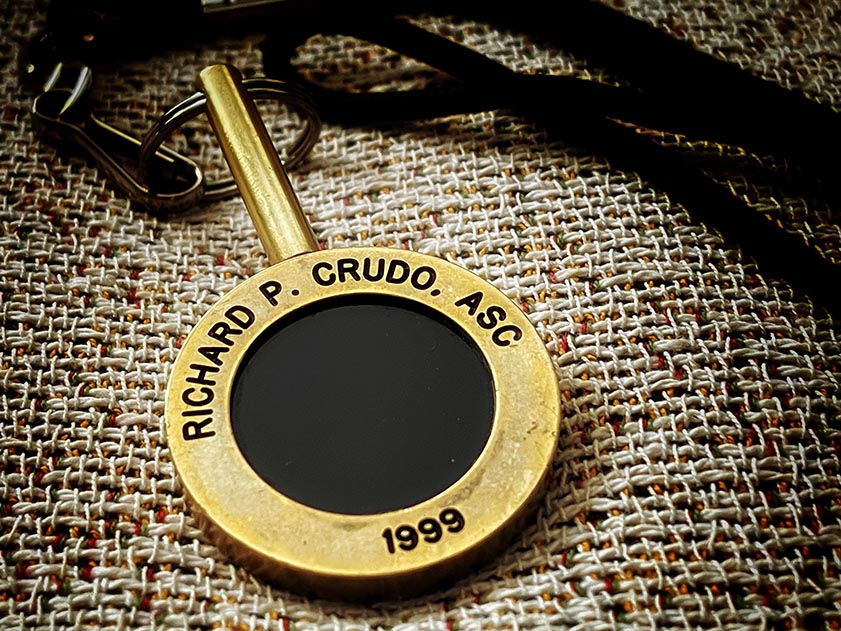
Once or twice on every shoot, someone will ask about the little pendant swinging from my neck as I move around the set. When I reply that it’s a contrast viewing filter, it usually provokes a follow-up query.
“What the hell is that?”
According to spectracine.com, this simple piece of smoked glass will “…permit visual judging and interpretation of a scene by compressing the scene’s brightness contrast-range to that of the film.”
I might accept this explanation if we were living in 1935. For the digital era, it doesn’t apply at all! Granted, proper use requires a certain calibration of your eye. But with the enormous latitude of today’s sensors, especially in the lower end of the curve, using it in the proscribed fashion will grossly mislead you about exposure. The same problem applies to modern emulsions, and by that, I mean anything manufactured post-1960’s. Throughout a lifetime spent around the camera, I’ve never witnessed a cinematographer using a contrast viewing filter, nor have I done so myself.
Why do I carry one? I use it to protect my eyes. Years ago, I had a layer of welder’s glass applied to the original surface. Thus, when I need to check the sun’s position or presence through the clouds, or if I need to sight-in a fresnel or other powerful lamp, I don’t risk burning my retinas. It also keeps me from seeing spots all day. I highly recommend using it this way, especially to younger cinematographers who may not be familiar with its actual value.
There’s also a “badge of office” aspect to it. When people see it at the end of my black lanyard, it creates an air of mystery. And there’s perhaps the most important use of all. It gives me something to fiddle with as I check the results on what has become the ultimate contrast viewing filter – the production monitor!
The contrast glass was one of the first toys I bought when I wanted to be a cinematographer; it wasn’t expensive and it was a first step for me towards my dream. I still use it on set and I got asked several times what it was. I always answered that is like a strong ND filter that allows you to look at the direct source of light without getting blind. I use it to look at the sun position as it moves behind clouds, but mostly to look at backlights and aim them perfectly where I want them. I thought it was a common tool light using the light meter, another object I got asked just yesterday on set what it was by a young PA.