
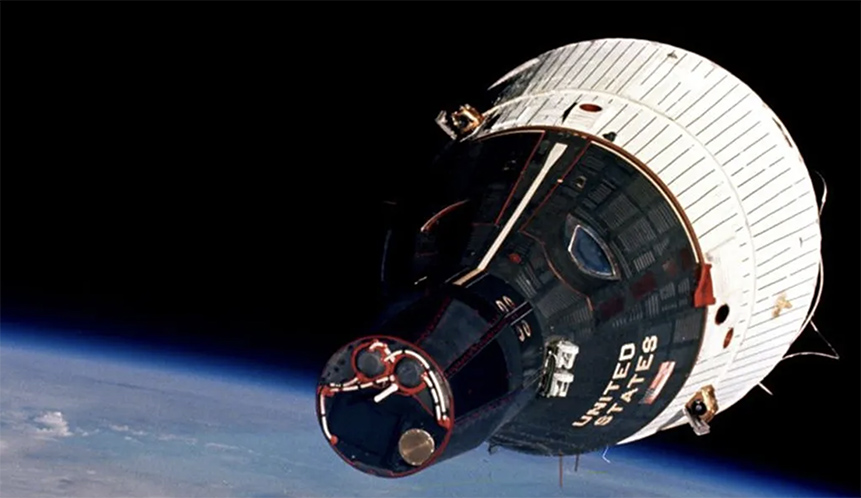
When I recently saw this photo of Gemini 10, which flew in space July 18-21, 1966, I was brought back to my childhood and the time when such events were common and really set the imagination free. The graphic form, contrast and color of the spacecraft and the earth behind it called up emotions I thought were gone forever. Life Magazine – the era’s greatest visual reference – was our chief organ for receiving information about the space program, and images such as this were highly anticipated with each new issue. Though there was a lot of craziness going on in the world at the time, the astronauts and their adventures were the most exciting things a kid could be obsessed with. I still am, in a way, and salute those men who memorialized an important part of our history with such outstanding pictures – executed in a hazardous, weightless environment as far from home as it was possible to be.
More recently, ASC member James Neihouse spent a considerable portion of his career training various space shuttle crews in their photographic duties. A variety of formats have flown over the years, both film and digital, right on up to IMAX. It’s a testimony to Neihouse’s instruction that the incredible imagery continued to flow in, captured by people who were essentially newcomers to the craft.
His star pupil would have to be Air Force Colonel Terry Virts. Among his dizzying list of accomplishments, he piloted the space shuttle and served for a time as commander of the International Space Station. But there’s something I find even more impressive about him: He has taken more photographs of the earth from space than any other human being – somewhere in the vicinity of 35,000 of them, as I understand it.
The best have been published in his book, View From Above: An Astronaut Photographs the World (2017; National Geographic). Check it out. It’ll put you into that childlike state of wonder I felt while looking at that shot of Gemini 10.
It was a magical time to grow up. Going to the model store. Buying paint, glue and the Gemini model kit. Then using my hands to glue it together. I could smell the paint. I glued my fingers together then got the decals on crooked but to me it was perfect.
Tim – Oh, yes…I do remember that, too. But you’ll also recall around this time of year: sticking fire crackers inside the finished models and blowing them up!
Hi Richard,
Are there any instances on set where you or your ACs have needed to calculate depth of field or the hyperfocal distance? Are there any formulas that you would recommend the average cinematographer to be aware of?
Thank you!
Andrew
I remember listening to the moon landing on American Forces Vietnam Radio at Blackhorse base camp.
Andrew – Cinematographers use depth of field and hyperfocal distance as creative tools all the time. I’d imagine the most common case would be when the camera is raking across two people in a car (say, through the passenger window looking toward the driver). There are pre-figured tables that will tell you the exact parameters of what you’re working with. You can find them in the ASC Film Manual and on a variety of apps. Let’s say you’re shooting 35mm film, using a 40mm lens focused at 8′ with a stop of T2.8. Depth of field would be 7’1″ to 9’3″. Hyperfocal distance: 57’10”. Simple! Nowadays, it’s a bit more varied due to the many sizes of sensors we’re dealing with. That’s why I prefer the apps to do the math for me.