
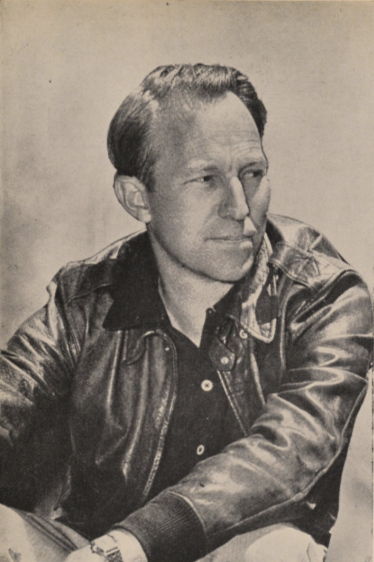
John Fulton, ASC, 1945
If you’ve seen any of, say, twenty studio films made before 1966, you’ve seen more of John Fulton’s work than any cinematographer you can name. As a career special-effects cameraman, his contributions to the believability of the unreal and the advance of filmmaking are unmatched. They resonate in everything we’ve seen to this day.
A native of Beatrice, Nebraska, Fulton was born in 1906. In an amusing coincidence, his father was the doctor who delivered future movie stars Harold Lloyd and Robert Taylor. Beginning his career with D.W. Griffith’s company, he quickly progressed from assistant cameraman to a brief stint as a cinematographer before finding his calling as effects supervisor at Universal. While there, he created the magic for such landmark films as Frankenstein (James Whale\Arthur Edeson, ASC; 1931), The Mummy (Karl Freund\Charles Stumar, ASC; 1932) and The Invisible Man (Whale\Edeson; 1933), which featured the most astounding “trick” photography of its time.
During the early ’40’s he continued at Universal while working on loan-out for a variety of studios, eventually taking over the effects department at Goldwyn in 1945. Eight years later, he moved on to the same position at Paramount where he collaborated with Alfred Hitchcock and principal cinematographer Robert Burks, ASC on Rear Window (1954), To Catch a Thief (1955), The Trouble With Harry (1955), The Man Who Knew Too Much (1956) and Vertigo (1958). In between those efforts, he somehow managed to part the Red Sea – among other miracles – for Cecil B. DeMille on The Ten Commandments (Loyal Griggs, ASC; 1956). I remember seeing that film in a roadshow revival at a Times Square theater as a very young child. The impression it made on me has never faded.
Other notable movies on his resumé include, Saboteur (Alfred Hitchcock\Joseph Valentine, ASC; 1942), Sabrina (Billy Wilder\Charles Lang, ASC; 1954), The Bridges at Toko-Ri (Mark Robson\Loyal Griggs, ASC; 1954), Gunfight at the O.K. Corral (John Sturges\Charles Lang, ASC; 1957), One Eyed Jacks (Marlon Brando\Charles Lang, ASC; 1961) and Breakfast at Tiffany’s (Blake Andrews\Franz Planer; 1961).
By all accounts, Fulton was a brilliant, friendly, active guy who was always interested in what was about to happen next. He was an avid golfer and fisherman and was frequently found in the air behind the stick of his own plane. Over the course of his career, he amassed nearly three-hundred-fifty credits, with eight Academy Award nominations (and three wins).
Fulton passed away in London in 1966 due to complications from an infection. At the time, he had been working on the effects for The Battle of Britain (see my August 4 post).
“The future still holds most of the important things I’ve planned to accomplish,” he told American Cinematographer in 1945. “I haven’t come anyplace close to doing what I’ve visualized in my career.”
Having looked into Fulton’s amazing life and body of work, I find that sentiment very hard to believe!