
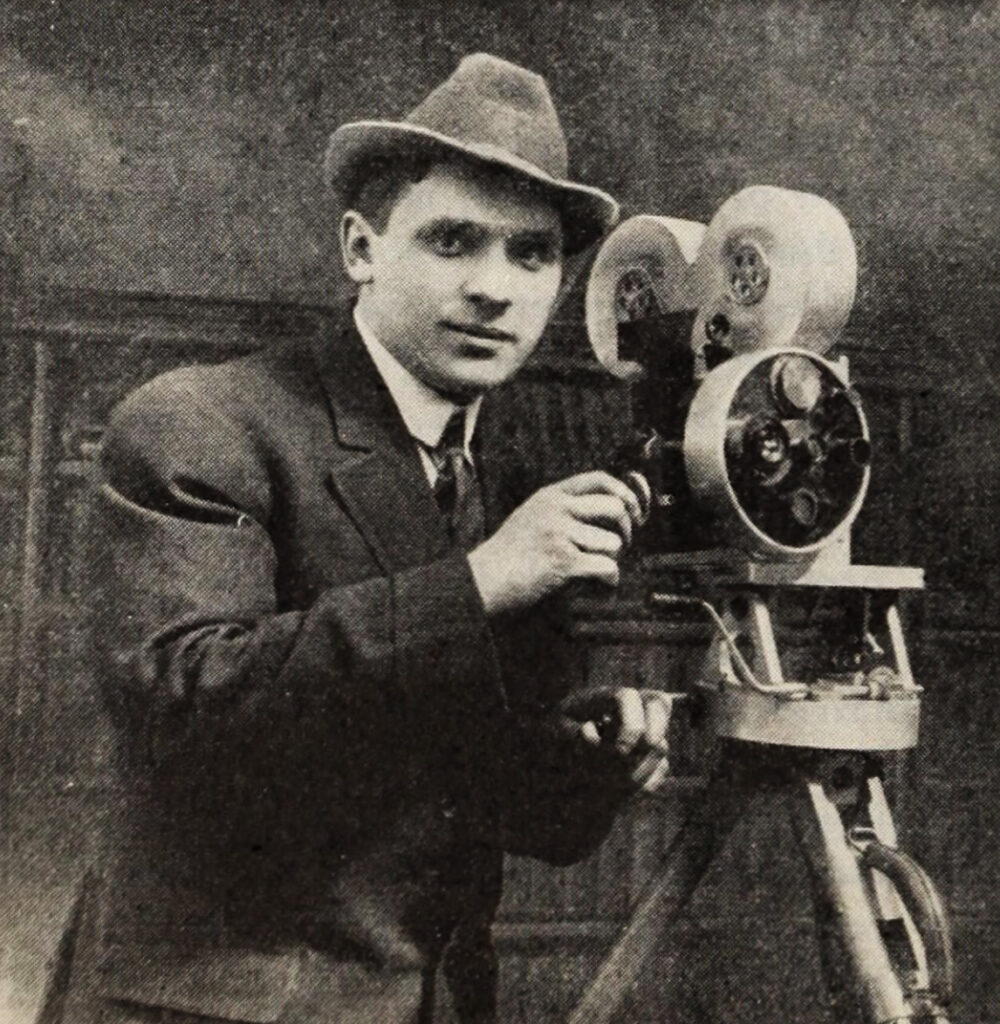
Jackson Rose, ASC with his Bell & Howell #1
Everyone interested in cinematography is aware of the ASC’s flagship publication, the American Cinematographer Manual. Currently in its eleventh edition, it has been an essential part of the kit since 1935 and was the brainchild of a seldom-recognized member, Jackson Joseph Rose (1886 – 1956).
Rose entered the industry in 1910 via the old Essanay Company in Chicago, when Harry Zech (later, ASC) hired him based on his work as a commercial still photographer. Over the next decade, he served as the cinematographer on at least two-hundred-twenty-five silent films, many of which featured such legends as Charlie Chaplin and Francis X. Bushman. In 1912, he became the first to use a 35mm Bell & Howell motion picture camera (serial number 1, oddly enough!). A tremendous improvement over the previous standard, it was an all-metal device that featured a small, collapsible finder and two-hundred-foot magazine. Like many of his contemporaries, Rose was a compulsive tinkerer and inventor. When he finished modifying the rig to his own specifications, it was estimated to have attained a worth of more than $2,000.00 ($63,000.00 in today’s money).
In many ways, Rose’s innovations outweighed his work onscreen. In 1919, he created a device that allowed for the development of hand tests, which gave cinematographers a fast and easy way to review exposure without resorting to the traditional lab. During the late ’20’s, he was instrumental in forming the cinematographers’ union, IATSE Local 659, in Hollywood. In 1940, he conducted the most comprehensive tests of film stocks and filtration known to that time. His conclusions were shared across the industry and affected the look of movies for decades to come. He also invented the “Cinema Focus Chart,” which in one form or another is still in use today. Ultimately, he stacked up ninety patents before his retirement in 1952.
But his crowning glory would have to be his 1935 assemblage of The American Cinematographer Handbook and Reference Guide. It was a more practical successor to the organization’s Cinematographic Annual, which was published only from 1930-31 and featured as much art as technical information. At eighty-four pages in length, it sold for $3.50 and was updated and revised through the ninth edition in 1956 (the year of Rose’s death). Four years later it was substantially expanded and renamed The American Cinematographer Manual. Already known as the ‘Industry Bible,’ the work grew to nearly five-hundred pages that covered everything relevant to the cinematographer’s job. Relying on contributions from across the artform, it was edited by members Joseph Mascelli, Arthur Miller and Walter Strenge. By that time, over one-hundred-thousand copies had been sold throughout the world.
Cut to 2023 and The Manual (over nine-hundred pages and counting) remains the go-to resource for the most precise, comprehensive information available. I purchased my first copy in 1979 and still get a thrill whenever I thumb through it. The 12th Edition is forthcoming and promises to feature an even greater amount of film and digital content. Keep an eye on www.theasc.com for the timeline of the new release.
And when you sit down to have a read, remember to give a little tip of the hat to the man who turned this incredible concept into reality.
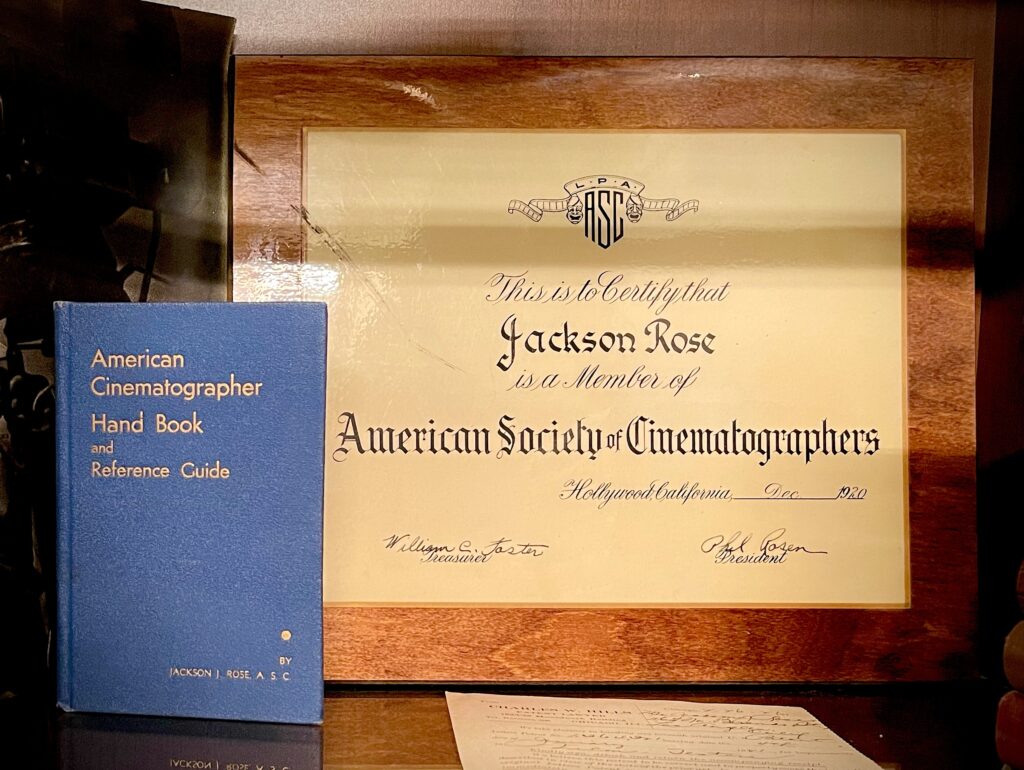
A copy of Rose’s first manual and his membership plaque, both of which are on display at the ASC Clubhouse in Hollywood.
I love the history of it all. I did find digital copies of the older manuals a couple of years ago online. The people before us deserve our respect for what they did for the art and the craft.