
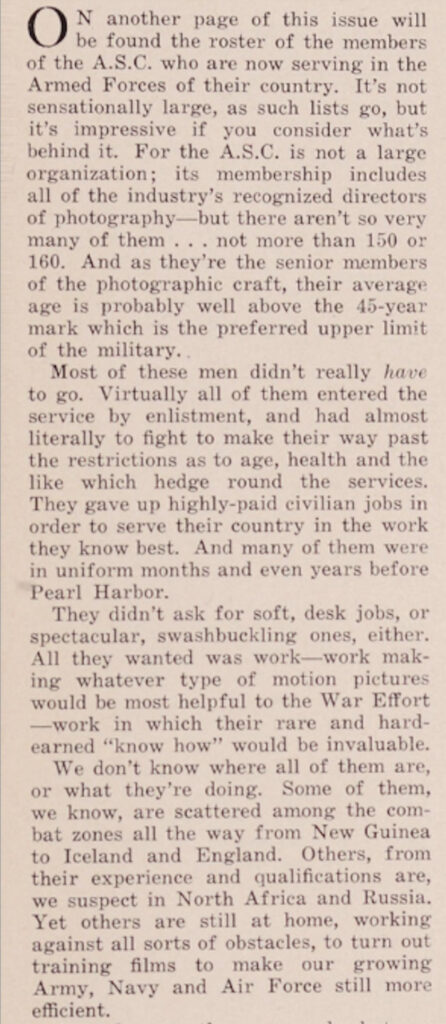
In honor of Veteran’s Day (which falls tomorrow), it’s appropriate to recognize ASC members who served our country – a tradition that goes back a long way. I’ll leave the intro to a clipping from the December 1942 issue of American Cinematographer:
Captain John Alton, United States Army – WW II
Lieutenant Commander Arthur Arling, United States Navy – WW II
Monroe Askins, United States Navy – WW II – John Ford Field Photo Unit
Commander Joseph August, United States Navy – WW II – served in Iceland and the Pacific
Captain Joseph Biroc, United States Army – WW II – Signal Corps – 1st cameraman to shoot Paris liberation & the liberation of Dachau
Norbert Brodine, United States Army – WW I – photographer
Stephen H. Burum, United States Army – Signal Corps, Astoria Studio, New York
Robert Caramico, United States Marine Corps – Korea – 5-year combat cameraman
Lieutenant Commander Philip Chancellor, United States Navy – WW II
Captain Wilfred Cline, United States Army – WW II
William Clothier, United States Army Air Force – WW II – photographed William Wyler’s legendary 1944 documentary, Memphis Belle: A Story of a Flying Fortress
Sgt. Stanley Cortez, United States Army – WW II – principal cinematographer of the Yalta and Quebec conferences and the liberation of Paris
Major Floyd Crosby – United States Army Air Force Transport Command – WW II – shot many pilot training films
William H. Dietz, United States Navy Reserve – WW II
Captain Clyde DeVinna, United States Marine Coprs – WW II – was the official photographer of our Pacific Fleet
Major Elmer Dyer, United States Army Air Force – WW II
Gerald Feil, United States Army Pictorial Unit – WW II
Captain Ray G. Fernstrom – 9th United States Army Air Force – WW II – disabled during the war
William A. Fraker, United States Navy – WW II
Major Ellsworth Fredericks, United States Army – WW II – 1943-44, was the official cinematographer of President Franklin D. Roosevelt
Captain Henry Freulich, United States Marine Corps – WWII
Karl Freund – WW II
Lieutenant Commander Alfred Gilks, United States Navy Reserve – WW II
Lieutenant Jack Greenhalgh, United States Army Air Force – WW II
Lieutenant Commander Sol Halperin, United States Navy – WW II
Robert Hauser, United States Army – WW II – combat photographer
Lieutenant Charles W. Herbert, United States Army – WW II
Gerry Hirschfeld, United States Army – WW II – Signal Corps, Astoria Studio, New York
Lieutenant Winton Hoch, United States Navy – WW II
Master Sergeant David S. Horsley, United States Army – WW II – 18th Army Air Force Base Unit (Motion Picture Unit); awarded the Legion of Merit for performance of outstanding services during the period of September 1944 to March 1945, in connection with the development of a secret device which materially added to the success of briefing B-29 crews for actions against the Japanese
Emery Huse – WW II
Levie Issacks, United States Army – Vietnam – decorated for actions taken during the Battle of Dak To
Ray June, United States Army Signal Corps – WW I
Richard A. Kelley, United States Coast Guard – WW II – made fourteen Pacific landings
Ken Kelsch, United States Army – Vietnam – served in Special Forces, MACV\SOG
Victor J. Kemper, United States Navy – WW II
Richard Kline, United States Navy – WW II
Captain Lloyd Knechtel, WW II
Sergeant Herb Lightman, United States Army – WW II – 167th Signal Photo Company; served with General Omar Bradley’s 12th Army Group; later became editor of American Cinematographer
James Liles, United States Merchant Marine – WW II
Captain Arthur Lloyd – WW II
Master Sergeant Fred Mandl, United States Army Signal Corps – WW II
Sergeant John Peverell Marley, United States Army – WW II
Brick Marquard, United States Navy – WW II – a member of John Ford’s Field Photo Unit, he was assigned by Ford to cover the D-Day Normandy landing
Lieutenant William C. Mellor – WW II
Ira. H. Morgan, United States Army – WW I – awarded the French Lègion d’Honneur
Staff Sergeant David L. Quaid, United States Army – WW II – served with the 5307th Composite Unit (Provisional) (Merrill’s Marauders); Chinese 38th Division; British 36th Division; Mars Task Force; 164th Signal Photo Company in the China-Burma-India Theater
Tech Sergeant William Rees, United States Army – WW II
Chief Gunner’s Mate Jack L. Richards – WW II – United States Navy
Peter Romano, United States Navy – combat cameraman
Joseph Ruttenberg – WW II
Lieutenant Commander Allen Siegler, United States Navy Reserve – WW II
Howard Schwartz, United States Marine Corps – WW II – Pacific photographer
Major Lester Shorr, United States Army – WW II – Signal Corps – enlisted April 1942, spent 26 months in the China-Burma-India Theater
Captain William V. Skall – WW II
Captain Clifford Stine – WW II
Lieutenant Colonel Ted Tetzlaff, United States Army Air Force – WW II
Commander Gregg Toland, United States Navy – WW II – served in John Ford’s Field Photo Unit; directed the U.S War Department documentary, December 7th
Captain Leo Tover – WW II
Lieutenant Thomas Tutweiler – WW II
Captain Joseph Valentine, United States Army Special Services Division – WW II
Lieutenant Paul C. Vogel – WW II
Roy Wagner, United States Air Force – Vietnam
Major Gilbert Warrenton, United States Army Air Force – WW II
Lieutenant Harold “Winnie” Wenstrom, United States Navy Reserve
Joseph Westheimer, United States Army Air Force – WW II – was part of the 18th Base Unit housed at Hal Roach Studio in Culver City
Captain Al L. Wetzel – WW II
Haskell Wexler, United States Merchant Marine; WW II; three ships he served on were sunk by enemy torpedoes
Commander Charles Wheeler, United States Navy – WW II – enlisted in July 1941; began WW II as an Ensign; attended the Training Film Division at the Bureau of Aeronautics in Washington, D.C.; also attended the Photo School at Pensacola, Fla.; studied aerial mapping and photogrammetry in Norfolk, Va.; saw action in Pacific in a Combat Photo Unit and as an aircraft carrier photographic officer; was Officer-In-Charge of all photography of the Japanese surrender aboard the USS Missouri, 9\2\45
Gordon Willis, Staff Sergeant, United States Air Force – Korea – cinematographer
Jack Woolf, United States Navy
Alvin Wykoff – WW II
ALSO:
John Arnold – though not formally inducted into a service branch, he played a huge role in training Army and marine combat cameramen
Thanks for the recognition for all these men. Ken
Ken – Sad that it’s sort of the unknown history of the ASC, isn’t it?
Thank you, Richard.