
I’ve never been a serious fan of science fiction, but Criterion’s DVD release of George Lucas’ THX 1138 belongs in every cinematographer’s library. Set in a dystopian future where humanity exists in narcotized servitude to a totalitarian authority (sound familiar?), the razor-thin plot would disintegrate if not for the movie’s imaginative visual motif. After watching it for the first time the other night, I couldn’t believe it had taken me so long to get hip. It’s indeed an amazing accomplishment.
It was also interesting that the two credited cinematographers – Albert Kihn and David Myers – were documentarians who had no prior feature experience. I suspect that second unit DP’s Caleb Deschanel (future ASC) and Haskell Wexler, ASC exerted a heavy influence, but whatever the combination, the team delivered a look that’s perfect for the story.
Lucas wanted to shoot in widescreen because he felt THX was above all an environmental film; this made it essential to get the biggest image onscreen. His desire for a docu-like approach also meant shooting in available light whenever possible, and in as low light as possible everywhere else. Rather than choosing the anamorphic format and its slower, bulkier lenses, he went with 2-perf Techniscope (2.39 aspect ratio). This allowed use of the faster, spherical Nikkor primes, with a set ranging from 21mm-300mm. Kodak’s 5254 negative was processed at Technicolor and pushed one stop (with the exception of scenes intended for opticals). Two cameras were often in play, both Eclair Cameflex CM-3’s. This was an unconventional choice at the time, no doubt a product of Wexler’s enduring fondness for their light-weight, adaptable characteristics.
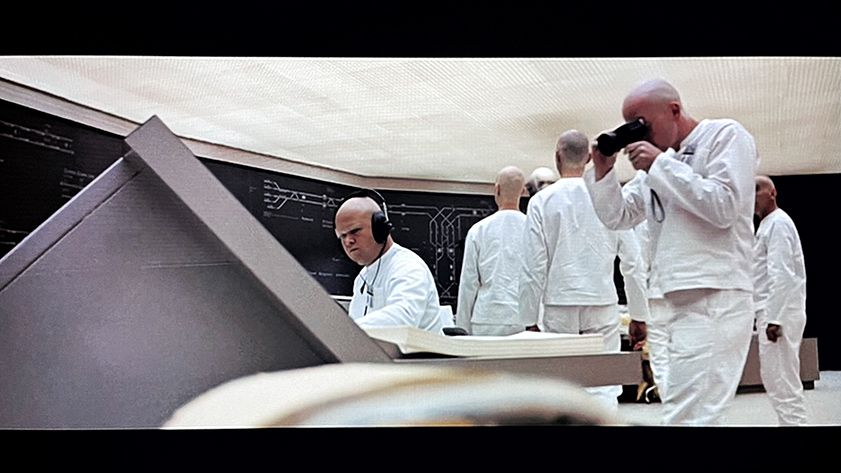
Since there are no exteriors save for the film’s final shot, great emphasis is placed on production design, all of which was realized with minimalist restraint on practical locations in and around San Francisco. Sets, decoration and costumes are predominantly rendered white until late in the proceedings, and this creates an alternative reality; often the only color seen is in the actors’ faces. This style peaks in a number of sequences that unfold in a sort of limbo domain – an enormous stage lined by a white cyclorama. The lighting is diffused, even and shadowless and implies an infinite space (though one from which the characters can’t escape). This had to have presented some challenges in terms of contrast and balancing of fleshtones, but the palette is consistently natural with a pleasing softness. In terms of exposure, the huge area was lit to T11 with the iris set at T5.6; this allowed the naturally reflective quality of the white cyc to add almost 1\2 stop more exposure. It’s good that Lucas had no choice but to shoot on film. I don’t think the same texture would have been possible if digital had been available at the time. The electronic medium is too harsh to handle such a subtle task.
Appropriate to the controlled lives of the characters (and with the exception of a vehicular chase sequence), the camera does not move – ever. No pans, no tilts, no dollies, no cranes; it’s merely a locked-off observer of whatever happens in front of it. Fortunately, strong graphics take up the slack. Every frame has something to charm the eye, especially in those white-limbo-surroundings where there’s nothing in the background to distract from the foreground. Added to that, much of the narrative unfolds in close-up, which further enhances the claustrophobic atmosphere. The entire show seems to have been photographed on long lenses to the extent that even the wider shots have a telephoto feel to them. This go-for-broke distancing effect is perhaps the most powerful yet least obvious device on display.
There are also frequently recurring images of action on TV monitors, which isn’t unusual for a futuristic fantasy. But the unique thing is, Lucas decided to leave in the rolling bars that we used to fight so hard to eliminate during the CRT era. What a great idea! As odd a choice as that was, in 2023 it still references like something from a hundred years on. A number of holograms also make an appearance; they’re convincing enough in their own right. And then there’s the scene depicting the hero as the victim of a show trial. With its odd angles and play of reflections off the surrounding glass booths, it has an unnerving way of recalling East Germany, circa 1955. Combined with the hauntingly recurring voice of an official touting the virtue of earning social credits, it’s not much of a leap to imagine a world like this under the twisted values of the Chinese Communist Party.
Speaking of which, I’d be remiss if I didn’t praise the brilliant Walter Murch for his sound design. It’s an important part of THX’s success and in many instances helps raise potentially mundane moments to the next level.
This movie should’ve been a giant hit and received a boatload of awards, especially for its cinematography. As was typical of the old-timers running Warner Brothers, they didn’t understand it, so they acted according to their nature and dumped it in a limited release. I always thought American Graffiti (1973) was Lucas’ masterpiece, but THX 1138 changed my mind. That he brought it in for less than $800,000 – which even in 1970 was next to nothing – is a miracle.
The best part is that all the techniques I’ve spoken of stand in service to the story. The camera work is certainly stylized. But by never calling attention to itself, the cinematography just is. And that’s the highest compliment I’m capable of offering.
A note of ‘inside cinematography’ trivia: If you watch the DVD, pay close attention at the 1:21:00 mark and you’ll see a bit player waving a Pentax Spot Meter around as if he actually knew what it was used for.
Thanks for this, Richard. I’ve never seen the film considered or appreciated in this particular way. Your reactions are insightful given Lucas’s later pro-video and anti-Hollywood stance. Nice to read a shout-out to David Myers, whose unique body of work includes many rock-related films that brought me to new worlds growing up in remote Northeastern Wisconsin.
This movie was first conceived as a student film while Mr. Lucas attended USC. I saw it presented in a film festival while attending UCSB. I had a feeling this kid was going places…
Regarding the fixed camera technique, a CBS cameraman, who was the first to stick a movie camera(an Aruicon with Mitchell mags) on my shoulder said: “Look its moving pictures not moving camera. Frame your shot and let shit happen in front of you.”
Good advice, John. Some of today’s directors should take notice!