
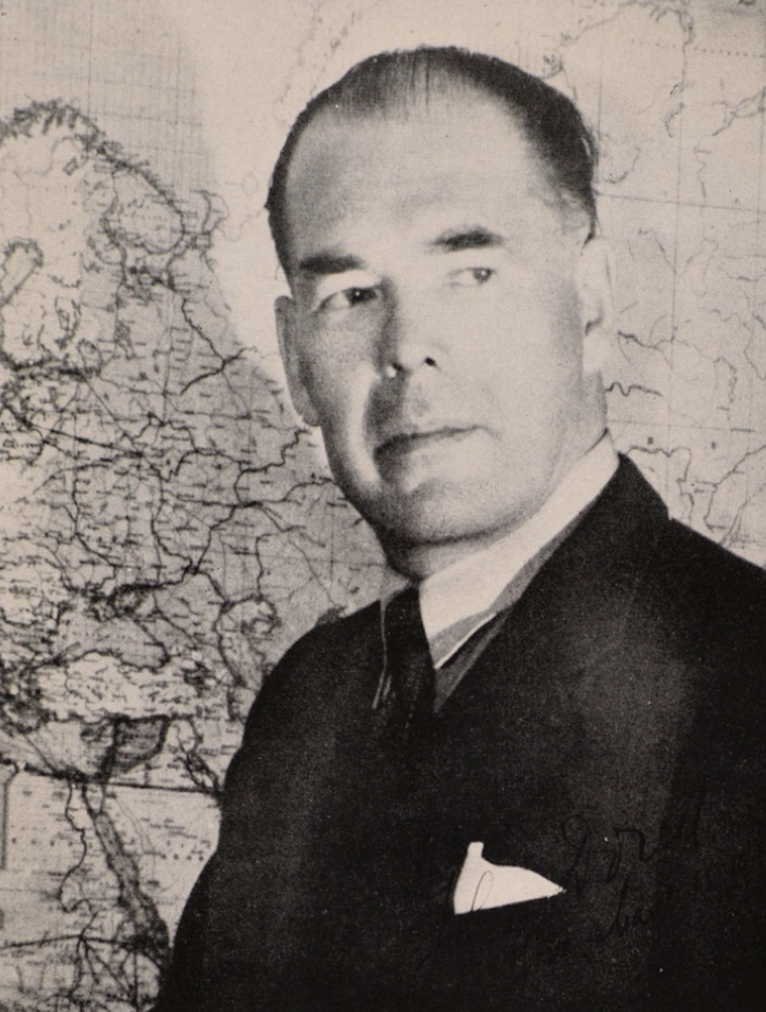
During the four-year run of this blog, I’ve resurrected a few names that would otherwise have been lost to the ages. The latest to surface – John Dored – is without doubt the most obscure of them all, and there’s a good reason for that. He spent almost the entirety of his working life shooting newsreel footage and documentaries outside the United States. He was never a part of Hollywood and there doesn’t seem to be any evidence of him delving into fiction on a significant level. The motives behind his invitation to ASC membership – a strictly narrative-based organization for its first eighty years – are a mystery and will probably remain so. Anyone who might provide a clue has been dead for a very long time.
This doesn’t mean that Dored didn’t deliver amazing work nor have an incredible career. Any of us would’ve been over-the-moon to be present for half the events he witnessed from behind the camera. Born and raised in Moscow, he learned his trade in Paris and London before landing in the U.S. in 1907, where he went to work for Pathè’s American branch at Bound Brook, NJ. He eventually crossed the continent to join the World Film Company in Portland, OR before landing in Los Angeles at the old Selig Polyscope Company. By 1912, his wanderlust got the better of him and he returned to the city of his birth.
While there, his documentary efforts really kicked in. He circled the planet several times and by the start of World War I in 1914 was sent to cover the major naval battles on the Black Sea as well as the most notable fights on land. When the Russian Revolution began in 1917, he was called home where the authorities made him an offer he couldn’t refuse. With requisite totalitarian charm, they told him: “You either work for us, or we shoot you on the spot!”
While filming Leon Trotsky’s effort to organize the Red Army all over Russia, Dored managed to escape to Warsaw in 1920. Penniless, in rags and hungry, a fortuitous meeting with colleague George Ecole of Pathè News, New York (which became Paramount News in 1927) put him back on track. Among the many events he subsequently covered were: the Polish-Soviet War, the Memel Putsch, the Jewish-Arab revolt in Palestine, Wilkins’ Alaska-Spitzbergen flight, General Nobile’s dirigible expedition to the North Pole, the 1934 Austrian revolt in Vienna, the Italo-Abyssinian War, the Spanish Civil War, Hitler’s entrance to Austria, the Nazi occupation of Czechoslovakia, the occupation of Albania by Italy, the Nazi storming of Poland and the beginning of World War II in 1939…and countless other issues of interest. In 1948, he accompanied Wilkins on his expedition to and under the Arctic ice in the submarine Nautilus. Several years later, he ended his career with an assignment spanning South America as part of the United States’ Good Neighbor policy.
If that wasn’t enough for one lifetime, Dored and his Norwegian painter wife, Elizabeth, were also the subject of a filmed biography, titled John Dored’s Island. I haven’t seen it, but the producers had access to the couple’s letters and other documents. It’s purported to be about profession and destiny, love, life and death. Dored spent his last years in Norway, living on a lake near the town of Halden. The locals named a nearby island in his honor.
He summed up his philosophy in his memoirs. “I’ve always felt limited by scripts and staging. I always yearned for freedom. I became a film reporter to shoot footage of those things for which our Father in Heaven writes the screenplay.”
He sounds like a really interesting guy, but he’d never make it in today’s homogenized, corporatized world. Once again, I ask: Why does it seem that the most fascinating lives have already been lived? He sounds like the insightful type and I would love to have heard his reply.
Wow, what a great article, Richard! Dored sounds like the inspiration for “The Most Interesting Man in the World” character…
Fantastic read. Thank you
A contemporary of Dored was Tom Priestley brother of Jack Priestley (ASC?). I worked with Tom on many documentaries both at NBC and ABC. Rich may have been on one of those filming days. Dored had a super career and there are many of us that followed in his footsteps doing documentaries and magazine shows. Tom’s NYT obit is below.
Thomas A. Priestley, a photographer, producer and director of award-winning television documentaries, died on Thursday in New York City. A resident of Manhattan and East Hampton, L.I., he was 75.
He died of a heart attack en route to his physician’s office, said Ann Garfield Black, his companion. They were to have been married this weekend.
Known professionally as Tom Priestley, he was born in Fort Lee, N.J., and attended St. John’s University. Starting his career as a newsreel cameraman for Universal Pictures, he was a pool photographer assigned to Gen. George S. Patton’s command in Europe during World War II.
His wartime work included filming the liberation of the Buchenwald concentration camp. Later, sent to the Far East, he documented the Japanese surrender on the deck of the battleship Missouri on Sept. 1, 1945.
In his postwar career with the NBC and ABC networks, Mr. Priestley worked on more than 300 news and cultural programs, nine of which won Emmy Awards. His credit line appeared on such noted documentaries as “The Louvre,” “John Steinbeck’s America and the Americans,” “Sahara,” and “Venice Be Damned!,” a portrait of a magnificent city in slow decay narrated by Jose Ferrer.
“The Killing Ground,” broadcast as an ABC News Closeup in March 1979, offered a chilling survey of toxic waste dumps. It won an Emmy, was nominated for an Academy Award and received an hour long update, which he also directed, in August 1980.
Mr. Priestley’s first wife, Geraldine, died in 1963.
Mr. Priestley’s survivors include his son, Thomas Jr., of Cliffside Park, N.J.; Ms. Black and her daughters, Andrea, of Hong Kong, and Alison, a student in Paris; a brother, Jack, of Los Angeles; a sister, Lillian Boyd, of Freeport, L.I., and four grandchildren.
Beautiful story Richard. You’ve rescued a man’s name from obscurity and I am grateful to learn of his huge list of cinematography assignments. What a life!!
Thanks again Richard for your persistence of fascinating stories and cinematographic history.
Simply awesome!
Very interesting.
Greg – It’s amazing how many people have had such interesting lives and careers, yet no one knows who they are today. I’m doing my best to save them from obscurity. Dored was a particularly good one to learn about.
Richard, Thanks so much for this article. It’s embarrassing to me that I had never heard of John Dored, since I’ve spent my life in the news and documentary racket. By comparison I feel that my own career has been a mere dalliance. Cheers, JG
Interesting story, I think we all want to be remembered in some small way.
When we’re living “history” and sometimes even documenting it we don’t always think about being there for some major event. He and all of those like him had to have some idea of the gravitas that their images and stories would carry by making a record of the events.
Thank you for sharing and sending me down this particular “rabbit hole!”
I found the Documentary on YouTube.
https://youtu.be/tmpKibEQeB8?si=_nvugd5lVRCgTseY
And an interview with the director.
https://offscreen.com/view/dzintra_geka
JOHN DORED, in Latvian – JĀNIS DOREDS, was born in Latvia which at the time of his birthday was part of the Russian Empire. Latvia proclaimed its independence in 1918.
Elvira – Thank you for pitching in with that! It adds more detail to a man who led an incredible life.
Dear Mr Crudo,
Please correct the facts in your article. John Dored (Jānis Doreds) was born in Cēsis, Latvia. Born and bred in Latvia.
He moved to Moscow to work in his brother’s photo supply shop where he got interested in Edison’s kinetoscope, hence his amazing career.