
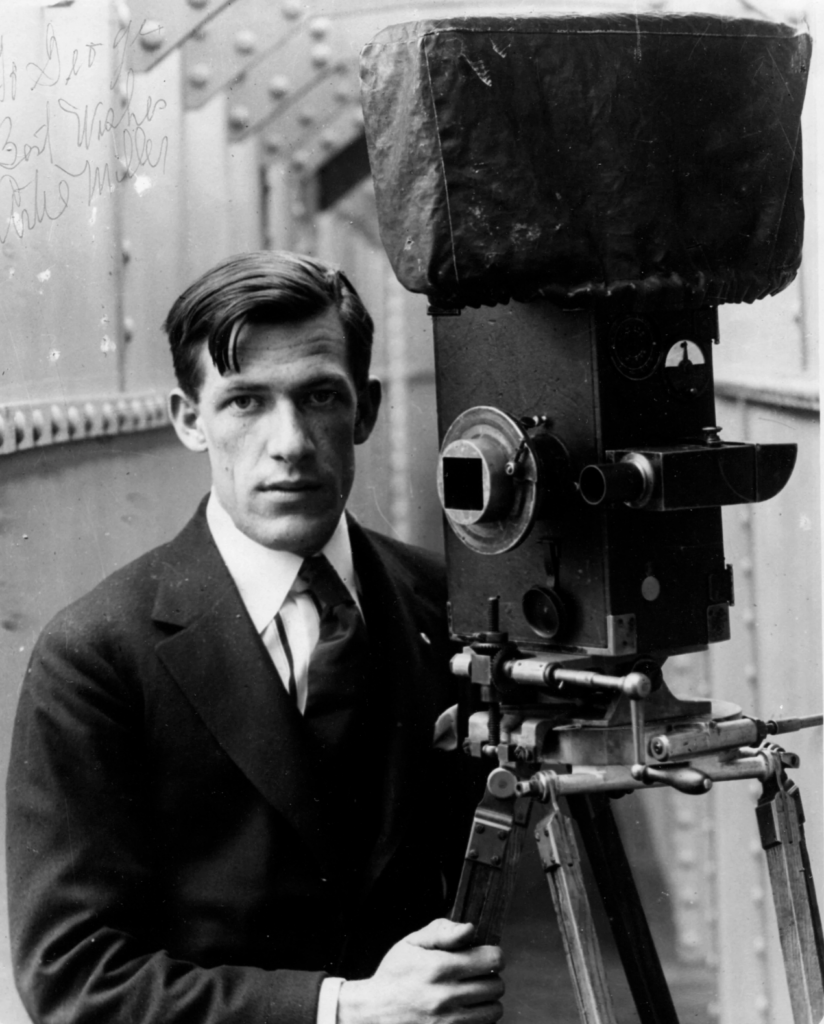
Miller with his 1912 Pathe 35mm camera. This exact model is currently on display in the ASC Clubhouse.
Arthur Miller, ASC (1895-1970) is one of our all-time great cinematographers. A native of Roslyn, NY, he began his career as a lab man in 1908; by 1912 he was filming shorts for a variety of independent companies in Los Angeles. In addition to his exclusive contract to shoot nearly all of child-star Shirley Temple’s films, he was nominated for an Academy Award on six occasions, winning for his efforts on How Green Was My Valley (1941; John Ford), The Song of Bernadette (1944; Henry King) and Anna and the King of Siam (1947; John Cromwell). Each of them remain admirable to this day.
Anyone who’s played the game knows that a cinematographer never has complete governance over the look of their work. People forget that this is a collaborative art. Lots of things will get in the way of those brilliant intentions you develop while reading the script at home. Certainly, the director’s vision is of primary concern. But there are limitations of time, budget, equipment and personnel, not to mention the endless parade of unpredictable events and situations that strain to be controlled, and are too often beyond our influence.
Miller knew that, and in these quotes from an April 1942 piece in American Cinematographer, he expounds upon an overlooked aspect of what we do.
Keep in mind, this was published eighty-two years ago. To bring it up to date, include women in your thoughts wherever he uses the word, men.
“…the director with whom you’re working and the executives for whom you’re making the picture can do a great deal to make or break the photographic job you deliver. There are directors who seem to defy you to get even decent photography, men to whom photography, good or bad, doesn’t seem to mean a thing. And then there are men like John Ford, who directed “How Green Was My Valley.” Ford appreciates the value of good photography, not only from a decorative standpoint, but for its dramatic value, as an aid to his own value, work. He’ll go out of his way to help you. Working with John Ford, even on the most difficult sort of a production, is a pleasure which cannot come any too often to any of us.”
If only every director was like John Ford! But wait until Tuesday, when you’ll learn what Miller had to say about producers.
richard- I love Miller’s comments which are so true. I know we’ve all been there one time or another. Now you have me hooked to wait another week for his words about producers. I certainly have some of my own!
Great post!
Tracy – I concur!