
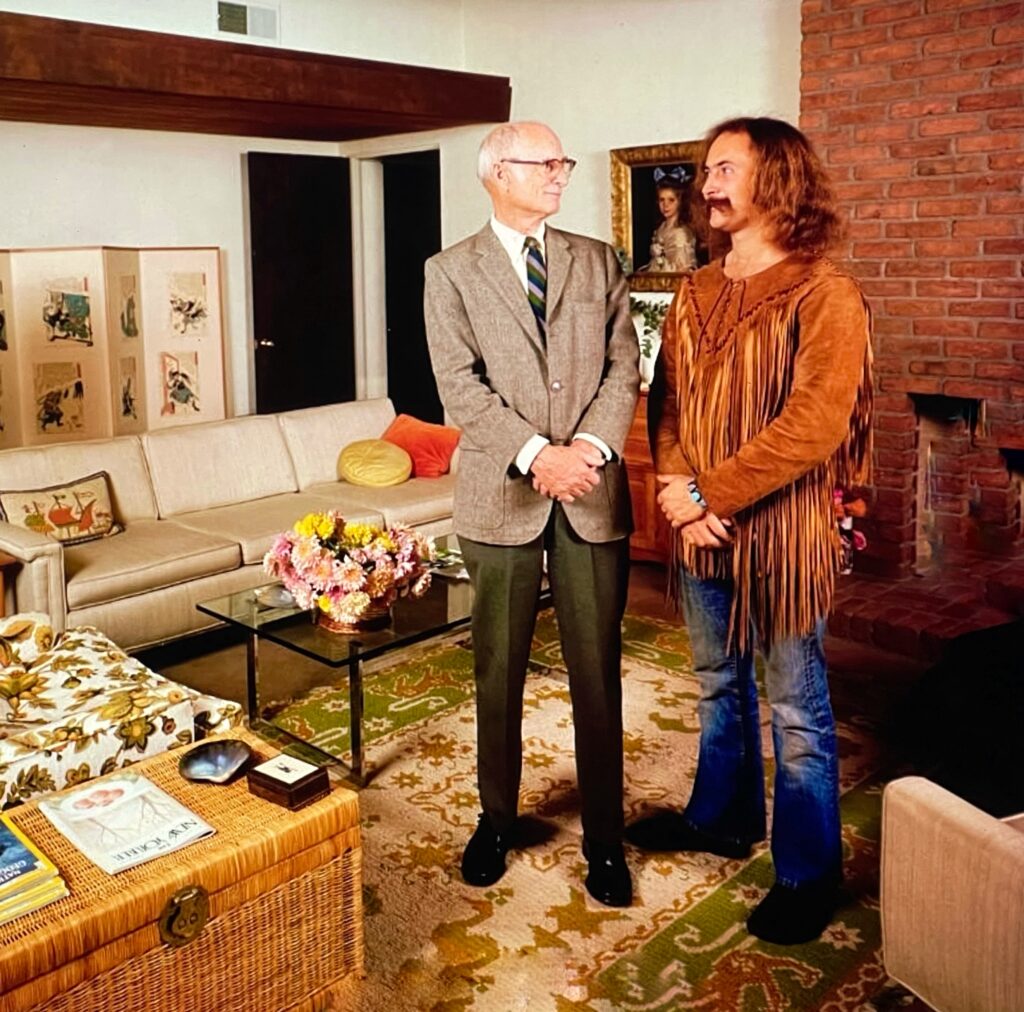
This photograph by John Olson, first published in the September 24, 1971 issue of Life magazine, shows rock star David Crosby and his dad Floyd at the elder man’s home in Ojai, California. It was part of an article entitled, The Rock Family Affair and gave an unironic glimpse into the off-stage origins of some of the major entertainers of the day. Interest in it might end there, but as dedicated readers of this blog will know, I’ll always find a way to relate the subject to cinematography.
In this case, Floyd was a major figure in our world for many years. Born in Philadelphia in 1899, he was a descendant of the prominent Van Rensselaer family and as a young man held a number of jobs before enrolling at the New York Institute of Photography. His career began in earnest in 1927 when marine biologist William Beebe hired Crosby to document his expedition to Haiti. Quickly establishing himself as a talented cameraman, he was then hired by Robert Flaherty to shoot the ethnographic feature, Tabu: A Story of the South Seas. Surprisingly, this effort brought him an Oscar for Best Cinematography at the fourth Academy Awards. His career in documentaries flourished after that, which led him to collaborate with such pioneers as Pare Lorentz and Joris Ivens. During World War Two, he shot training films for the Army Air Corps. A post-war distaste for studio politics saw him avoid mainstream filmmaking, but that changed in 1952 when director Fred Zinneman asked him to shoot High Noon. The film won four Oscars and Crosby picked up a Golden Globe for Best Black and White Cinematography.
Subsequent to that, he continued to thrive on the fringes of the industry, joining up with legendary B-movie director Roger Corman on Five Guns West in 1955. For the next twelve years, they worked on twenty-one films together, among them some of the most fondly-remembered staples of my childhood TV-watching years: Attack of the Crab Monsters (1956), War of the Satellites (1958), Machine Gun Kelly (1958), She Gods of Shark Reef (1957), Crime and Punishment U.S.A. (1959) and X: The Man with the X-Ray Eyes (1963). Also during that period, Crosby shot what are widely recognized as Corman’s best efforts – his Edgar Allan Poe series – House of Usher (1960), The Pit and the Pendulum (1961), The Premature Burial (1962), Tales of Terror (1962), The Raven (1963), The Haunted Palace (1963), The Masque of the Red Death (1964) and The Tomb of Ligeia (1964). And if those aren’t enough, Crosby managed to squeeze in The Old Man and the Sea for John Sturges in 1958.
While David Crosby certainly made his mark on the music world, his father – who died in 1985 – created an important, lasting impression as well. What I wouldn’t give to have been standing just outside the frame when that photograph was taken…
I remember reading his obit in AC & I’m glad you revisited his story. I don’t recall that the AC obit referenced his long career.
Thanks, Richard. I have always been fascinated and amused when I see this photo. It’s a visual representation of the intersection of two of my great interests and passions in life — cinematography and music. David Crosby’s autobiography — a cautionary tale — gives a couple small hints about growing up as Floyd Crosby’s son. The late George Turner, former AC editor and my mentor and good friend, loved the movie Tabu, and I always think of him when I come across the elder Crosby’s name.