
The laboratory business has always been a highly competitive one, with each franchise operating under the tightest of margins. Just like today’s similarly-challenged post houses, they were constantly on the hunt for some proprietary ‘special sauce’ that would raise them above the herd and make them more attractive to their cinematographer customers.
I recall an early-80’s lab in New York City by the name of T.V.C. They were considered a low-rent choice by most, and with good reason. I have no idea what the initials stood for, but their claim to fame was a process called chemtoning, which was a form of chemical flashing that purported to open up the shadows. Their print ads always featured examples of the effect that were shot in the subway, under dim fluorescent light. It’s no surprise that the results were horrible: Green and grainy, regardless of what publication you were viewing. I never got to try chemtoning – I was an assistant cameraman at the time – but I don’t remember a cinematographer ever saying something good about it.
Simultaneously, in a different part of Manhattan, Irwin Young and his venerated staff at DuArt were offering wet gate printing, which by submerging the negative in a liquid with a matching refractive index, reduced the effects of scratches and other small defects. Later to become an industry standard, this quickly became a popular choice when release printing and came at a not inconsiderable jump in price. DuArt was also the reigning expert in 16mm-35mm blow ups, which were popular among low-budget and documentary filmmakers. I enjoyed an extensive history with them as both an AC and cinematographer and can attest to their expert technology and workmanship.
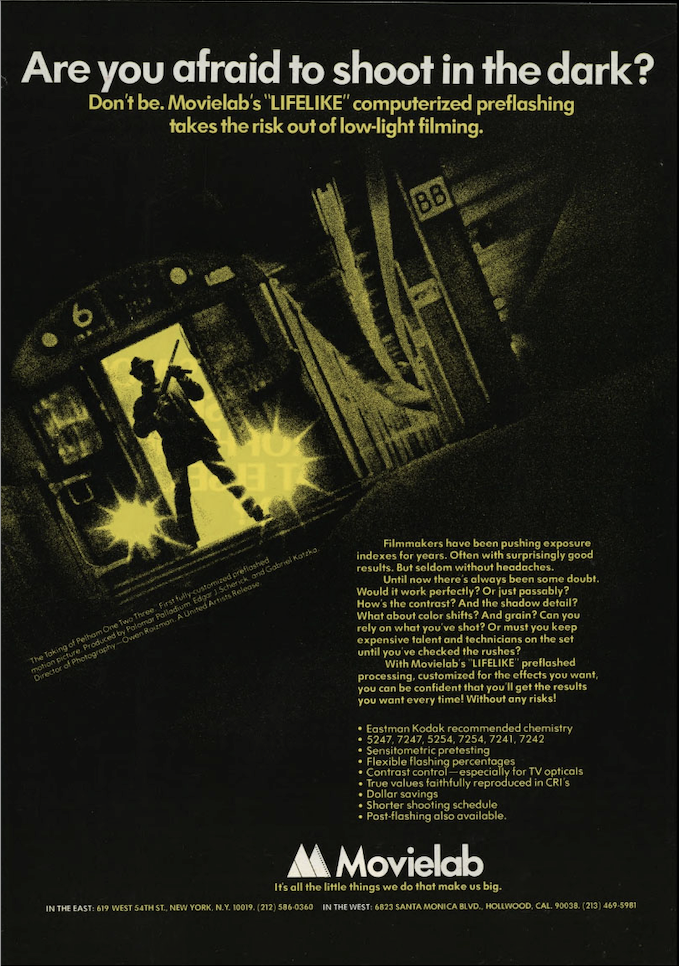
Then, there was Movielab and their ‘computerized’ flashing innovation, as touted in the ad below. Adding a computer to the chemical process in 1974 should’ve given us a hint of the direction things were heading, but the movie they use to illustrate it – The Taking of Pelham One Two Three (Joseph Sargent\Owen Roizman, ASC) – was a good one. I discussed it on many occasions with Roizman and he never mentioned the issue of flashing the negative, intermediates or print. He did apply a one-stop push to the Eastman 5254, but I suspect the fabulous look of the film had more to do with his artistry than anything the lab did on its own.
Regardless of their efficacy or lack thereof, these innovations evoke a charming remembrance of a time when the human touch was more present in the work we do. Creation of today’s secret sauce requires a mathematician, and though we can do more things more creatively and quickly, it’s not quite the same. And it’s just another reason for the old-timers to roll over in their graves…again.
Richard – Through my association with Kodak, I had the pleasure of knowing Irwin and Linda Young, and I recall vividly being given tours of the DuArt lab when I was writing about one project or another in the 1990s. Little did I know it was the end of an era. But I never forgot the devoted, loyal relationships they had built with filmmakers. Thanks for bringing those memories to mind with your piece.
When I worked for NBC in the mid-70’s, the film of choice for newsreel was 16mm color reversal processed in house. I was able to convince the producers/directors I worked with to switch to color negative on documentaries that I filmed. TVC was their choice because of cost and perhaps some behind the scenes chicanery. I tried chemtone once and was not impressed. Eventually I settled on DuArt when the choice was up to me and Foto Chem in LA. The infamous CFI was nick named Can’t Find It by the civilian cameramen in the USAF.
I used TVC and the Chemtone for a lot of 16mm film shoots that I did and I was pleased with the results. I can’t say that I made a direct comparison shooting the same footage on two reels and then doing one at TVC and another at Movielab or DuArt so it isn’t a scientific assessment, purely my memories of the output in the late 70’s in NYC. I was shooting a lot of low (no) budget shorts and a self- produced documentary film about a Formula Ford race car driver as he was building the car in Ct. and then eventually racing at Lime Rock and Road Atlanta. I never did complete the doc and recently donated all my neg and dailies prints to a race car historical foundation on the east coast.
My point is that I liked the results that Chemtone was giving me AND it was several pennies cheaper per foot than the other labs.
Well, Roberto…you liked the Chemtone results because you were talented\smart enough to get the best out of it! Unfortunately, that description doesn’t apply to most of the rest of the herd.
I believe “Superman: The Movie” used Chemtone for their night work in NYC, I don’t know if that was a decision made by Sol Negrin, who did the 2nd Unit work there. One lab invention I really liked was FotoKem’s dynamic printer light system where you could change printer lights in mid-shot, allowing some adjustment during a camera move or something. Very useful for dealing with optical printer transitions that didn’t balance perfectly….
Regarding wet gate printing, from the Academy’s website:
1959 Academy SCIENTIFIC OR TECHNICAL AWARD (Class II)
To WADSWORTH E. POHL, JACK ALFORD, HENRY IMUS, JOSEPH SCHMIT, PAUL FASSNACHT, AL LOFQUIST and TECHNICOLOR CORP., for the development and practical application of equipment for wet printing.
Technicolor invented wet gate printing principally to mitigate surface scratches when making the color matrices for Dye Transfer Printing. Joe Schmit (mentioned above) told me that they had actually been using wet gate printing in the early 1950s trying to keep it a secret.
I’m going to digress here, Joe was still at Technicolor in 1999, and was an invaluable resource for Technicolor because of everything he had stored in his head about different optical printing techniques and setups. Joe was the one that set up the printers for Jon Alcott’s Super Techniscope (later Super 35) cinematography in on 1984’s Greystoke, the Legend of Tarzan. Interestingly enough, Joe started at Technicolor just as the Superscope process had stopped being used, and had no recollection of Superscope when the Super 35/Super Techniscope format came into vogue in the 1980s. The “Superscope 235” format is identical to the Super 35 format in all respects, except that the aspect ratio had changed to 2.39:1 in the 1970s.