
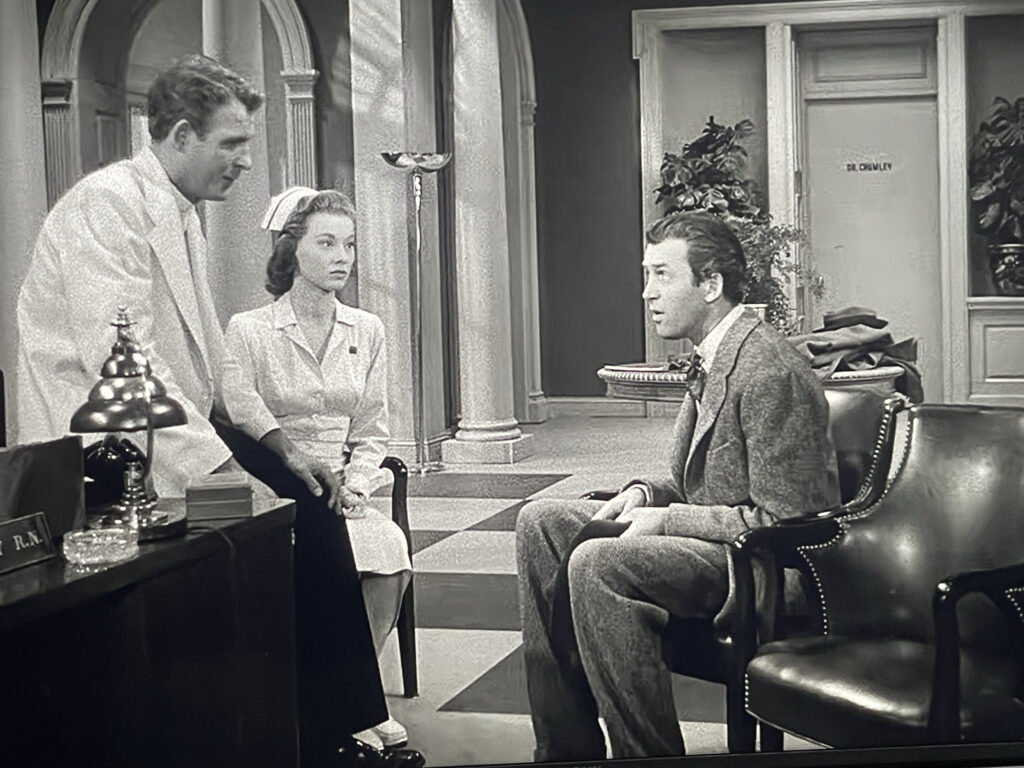
The other night I somehow found myself watching Harvey (1950; Henry Koster\William Daniels, ASC), an oddball of a movie that I’m not particularly fond of. I stuck with it though, if only to appreciate the performance of one of my all-time favorite movie stars, Jimmy Stewart.
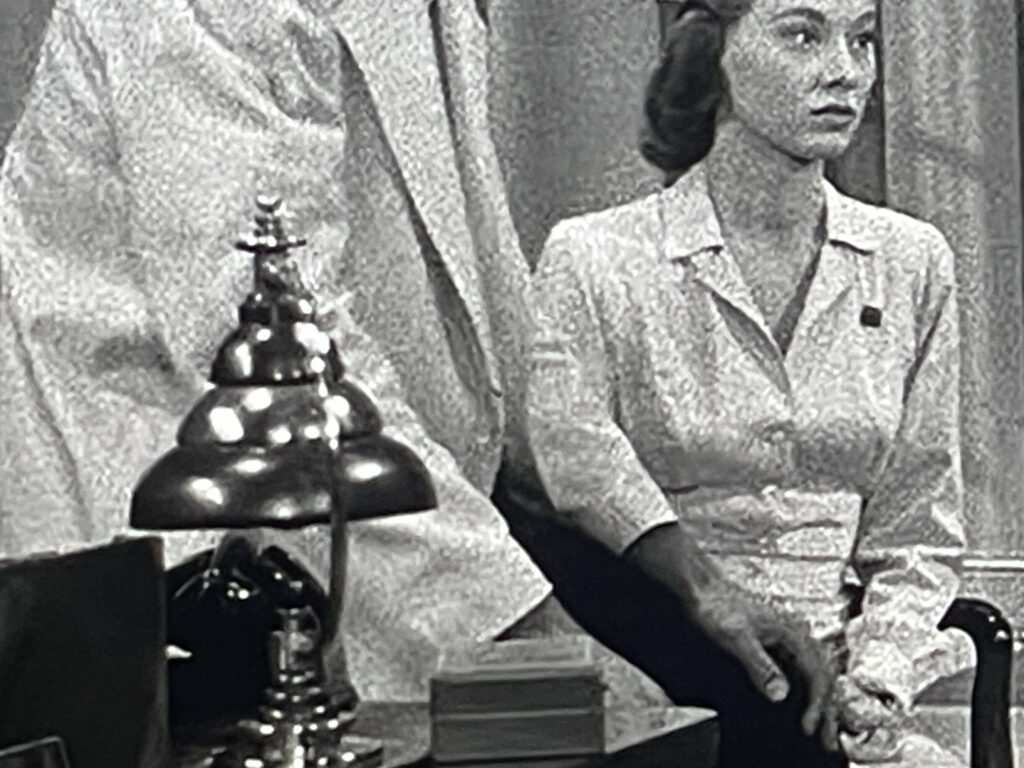
Daniels’ photography was an additional reward. It’s crisp, clean and polished in that way the old-timers seemed to deliver as if they were falling out of bed. But amidst all the perfection, I did notice a small anomaly in the scene noted below. Look closely at the desk lamp on the lower left of frame. It’s rare that you’ll see something this telling in films of the Studio Era, but the example is a good one. Every light mounted in the greenbeds is plainly reflected by the polished surface. By my count, there could be upward of twenty units at work (some of them seemed banked together), and that’s not including any lamps coming in from behind and whatever else might’ve been working from floor stands.
Due to the slow sensitivity of emulsions at the time, Daniels was forced to work with an ISO range of between eighty and two hundred, so you can imagine the vast amount of electricity, heat and manpower that were expended. Thankfully, that’s of no account today.
Imagine what Daniels, his gaffer and their lamp operators would say given a job shooting with the Sony Alpha a7S III – and its expanded exposure range of up to ISO 409,600.
I’ll go out on a limb and make a guess.
“Wow…!”
I marvel at the “clean, crisp and polished” look of so many movies from this era. The level of craft continues to astound me. Working with the Sony Venice II here at saying “Wow…!” pretty much every day.