
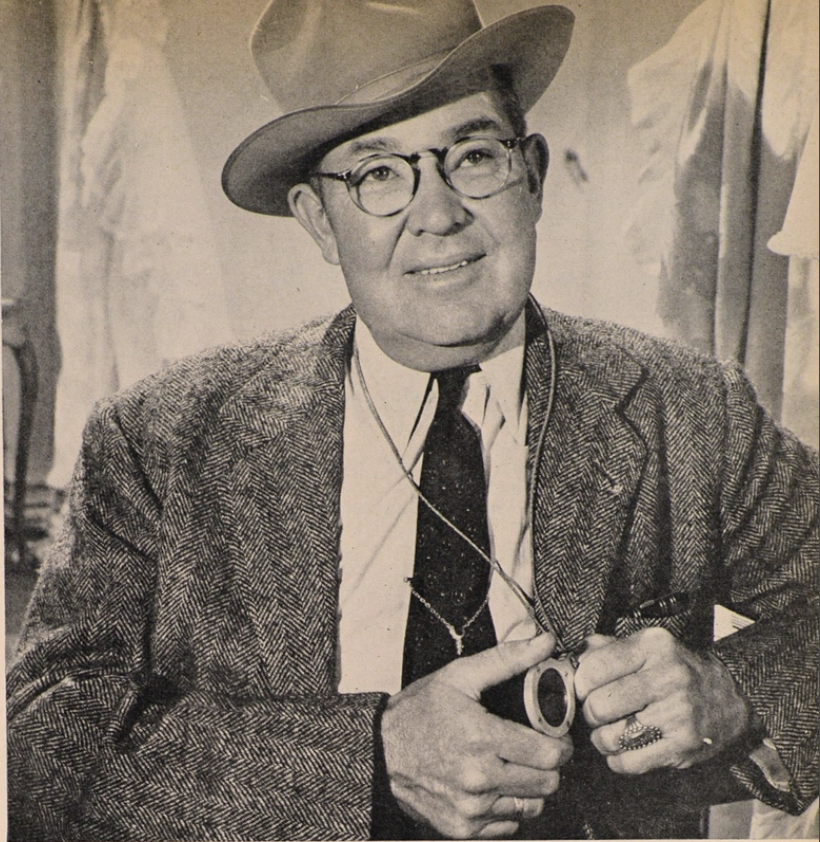
Everyone in the film industry has an origin story, but cinematographer Archie Stout’s has to be the most unusual.
While directing a one-reeler on a Malibu location in 1914, legendary comedy producer\studio head Mack Sennett needed a shot of a pelican nipping at actress Louise Fazenda’s backside. Concerns for the bird’s welfare led to delays and as Sennett’s patience wore thin, he was ready to give up on the idea. But the sudden appearance of a game warden cleared up the matter, which led to the shooting of a successful gag. That moment also marked the unofficial start of Archie Stout’s forty-year run in motion pictures, one that for the sake of being in the right place at the right time might never have happened.
A native of Renwick, IA, Stout’s early wanderlust brought him into the hotel business, whose journeys took him to Honolulu and Japan. In 1909 he returned to the mainland as executive secretary to the commission in charge of the Hawaiian exhibit at the American Yukon Expedition. He then went to Los Angeles for a fling at selling real estate, and from that entered the forest service, which expedited his meeting with the pelican jokers.
Fascinated by the movie-making process, Stout began hanging around Sennett’s Echo Park studio and was quickly taken in by camera department head and ASC Vice President Fred Jackman. Impressed by the young man’s enthusiasm for the craft, he taught Stout the basics and sent him off to the Sierras to capture background footage for an upcoming production. The resulting material was breathtaking, and Stout was rewarded with a staff position. “He was a natural-born cameraman,” explained Jackman at the time. Stout countered, “I sure feel kindly toward all pelicans. And I sort of wish that I could locate that old pelican that helped me get into the photographic profession. I’d like to give him a nice mess of fish as a reward for what he did for me.”
Over the next eight years, Stout shot 300 shorts for Sennett, many of them featuring such stars as Wallace Beery, Gloria Swanson, Charlie Chaplin, Mabel Normand and Fatty Arbuckle. Tired of being typecast as a comedy shooter, he’s believed to be the first in Los Angeles to purchase an Akeley camera; he then used the accompanying set of lenses (including a 340mm!) to experiment and improve his abilities. This brought him to the attention of Cecil B. DeMille, for whom he delivered some of the most imaginative shots as part of the second unit for the original version of The Ten Commandments (1923). In 1930, he finally got his shot as a First Cameraman on Manslaughter (George Abbott), which was also Claudette Colbert’s debut as a leading lady. In addition to his Sennett work, he went on to shoot 136 full-length features (among them, 29 collaborations with John Wayne – one of which was as best man at Wayne’s wedding!) and an equally large number of second units. On Fort Apache (1948; John Ford) he was praised for the use of infrared film to achieve dramatic day-for-night effects, but his most notable one resulted in a shared Oscar with principal cinematographer Winton Hoch, ASC for The Quiet Man (1952; John Ford). To date, Stout is the only cinematographer to win an Academy Award for second unit work…and that very trophy currently sits on display in the President’s Office at the ASC Clubhouse in Hollywood.
In spite of his great success, Stout also experienced great tragedy. On January 22, 1945, his only son Junious – a Navy aerial photographer with John Ford’s Field Photo Unit – was killed when his DC-3 reconnaissance plane was shot down over Guernsey in the English Channel. Though he reportedly kept up a strong front, it was clear to those around him that the loss had taken a terrible toll.
Stout was married three times, first during the 1910’s to Laura Grace Fuller (mother of Junious). Next up was Minnie Evelyn Futrell McCulloch (aka Minnie E. Arbios) during the 1920’s. Finally, there was Bernice Viola Weston, from the mid-1930’s until his death in 1973.
After suffering a heart attack, Stout retired in 1954 but remained active at the ASC for the remainder of his life. I’m sure he’d agree that his career turned out to be more rewarding than wrangling pelicans would at first have indicated!
This is just fantastic. Thanks again, Richard, for turning the spotlight on the fascinating people who bequeathed to us the ASC.