
There’s not much information available regarding J. Burgi Contner, ASC, but one thing is clear – he was a busy and innovative cinematographer throughout the entirety of his career.
He seems to have been a native of Lakeland, FL, but his career was based in New York City. His first credit appeared in the 1924 film Missing Daughters (William Clifford) on which he handled additional photography chores for Ray June, ASC. Though many more movies followed, he made his most significant mark in television. IMDB.com will dispute me, but I’ve verified each of these credits through my own research: Contner shot segments of 13 shows for the Melvin Douglas Off Beat series, 37 episodes of The Doctor, 26 episodes of Top Secret, plus numerous individual shows of other filmed TV series. He also shot the first 13 episodes of You Are There for CBS, 39 episodes of Registered Nurse, 39 episodes of I Spy (featuring Raymond Massey) and 39 installments of The Goldbergs. A considerable number of other television productions continued until the conclusion of his career.
Although cinematography was his primary vocation, he was well-known for other pursuits related to motion pictures. As a young man he was a projectionist, later purchasing a 35mm camera that he used to produce local ads and newsreels. To speed up the process of getting his work on screen, he set up his own laboratory.
When talkies arrived, theaters were thrown into a furor due to the many sound systems that were being devised. Contner developed a method that enabled any house to project silent films or sound-on-disc films without having to install separate adapters for each. The idea seemed so promising that he moved to New York where he set up a manufacturing plant for his multi-system adapter. He subsequently developed other innovations for motion pictures and soon his Blue Sea Sound Devices became famous throughout the industry.
Contner later became the first American cinematographer to shoot bi-pack color, and he established the first color film laboratory in New York. His process was trade-named Super-Color (later known as Cinecolor).
Overall, Contner was another one of those highly competent, work-a-day cinematographers who was busy all the time but never got much notice. By every account, he always got the job done on schedule and with the highest of professional standards.
An interesting sidelight: through the majority of his career, Contner shot with Mitchell BNC Number 2. While that might not mean much to the casual observer, it’s probably the most significant camera in movie history. Prior to his purchase, it belonged to Gregg Toland, ASC, who used it to shoot such landmark movies as The Grapes of Wrath (1940; John Ford), The Long Voyage Home (1940; John Ford), Citizen Kane (1941; Orson Welles), The Little Foxes (1941; William Wyler), The Outlaw (1943; Howard Hughes) and The Best Years of Our Lives (1946; William Wyler).
On a personal note, early in my career I had the good fortune to serve as an assistant cameraman on two features photographed by his son, James A. Contner, who eventually went on to an illustrious career as a television director. I remember him as a terrific guy and learned a tremendous amount from him. More important, in 2018 he generously donated his father’s BNC Number 2 to the ASC. Though the device had seen some radical modifications since Toland stood behind it, ASC Museum Curator Steve Gainer did a magnificent job in restoring it to its original state. The camera is presently on display at the Clubhouse…and it’s a beauty!
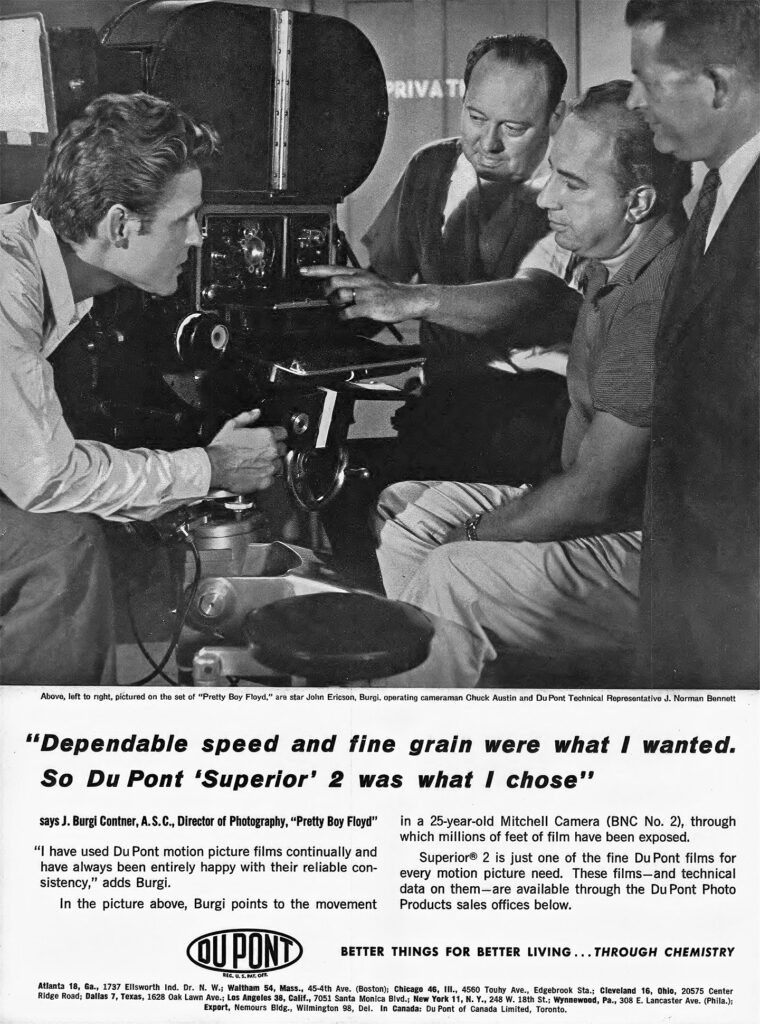
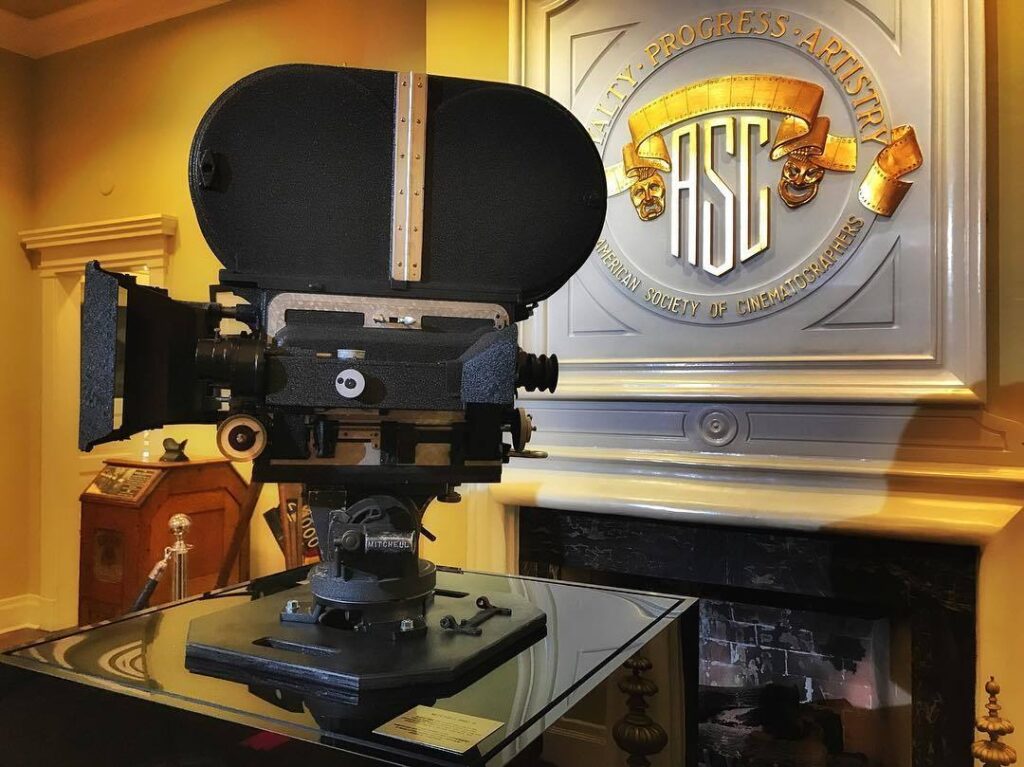
Mitchell BNC #2, currently on display at the ASC Clubhouse in Hollywood.
Rich, I remember seeing J. Burgi’s name in the classifieds of American Cinematographer in the late 60’s with a PO Box in the Bahamas.
Yeah, I think he did alright for himself…
As the present world of Cinematography rushes madly into an uncharted future, you keep us grounded in history. When I walked on the set of my first Hollywood job In 1969 (as a gopher), Citizen Kane had been released a mere 28 years prior. The Movies were still young. Thank you for keeping our heritage alive.
Hey Russ! Thank you for the kind words…that stuff is still so appealing to me.