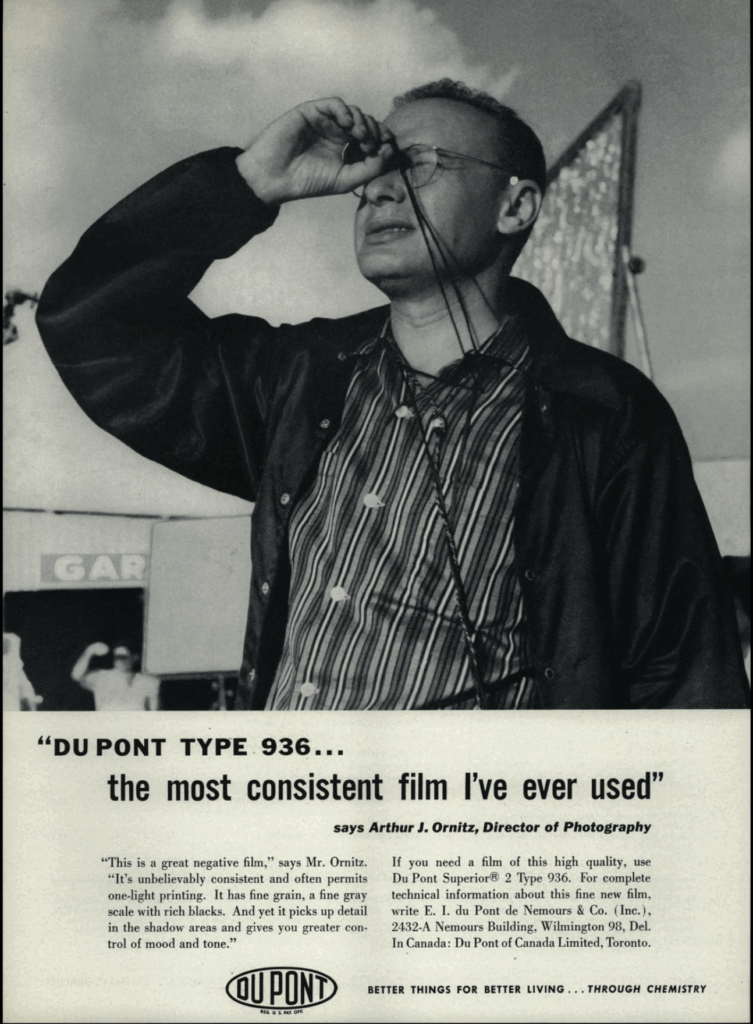
In the annals of cinematographers who should be celebrated today but are not, Arthur Ornitz, ASC sits prominently in the upper ranks. Born and raised in New York City, he was the son of Sadie and Sam Ornitz, a screenwriter who was blacklisted as one of the Hollywood Ten during the McCarthy Era witch hunts.
In keeping with the success of his later career, while studying film at UCLA in 1936, the short film he directed, Wanted – A Master, was nominated for an Academy Award in the Best Short Film (One Reeler) category. Little is known about what he did following that, but it’s clear that at some point he switched to the pursuit in which he made his best mark.
His first credit as cinematographer was on Power and the Land (1940), which was directed by celebrated documentarian Joris Ivens. Features didn’t come calling until 1958 with John Cromwell’s The Goddess, but then he was off and running. Ornitz worked non-stop for the next twenty-five years on a wide range of films with some of the best directors of his time. Among them were Requiem for a Heavyweight (1961; Ralph Nelson), The World of Henry Orient (1964; George Roy Hill) and Charly (1968; Ralph Nelson). But it wasn’t until the 1970’s that he came into his own. His output during that time was remarkable: The Anderson Tapes (1971; Sidney Lumet), Minnie & Moskowitz (1971; John Cassavetes), Badge 373 (1973; Howard W. Koch), Serpico (1973; Sidney Lumet), Death Wish (1974; Michael Winner), Next Stop, Greenwich Village (1974; Paul Mazursky) and An Unmarried Woman (1978; Paul Mazursky), to name a few. As much as any cinematographer, they continue to shape my recollections of the New York I grew up in. His final film, First Affair (1983; Gus Trikonis) was made for TV and was hardly worthy of his talents.
As a young AC, I was offered the opportunity to join his crew on several occasions, but the timing never worked out. I was probably better off. A cinematographer I regularly worked for had a long history with him, going back to when he started loading magazines in the early ’60’s. He claimed that Ornitz was a tough character to be around; his imperial presence and cutting remarks could deflate the best of intentions. Nonetheless, I had a delightfully memorable phone conversation with him when he was about to teach a small-enrollment course on cinematography. Sadly, he passed away before it came to pass .
Chase down some of his ’70’s work and let me know what you think!