
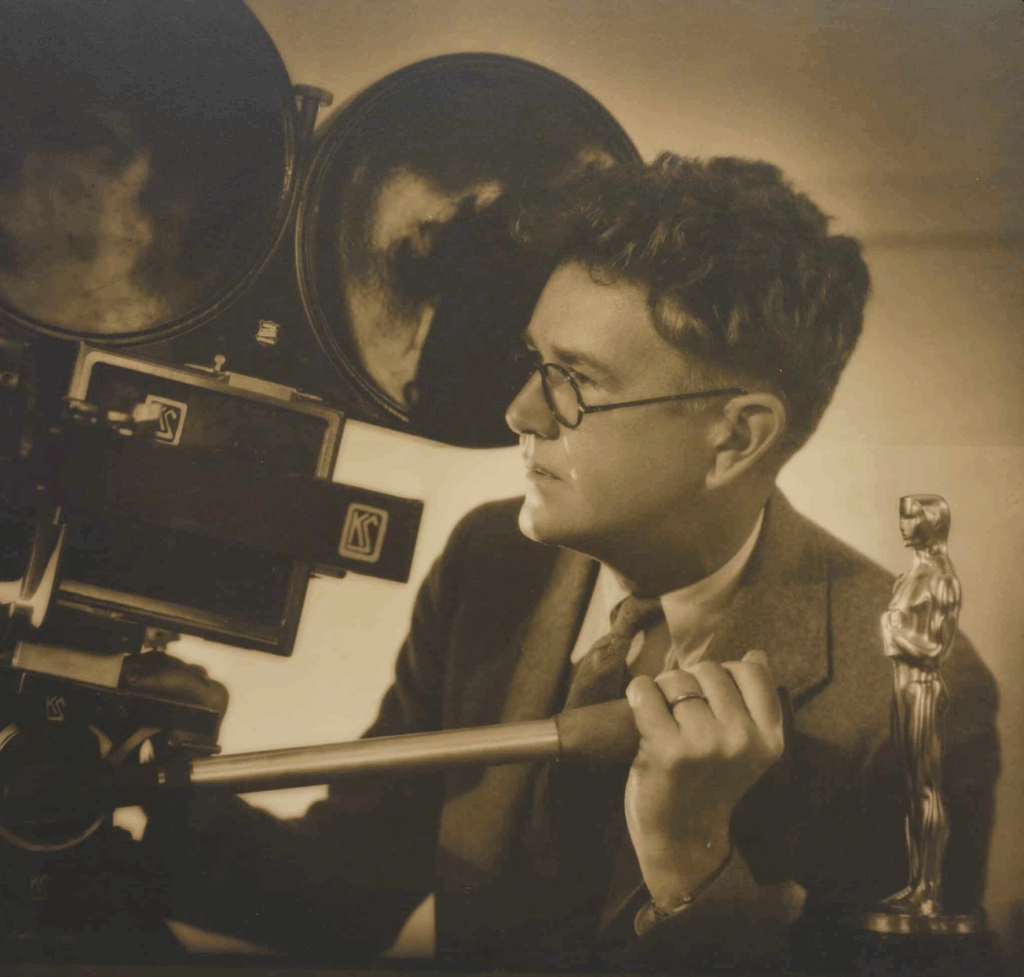
Unlike so many of his contemporaries, a quick Google search will reveal an enormous amount of information regarding Karl Struss, ASC and his long, fascinating career. Some might recall him as co-recipient (with Charles Rosher, ASC) of the first Oscar for cinematography for 1929’s Sunrise: A Song of Two Humans (F.W. Murnau), but that’s just a small part of his many achievements.
Born and raised in New York City, he became interested in photography at an early age and by 1909 had developed the Struss Pictorial Lens, whose soft-focus properties immediately made it popular among portraitists. The following year, his career began to take off when twelve of his works were chosen by Alfred Stieglitz for the Albright Gallery International Exhibition of Pictorial Photography, the final presentation of the Photo Secession movement, which promoted the medium as a fine art. His reputation continued to grow during his time as a student of Clarence H. White at Columbia University (from which he graduated in 1912), but a high point came in 1911 when he was part of the exhibition What the Camera Does in the Hand of the Artist at the Newark Art Museum. By June 1914, when he took over the studio vacated by his mentor White, he was quickly becoming one of the leading art photographers in the country.
Though he never considered it fashion photography, Struss secured commissions from the most popular magazines of the day, including Vogue, Vanity Fair and Harper’s Bazaar. By 1917, with World War I raging in Europe, he enlisted in the Army so as to fulfill his obligation through his craft. Ironically, a disheartening experience in that role led to Hollywood – and grand success of a different kind.
While teaching aerial photography, an investigation into Struss’s German ancestry brought a demotion from sergeant to private. After a spell in the stockade in Ithaca, NY, he was sent to Fort Leavenworth to serve as a prison guard and then as a file clerk. Later, in an attempt to clear his record of rumors of anti-Americanism, he entered officer’s training at the rank of corporal. Unfortunately, by the time of his honorable discharge in 1919, most of his professional relationships in New York City had been damaged due to the investigations. When a friend suggested he start over out west, he packed up and headed off in that direction.
Landing on his feet, Struss signed a two-year contract with Cecil B. DeMille shortly after his arrival and began a long run of magnificent work for the screen, including significant contributions to Ben Hur: A Tale of the Christ (1925; Fred Niblo, Charles Brabin & Christy Cabanne). He shot all the great stars for DeMille and in 1927 moved to United Artists, where he worked with D.W. Griffith on Drums of Love (1928) and Abe Lincoln (1930), and shot Mary Pickford’s first talkie, Coquette (1929; Sam Taylor). In addition to the aforementioned shared-Academy Award, his career was in full-gear. And with his Struss Pictorial Lens in high demand across the industry, he continued tinkering with camera technology, developing the “Lupe Light.” Most likely named for Mexican actress Lupe Velez, it was a soft but controllable source specifically used on faces. He also invented a new bracket system for the venerable Bell & Howell 2709. And in what little spare time he might’ve had, he refined the use of wedge filters in their application to special effects. Amazing…
From 1931 through 1945, Struss hung his hat at Paramount, where he continued to do outstanding work. Among his notable titles there were the ones for which he received three other Oscar nominations: Dr. Jekyll and Mr. Hyde (1931; Rouben Mamoulian), The Sign of the Cross (1932; Cecil B. DeMille) and Aloma of the South Seas (1941; Alfred Santell; shared with Wilfred Cline, ASC and William E. Snyder, ASC). He also shot Island of Lost Souls in 1932 for director Erle C. Kenton and The Great Dictator in 1940 for Charlie Chaplin. After experimenting with 3-D on several movies in Italy during the early ’50’s, he ventured into television on such popular programs as My Friend Flicka and Broken Arrow. In total, he photographed more than 140 features including a memorable horror film that scared the hell out of me as a kid, The Fly (1958; Kurt Neumann).
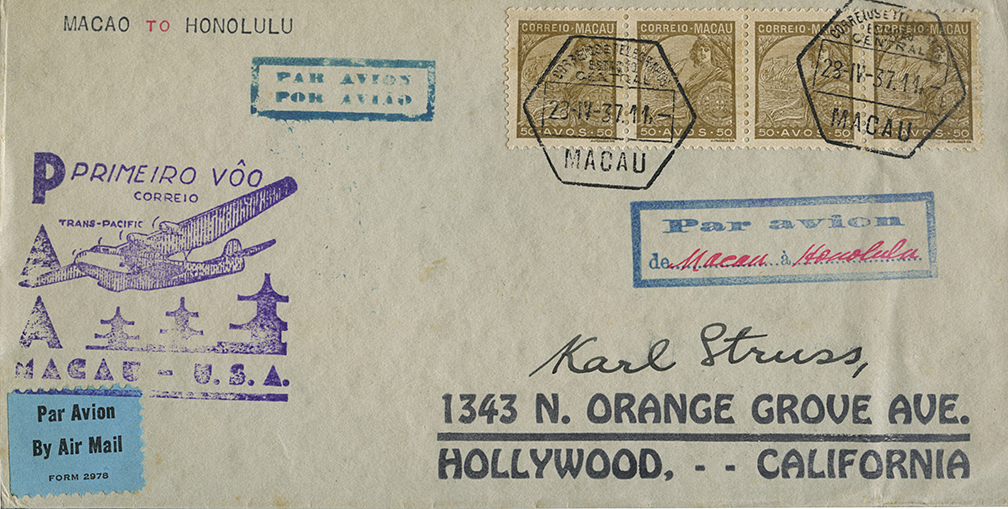
Struss was a founding member of the Academy of Motion Picture Arts and Sciences and was active at the ASC, frequently presenting his findings on technology to the membership. During WW2, he developed methods for using color film to penetrate ground-based camouflage as it was encountered from the air. He authored numerous articles for American Cinematographer and maintained a huge archive of exhibition prints, negatives and personal papers which are presently available at the Amon Carter Museum of American Art in Fort Worth, TX. He was married in 1921 to the former Ethel Wall; during the 1930’s they lived at 1343 North Orange Grove Avenue in Hollywood. Throughout his life, he was an avid stamp collector with a special interest in commemorative covers for the first transpacific airmail flights. Also, he was a long-time mentor to George T. Clemens, ASC, who would go on to become the noted shooter of the legendary TV series, The Twilight Zone.
In 1951, Struss starred in an appropriately titled short film, The Cinematographer, which outlined the responsibilities of the job. It was produced by the Academy, and having seen it a number of years ago I can say that he acquitted himself quite well on the other side of the camera. A major monograph titled New York to Hollywood: The Photography of Karl Struss was published in 1995 and cemented his reputation as both a stills and motion picture photographer. Originally assembled as the catalog for a major exhibition by the Amon Carter Museum, the book is recognized as the definitive overview of Struss’s career, examining his use of the autochrome process, his images of New York and Europe pre-WWI, Hollywood stars, landscapes and seascapes. The astute observer will notice that his stills-style combined technical mastery with artistic flair, which directly led to the development of his unique cinematographic aesthetics.
Struss passed away in 1981 at the age of 95. During the prior year, he was awarded a Silver Medallion at the Telluride Film Festival for “…recognition of achievements in the film industry.” Considering the tremendous breadth of his career, that’s indeed small praise for such an incredible artist.
Bravo!