
I try to keep alive the memories of obscure cinematographers through this blog…but do you really want to get obscure? The mis-spelling of Bert Shipman’s name in the ad featured in Friday’s post made me curious about him.
Born August 15, 1900, in New York, Shipman began in silents as the cinematographer of Below the Line (1925; Herman C. Raymaker) before stepping back to be an assistant cameraman on Satan in Sables (1925; Joseph Flood), So This Is Paris (1926; Ernst Lubitsch) and The Social Highwayman (1926; William Beaudine); all three films were photographed by John J. Mescall, ASC. He began working as Gregg Toland’s operator on William Wyler’s 1937 effort, Dead End.
Subsequent to that, the duo went on an incredible run that was interrupted only by Toland’s WW2 Navy service as part of John Ford’s Field Photographic Unit. Among those titles: The Cowboy and the Lady (1938; H.C. Potter), Wuthering Heights (1939; William Wyler), The Grapes of Wrath (1940; John Ford), The Long Voyage Home (1940; John Ford), Citizen Kane (1941; Orson Welles) and The Best Years of Our Lives (1946; William Wyler). In addition to many other assignments, Shipman also had the distinction of operating for ASC legend Stanley Cortez on 1942’s The Magnificent Ambersons (Orson Welles).
After Toland’s premature death in 1948, Shipman continued to work on a variety of productions, finishing his career on somewhat of a less distinguished note with such films as Ed Wood, Jr.’s Glen or Glenda (1953; William C. Thompson), Bride of the Monster (1955; Ed Wood, Jr.\William C. Thompson & Ted Allen) and The Cape Canaveral Monsters (1960; Phil Tucker\W. Merle Connell). In 1956, Shipman once again served as the cinematographer on The Flesh Merchant, a low-budget feature directed by Connell.
Not much else is known about Shipman’s life. As did so many of his contemporaries, he died at a relatively young age on February 17, 1963. And like them all, the work he left behind stands as a testament to the time he spent passing through this world.
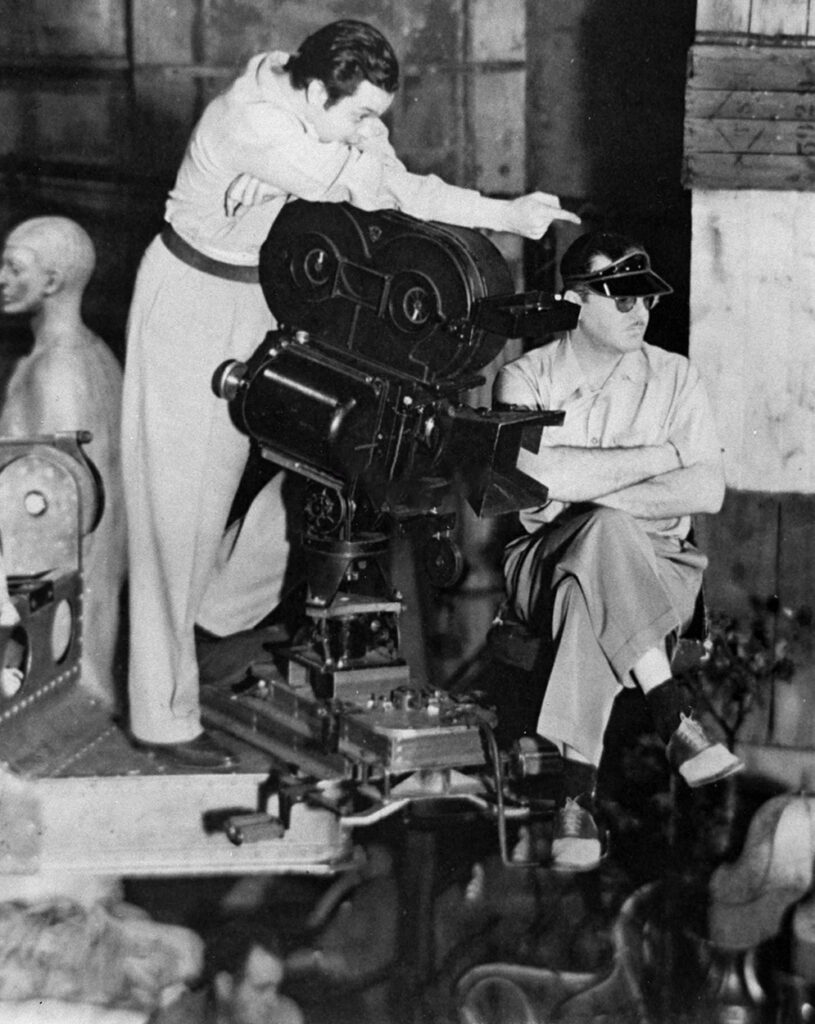
Director Orson Welles directs while camera operator Bert Shipman sports saddle shoes during the shooting of Citizen Kane (1941). BTW…the camera featured here – Toland’s own Mitchell BNC #2 – is now a part of the ASC Museum collection. A generous donation made by cinematographer\director James A. Contner, it’s on permanent display at the Clubhouse in Hollywood.