
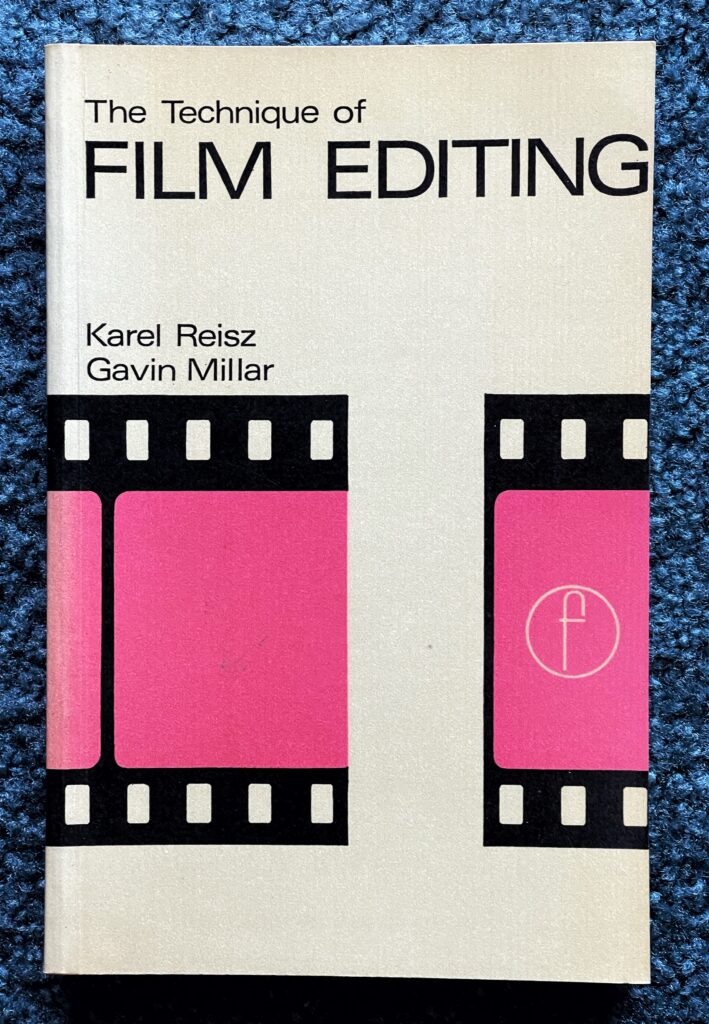
We all know the job of the cinematographer doesn’t end with camera, lighting, composition, color and movement. Learning to think as an editor does is of equal importance, and the faster we embrace that task is the faster the effectiveness of our images will increase.
I took it to heart when someone advised me of that during the early days of my career. The above-pictured book was my first step on the path, and the lessons it holds – at least in their essential grounding – remain true to this day. First published in 1953, it has been updated and re-released several times since. If you’re not familiar with it, go find a copy. It’s the perfect companion piece to Joseph V. Mascelli, ASC’s The Five C’s of Cinematography: Motion Picture Filming Techniques, as it promotes thinking in progressions of shots rather than individual moments.
Of the book’s co-authors, Gavin Millar had the less-distinguished career. Born January 11, 1938, he wrote film criticism for The Listener, Sight & Sound and the London Review of Books; his contribution to Reisz’s The Technique of Film Editing was the addition of a section on modern editing in 1968. He also presented BBC arts programs like Arena Cinema (1976-1980) and directed TV plays including Dennis Potter’s Cream in My Coffee (1980, BAFTA-nominated) and Victoria Wood’s Housewife, 49 (2006, BAFTA winner). His feature films include Dreamchild (1985; Billy Williams, BSC), Danny, Champion of the World (1989; Oliver Stapleton, BSC) and Complicity (2000; David Odd, BSC). He also directed episodes of Foyle’s War and The Crow Road. Millar passed away on April 20, 2022, from a brain tumor.
Karel Reisz was a Czech-born British film director and critic, renowned as a pioneer of the British New Wave and Free Cinema movement. Born in Ostrava in 1926, he fled to Britain as a child refugee in 1938 via Kindertransport; tragically, the rest of his family perished in the Holocaust. He studied at Cambridge, wrote his influential book and worked as a critic before entering directing.
In the 1950s, he co-founded Free Cinema, a documentary movement emphasizing working-class life and authenticity. Notable shorts include Momma Don’t Allow (1956, co-directed with Tony Richardson) and We Are the Lambeth Boys (1959), which captured youth culture in a raw, observational style.
His debut feature,cSaturday Night and Sunday Morning (1960; Freddie Francis, BSC), adapted Alan Sillitoe’s novel and starred Albert Finney in a breakout role as a rebellious factory worker, epitomizing “kitchen sink” realism. Later highlights include Morgan: A Suitable Case for Treatment (1966; Larry Pizer, BSC & Gerry Turpin, BSC), The Gambler (1974; Victor Kemper, ASC), Who’ll Stop the Rain? (1978; Richard Kline, ASC), The French Lieutenant’s Woman (1981; Freddie Francis, BSC) and Sweet Dreams (1985; Robbie Greenberg, ASC). Born on July 21, 1926, he passed away in London on November 25, 2002.
A little Inside Cinematography: As an AC in 1989, I spent a few weeks working a B-camera on the feature film Everybody Wins (Ian Baker, BSC). The assignment was unremarkable, but I do recall being excited to meet the director, Karel Reisz; two of his titles – Saturday Night and Sunday Morning and Who’ll Stop the Rain? were among my all-time favorites. Waiting for the right moment, I introduced myself one day during lunch and professed my deepest admiration for what had by then become forgotten efforts. Reisz looked up and in the most deadpan fashion imaginable simply replied, “Oh, really,” and turned back to his soggy, tasteless catering.
I didn’t hold that against him, though. I still like those films…and I still like his book.
Za za
Za