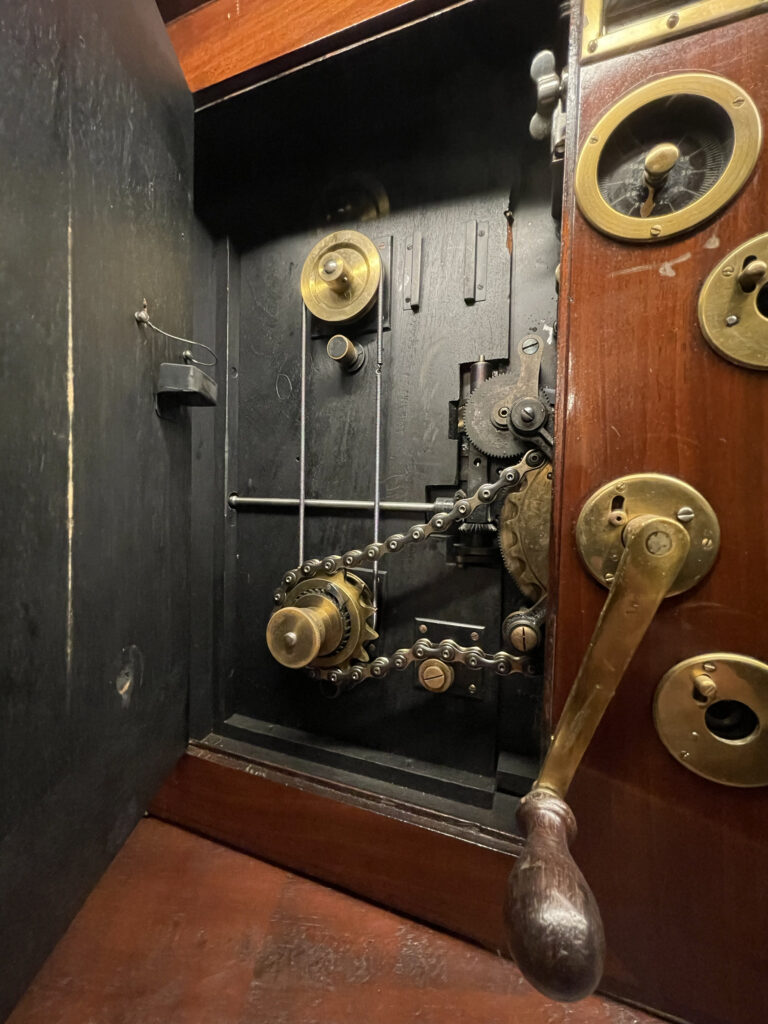
Imagine a motion picture camera whose movement was powered by a crank attached to a…bicycle chain. Well, that was precisely the case with this c.1910 Williamson Kinematograph model.
According to the British entity, Science Museum Group, it was…
…manufactured by The Williamson Kinematograph Co. Ltd., London and Brighton. ‘English Pattern’ upright cine camera for 35mm film in internal 300 foot magazines. Zeiss Tessar lens F:5cm f/3.5; fixed sector shutter; claw mechanism, two continuous sprockets. Helical focusing mount. Critical focusing through rear of gate; Vinten matte celluloid focusing screen and circle and binocular mattes in clip inside door. Footage counter, shoe fitting for viewfinder; carrying strap. Hand turned; single frame shaft. A Vinten matte celluloid focusing screen (and circular and binocular mattes) are in the clip inside the door.
James Williamson was primarily a filmmaker, until 1910 when his company moved from Sussex to London and began to concentrate on manufacturing cameras and printers.
The model in the photo resides at the ASC Clubhouse in Hollywood. Every time I see it, I marvel at the brilliance of men like Williamson. Operating with only a pencil, T-square and calipers, they were able to design and build the most amazing devices out of wood, metal and leather. Load it up with some film and it will perform like new. While that’s hard to believe in our digitally-driven world, it’s even harder to think that any of our modern cameras will work at all in 114 years.