
My latest Rescued From Obscurity dispatch…
In 1983, when I was admitted to New York’s IATSE Local 644 as an assistant cameraman, I used to pour over the union’s roster looking for connections that might lead to a working relationship. For some odd reason, the name Drummond Drury always caught my eye. Along with such superstar ASC members as Victor Kemper, Owen Roizman and Gordon Willis, he was listed as a Class ‘A’ Director of Photography, which automatically gave him a special status in my mind. Though the hook had been set, for the past forty years that was as much as I knew about the man. Never saw his credit. Never knew anyone who served on his crew. Never heard his name mentioned anywhere. Nada… Until the other night, that is, when I was scrolling through the July 1946 issue of American Cinematographer on the ASC website and came upon this ad:
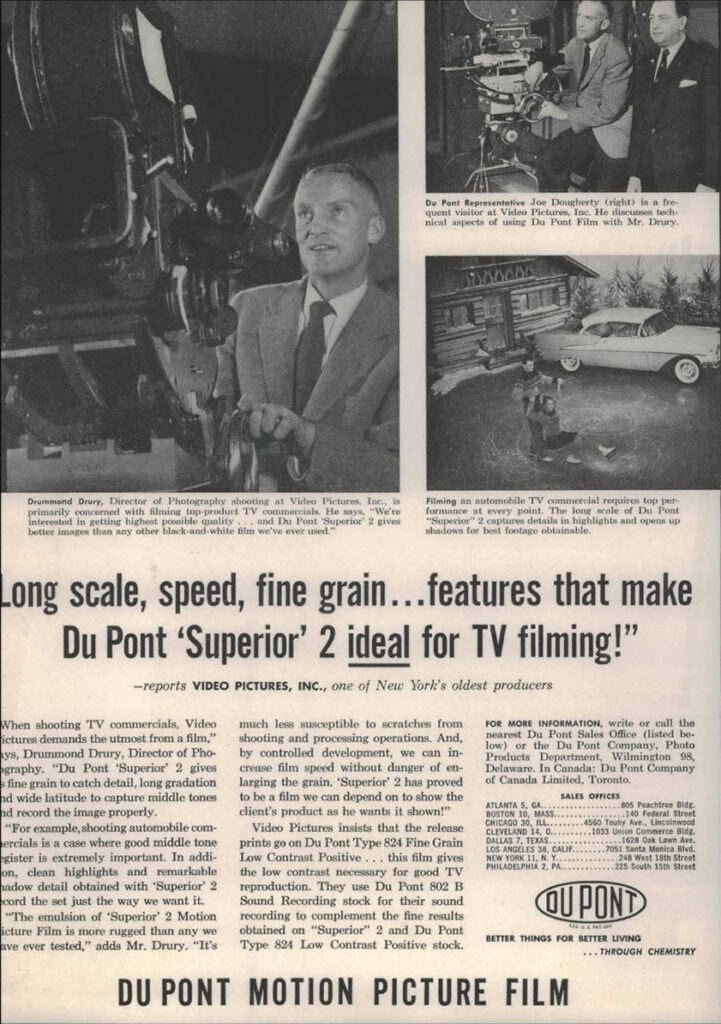
I was pleasantly surprised to learn that Drury really did exist and wasn’t just a fragment of my distant past. He had quite a career too, as is evidenced by this abbreviated obituary, also drawn from AC magazine, April 1989.
Born in Newcastle, England in 1912, Drury apprenticed at Elstree Studios, London, from 1932 to 1939, where he worked for many leading cinematographers. In 1940, he moved up to camera operator, tackling such productions as Ourselves Alone, Alias Bulldog Drummond, Housemaster, Piccadilly Incident and Marigold.
During World War II, he served as a lieutenant in the Royal Navy. Returning to the studios in 1946 as a director of photography, he went to South Africa to photograph the J. Arthur Rank production, African Journey. The following year he traveled to Canada to shoot three features for Quebec Productions, Inc. – Un homme et son Peche (which won honors at the 1949 Venice Film Festival), Seraphin (winner of the Canadian Academy Award for best photography in 1950) and Cour de Maman.
Moving to New York in 1950, he became a U.S. citizen in 1954. Soon, he was one of the busiest and most versatile of the East Coast cinematographers, working in features, television, industrial films, theatrical shorts, commercials and government films. His earliest TV work included The Court of Human Relations series with Fannie Hurst and Norman Vincent Peale, Jet Fighter and The James Thurber Story for Omnibus, Korean Folk Story, The Circus Comes to Bellview and Art in Rural America. He also was one of the first to utilize video tape (known in those days as “living tape”) for television productions in the 1950s.
Other credits included a feature about Carl Sandburg for NBC, the Les Paul & Mary Ford series, the Shooting Straight with Tim Holt series and The Mennen Hour, all filmed material for the 1956‑57 series of color Spectaculars sponsored by Oldsmobile, The Modern Age of Glass and more than 1,000 commercials and short films.
Drury was on the staff of Filmways, Inc. from 1958-62 and became VP of the company in 1960. He later spent several years shooting for Eastern Motion Pictures, Ltd., in New York. As a free‑lancer he worked for most of the production companies on the East Coast, including Columbia Pictures, Caravel Films, International Film Foundation, Transfilm, Elliott & Linger, Video Pictures, Craven Film Corporation, Princeton Films, Rockhill Productions, MKR Productions, Screen Gems, Pathescope and others.
One of Drury’s favorite projects was photographing the official films used by General Eisenhower in 1953 for his successful presidential campaign.
OK… His hey-day was well-before my time, so I can be forgiven my lack of Drury-awareness, but so were a lot of others whose work I knew well. This once again begs the question: How can someone who was this busy and no doubt influential in many ways be so profoundly unknown in our circles today? I understand that everyone’s preoccupied with their own lives and issues. I get that everyone is busy and overwhelmed and distracted. But I’d hate to think it’s because figures like Drury are now considered meaningless. Or worse…that no one cares.
I wrote this piece, so I clearly care. You’ve read it, so you must care. If anyone has an alternative theory, feel free to pass it along!
And to close on a positive note, here’s a bit of ‘inside cinematography’ trivia for you. His great-nephew Garth Drury informs that he was known by his family in England as ‘Drummie.’
“Drummond” is a name that doesn’t get used much any more!
I think one reason why he’s not known more (I hadn’t heard of him) is that we cinematographers as students are very feature-film-centric, plus often we not only don’t catch the names of who shoots the many more hours of TV programming (compared to features), we don’t even see credits for things like commercials.
Could be true, David. There were many who flew under the radar…
Dear Richard,
Thank you very much for raising ‘Drummie’ from obscurity in the ASC – and doing the research on his work.
I am humbly gathering the Drury family history (part-time) and I really appreciate this new (for me) information on my great-uncle.
Drummie’s older brother (my direct Grandfather) was a well known fly fishing expert R. Esmond H. Drury who patented the triple hook and designed the GP (“General Practitioner” – originally Golden Pheasant) fly meant to mimic a shrimp for rivers which forbade the use of fishing salmon with a shrimp or prawn (this can still be found on Google). He was the subject of a bet that it was possible to cast a line from the roof of the Savoy Hotel in London into the Thames , and he made it (documented in the Daily Telegraph at the time). However, he was less flashy about a greater service as commander (acting Colonel) of the Scorpion (Tank) Regiment at El Alamein (the first battles won in WWII vs the Germans).
My regret is never meeting Drummie before he died in 1989, because I was never knew where he lived (upstate New York) – even though I had been to NYC on several occasions and to Spring Valley in the northern suburbs while he was still alive.
Thank you again for your article/post on dear Drummie.