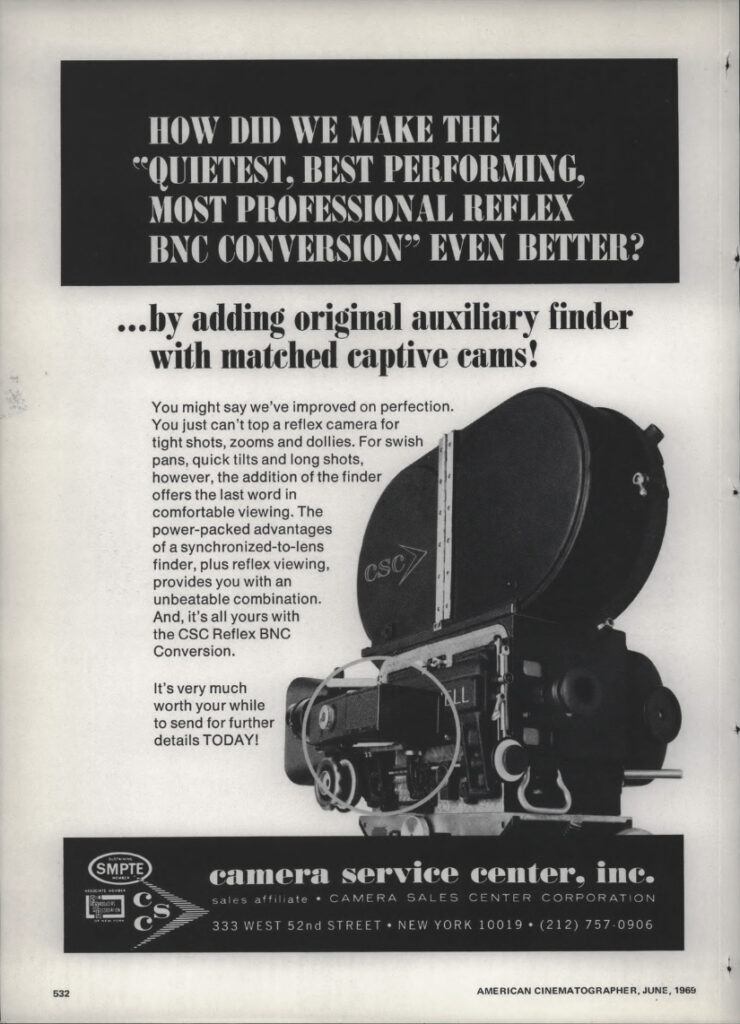
We all take reflex viewing systems for granted these days, but there once was a time when they were considered an amazing innovation. This ad, from the June 1969 issue of American Cinematographer, offers a perspective that had me scratching my head. With the pictured Mitchell BNC already reflex-modified, why would anyone retrofit it with an outdated, offset viewfinder?
The text seems to imply that it was an issue of comfort or mobility while operating, and I understand: It can be quite a challenge keeping flush-contact to that immovable eyepiece while executing a complex or spirited move. But that’s where camera operators earned their keep. Even today, with the wide range of on- and off-board monitors and adjustable viewfinders available, anyone can capture a simple lock-off. It’s when camera, actors and other elements simultaneously contort their ways around the set that we separate the players from the pretenders in this arena.
To date, I’ve never had the need for a BNC with an offset finder; I don’t suppose I ever will. Every old timer I’ve asked about it welcomed the switch to reflex viewing. Although this meant using only one eye, their level of precision increased exponentially. It’s ironic that so many modern operators are once again using two. The job has been made easier yet again, and that begs the eternal question: With technology advancing at such a break-neck pace, what will be lining up shots through next?