
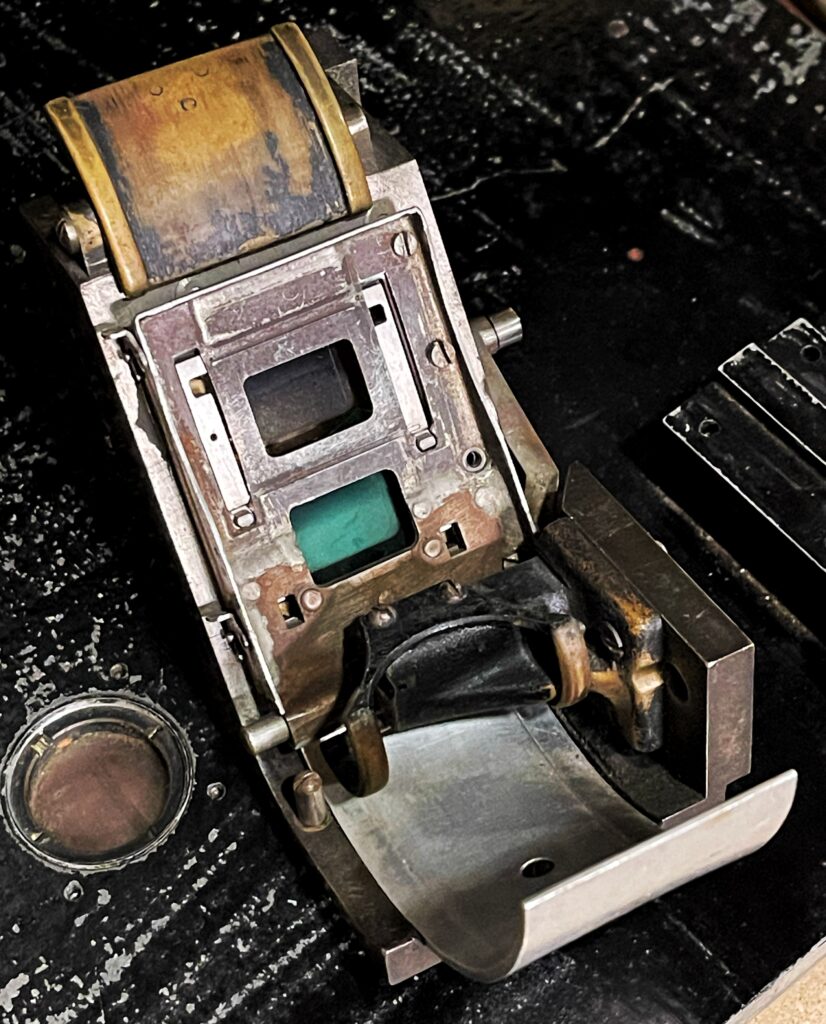
This little piece of antiquity is the gate from a c.1921 two-color process Technicolor camera. Designed by then-twenty-seven-year-old Arthur Ball, it used a beam-splitting prism to simultaneously expose a half-red and half-green image. When projected, the narrowness of the frameline and speed at which the two frames appeared onscreen fooled the viewer’s eye into seeing a single image in color.
Just imagine… Ball came up with this using nothing more than a pencil, a T-square and some drafting paper. No computers to do the math or laser-guided equipment to help with the precision work. Yet, his creation was so perfect that you can still run film through its host camera today. Even in our digitized world, it remains an impressive achievement. Measured against the time in which it was manufactured, it was nothing short of brilliant!
The unit is on display at the ASC Clubhouse in Hollywood, courtesy of the collection’s curator, Steve Gainer, ASC. Whenever I wander through and see something like this, I’m awed by the incredible things those people came up with over a hundred years ago.
I also wonder if the filmmakers of the future will have the same reaction when looking back at our technology from the vantage point of 2123. Somehow, I think not.
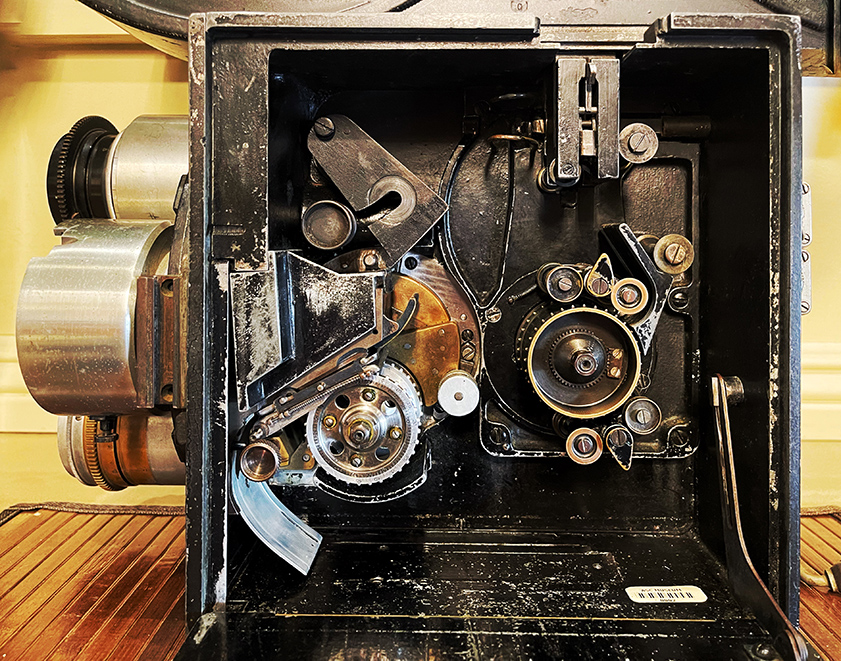
The movement of the 2-strip Technicolor camera to which the gate belongs.
Thanks Richard for this fascinating bit of history! It seems there was an earlier 2-color camera from 1917 to 1921 by Technicolor with a different prism that involved projecting the print with a special projector with two lens, one image having to also go through a prism to flip it back to match the others orientation, then the light passed through cyan and orange-red filters on each projector lens. It was dropped because the special projector was hard to use and prone to misalignment. Then Arthur Ball made this entirely new camera and prism in 1921, but Technicolor dropped the additive light projection system in favor of cementing two thinner dye-transfer prints together, one dyed cyan and the other orange-red (so a subtractive light system.) Later they figured out how to put the two layers of dye (later three) on one side of a single print.
Fascinating!! Thank you, Richard and David.