
A few minutes ago, I was informed by my good friend and colleague David Mullen, ASC that the earlier version of today’s post is somewhat inaccurate. And you know what? He was right! Originally, the piece of gear I was addressing was referred to as a “Scheibe” filter. In actuality, it is an Eastman Kodak Portrait Diffusion Disk.
Despite my tenacious efforts to present bullet-proof information, mistakes will occur from time to time. This’s one of those moments. Please accept my apologies for any confusion this may have caused and rest assured that moving forward I’ll be paying closer attention to the labeling on filter cases dating back to the 1930’s!
Enjoy the amended content. In the words of former U.S. Secretary of State, Henry Kissinger, “It has the added benefit of being true.”
And once again, thank you David for the sharp eye!
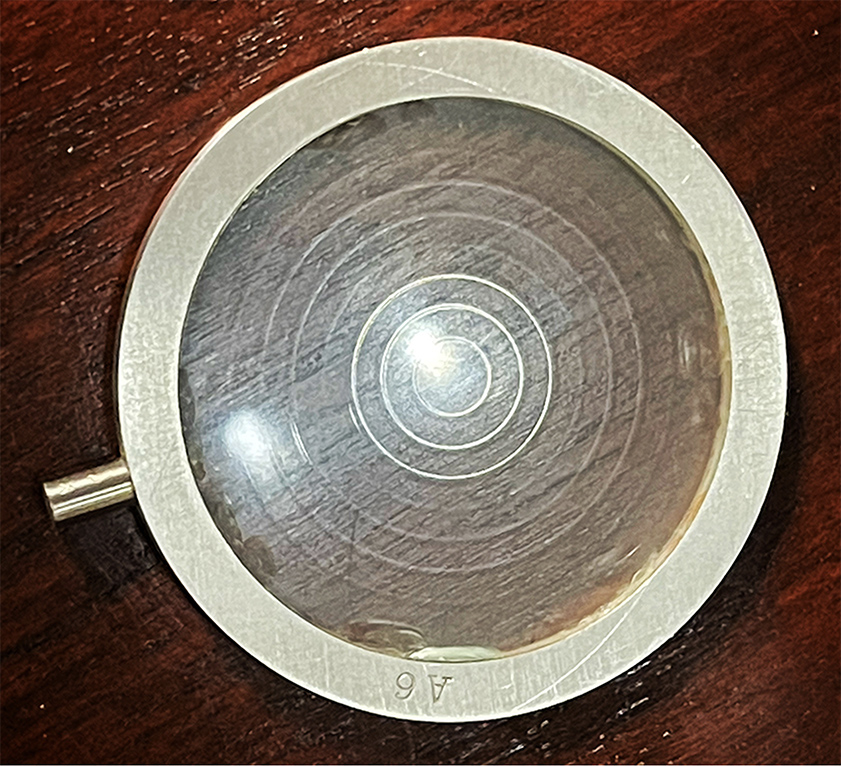
If you can’t identify this little knick-knack, don’t feel too bad. There aren’t a hundred people in the world who could name it on a bet, ASC members include.
It’s called an Eastman Kodak Portrait Diffusion Disk and was commonly used during the silent and early sound eras. Measuring about three-inches across, I lit the photograph harshly so as to bring out the concentric rings that gradually soften the edges of the image as the light moves away from the middle. To the naked eye, the filter appears almost clear. But the effect was indeed pronounced onscreen depending on what grade was chosen.
Thus, a cinematographer might compose a close-up of Mary Pickford or Jean Harlow and use the disk’s diffusing nature to smooth their complexion while simultaneously increasing the softness toward the edges of the frame. Combined with the right lighting, the result would create an idealized, romantic vision in which the viewer’s eye was subtly guided to the point of interest – which, of course, was the flawless, beautiful star.
With reflex finders and video-assist decades away, cinematographers had to rely on good taste and lots of experience to get the best from this small device. Like so many of the old-time techniques, its effect had to be captured in-camera, at the moment of exposure. Previously, they used gauze or nets over the lens, often burning holes in certain spots with a cigarette so as to create gradations. They also selectively smeared Vaseline on optical flats to spread the light rays afield. But the inconsistencies of those approaches were supplanted by the arrival of these devices. Though their look appears heavy-handed to a modern audience, they were a convention of their time. If something similar were called for today, the options available in the DI suite would make the heads of the old studio cameramen spin!
The Eastman Kodak Portrait Diffusion Disk in the photo above was drawn from a set owned by Alfred S. Keller, ASC (1911-1989). Keller began his career as an assistant cameraman in 1933 and went on to shoot a wide range of feature and television productions. I’ll always remember him fondly. He was the first ASC member I met on my inaugural visit to the Clubhouse during a quiet weekday in February 1984. His warm, welcoming nature was appreciated by a humble, at-the-time second assistant cameraman. Moments later though, another legend stepped from the shadows and revealed himself as Stanley Cortez. Immaculately turned out in a blazer and cravat, he held a cocktail glass in one hand and a walking stick in the other. And he told me in no uncertain terms to, “Get the hell out of here!”
I got to know him after that, briefly, before his passing. That was when I learned that his gruffness was actually a form of affection and appreciation.
And, yeah…that’s a story for another time!
Thanks for the update, but what did Mullen reveal that is more accurate than your original post? I also sent you a photo (your email) of Fresnels taken at a Maritime Museum in Rockport MA.
I was calling it a Scheibe filter, which is something else entirely.
Thanks for kind remarks! I’ve been looking into this topic lately of 1930s filters and had tested both Scheibes and Kodak Diffusion Disks lately, borrowed from Roy Wagner, ASC. Scheibe’s were more akin to Pro-Mist in effect, they involved spraying varnish onto glass. Scheibe also made a Fog at this same period but it was rather similar, just foggier. In the early 30s, you saw movies use mostly either nets (the original diffusion filters, so to speak), Scheibes, or Kodak Diffusion Disks (which Kodak also sold for darkroom enlargers). Soon Harrison & Harrison made their own Fogs and Diffusions, both similar to Scheibe but more consistent as a set, and then Mitchell Camera Corporation started selling a diffusion, which had a sort of diamond pattern imprinted or etched into the glass.
Thank you, Richard, and thank you, David, for the awesome lesson of history. I love this kind of posts!
Richard: Thank you for bringing to mind Mr. Keller — a genial and generous man. At the time I started at ASC, his office was in the cupola, which was an astonishing place for a kid from Appleton, Wisconsin to find himself. As I say about many ASC members, it was my privilege to know him and call him friend.