
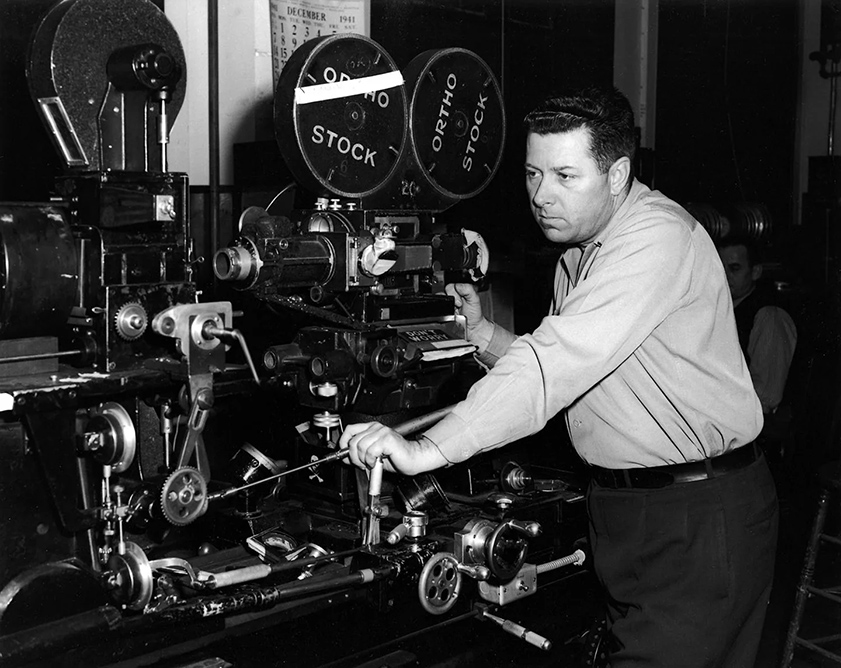
I recently attended a screening at the Academy of Motion Picture Arts and Sciences’ Mary Pickford Center in Hollywood. Their theater is named in honor of Linwood Dunn, ASC, one of the all-time great special effects experts. He was also one of the most fascinating characters I’ve ever had the pleasure of getting to know.
There’s a kindred spirit behind that notion. Dunn was born and raised in Brooklyn, NY, a few blocks from where my family lived until I was eleven years old. He once told me about watching a tricked-out Duesenberg convertible as it sailed across Avenue M when he was a boy. Inside was noted silent director J. Stuart Blackton, on his way to work at the nearby Vitagraph Studios. I knew the area well (my grandmother lived up the street) and the image he conjured of that moment gave me goose bumps.
Pursuing an early interest in film, he began as a projectionist in 1923 before transitioning to assistant cameraman. At risk of being left behind upon his employer’s move to Los Angeles, Dunn used the extra money he earned playing saxophone in jazz bands to pay his way across the country.
Once settled on the West Coast, he quickly ascended the ranks of special effects artists. It would be impossible to list even a fraction of the movies he contributed to during his nearly seventy-year career. Suffice it to say the most casual of viewers has probably seen more of his work than that of any other cinematographer.
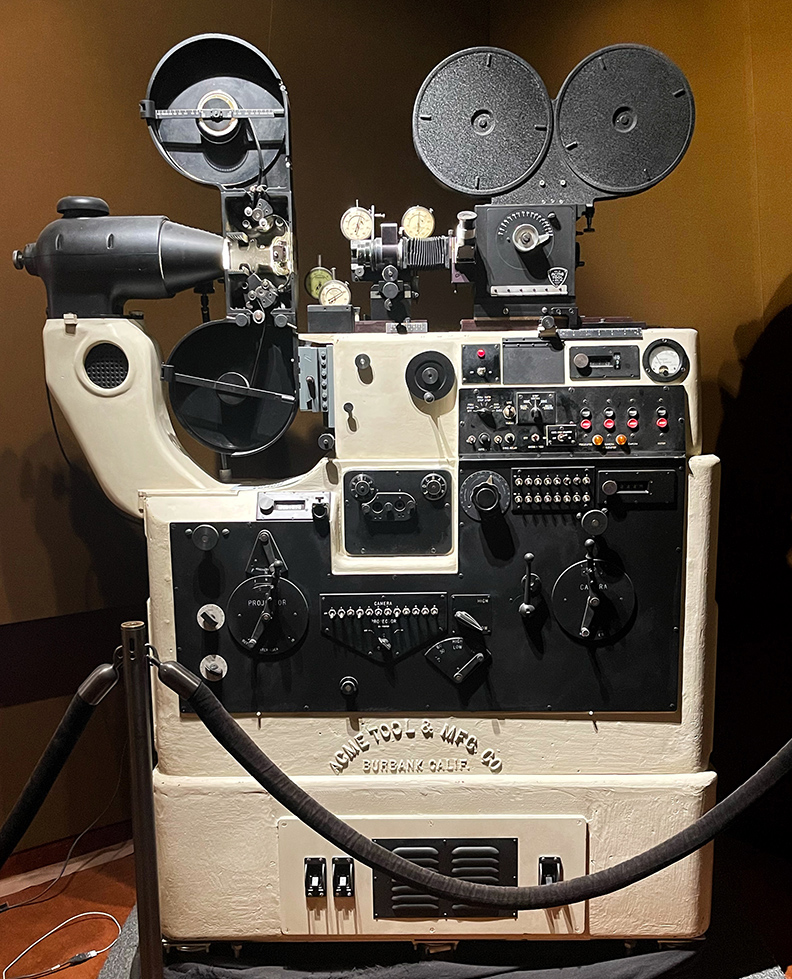
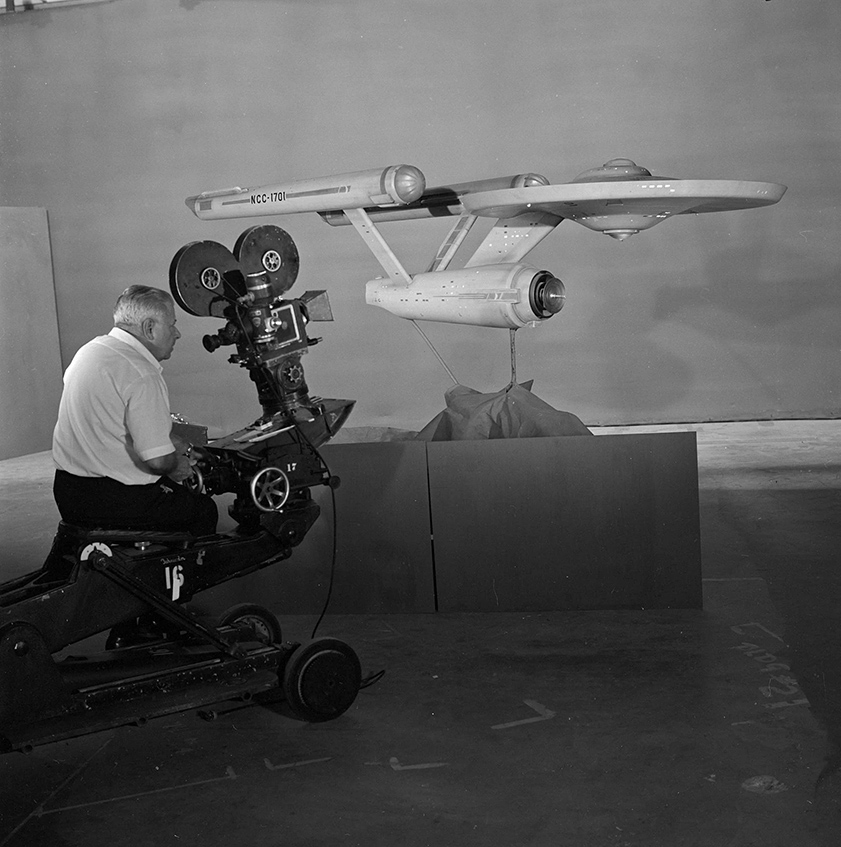
But his crowning glory has to be the co-invention (with Cecil Love) of the Acme-Dunn Optical Printer. The photo above shows the original item, which is on display in the lobby of the Dunn Theater. As was typical of latter-day Dunn, it’s also the same one I saw covered by a dusty sheet in his garage during the early ’90’s (right next to the model of the Starship Enterprise, used in the original TV show’s opening sequence!). The significance of this clunky, Iron Age device cannot be overstated. It started the industry on the path to the computer-based wizardry we enjoy today. I’ll let the accompanying placard tell the tale:
“For more than a half-century, the optical printer combined separately filmed elements into one composite image, thanks to the many contributions of RKO camera effects pioneer Linwood Dunn. When Dunn arrived at RKO in the late 1920’s (the early days of visual effects), no commercial printers existed. Studios built their own devices for creating simple optical effects, but Dunn envisioned a potential “magic machine” to advance the art of visual effects. Dunn and his team, including Cecil Love and engineer Bill Leeds, proved the premise by building an RKO printer that was an indispensable creative tool on King Kong (1933), Citizen Kane (1941), It’s a Wonderful Life (1946) and other classics.
During World War II, Dunn built this, his “dream printer,” under contract with the U.S. Navy’s Central Photographic Lab. Dunn’s team provided designs to the Acme Tool and Manufacturing Company, which built the then state-of-the-art device in association with Eastman Kodak Company. The result became commercially available after the war and an industry mainstay. Its wonders include precise controls for adjusting lens position, speed, and movement, and accommodating different sizes of film stock.
The Academy of Motion Picture Arts and Sciences awarded the printer’s creators a Technical Achievement Award in 1944, and an Academy Award of Merit in 1980.”
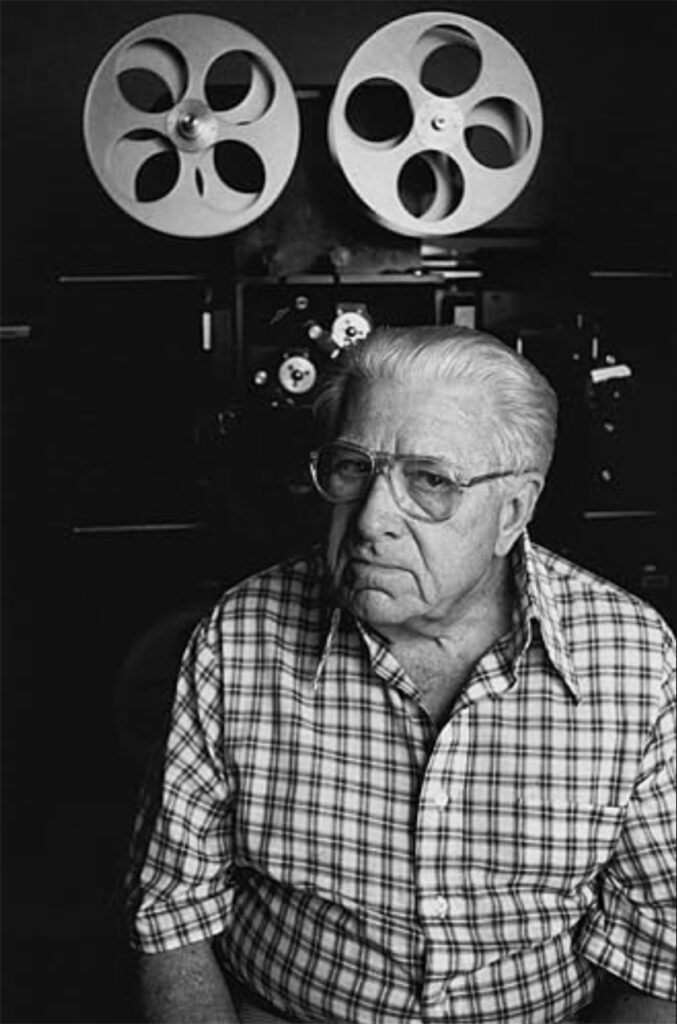
In addition, Dunn served several terms as ASC President and through AMPAS and SMPTE was a long-time leader in the effects community. Though his four Oscars and vaunted Gordon E. Sawyer Award further affirm his genius, he was never one to rest on his laurels. I recall him introducing me to the concept of digital projection over thirty years ago, and he couldn’t have been more excited about it. As a frequent beneficiary of his guidance, I remember him best as a friendly, funny, generous man. There’s still an enormous amount of knowledge to be mined from his body of work, but the greater lesson might be found in the type of person Dunn was.
For that, he will always have my gratitude.
Great post! I wonder why he had magazines permanently labeled for ORTHO stock?
Interesting question David, I was wondering the same thing. In that same photograph behind the film feed magazine is the calendar for December 1941.
David – It no doubt had to do with some special effect he was jacking up.
Greg – It no doubt had to do with some special effect he was jacking up.
“There’s still an enormous amount of knowledge to be mined from his body of work, but the greater lesson might be found in the type of person Dunn was.”
Never have truer words been written about Linwood Dunn. Encountering your poignant tribute to Lin has reignited a flood of memories. I recall the early 1980s when Linwood graciously brought me into the fold at Film Effects of Hollywood. From shooting IMAX Dome Titles for Dentsu Tokyo’s Portopia ‘81 to the intricate tasks of managing stages, cameras, labs, accounting, and the technical nuances of optical printing, Linwood guided me through it all.
Late nights at work were infused with Lin’s contagious humor, delivered in his unmistakable Brooklyn accent. He regaled me with tales of navigating the complexities of Hollywood’s film industry, offering not just insights into business but also life lessons. Despite facing adversity and extraordinary tragedy in his youth, Linwood always exuded kindness, optimism, and boundless generosity to all.
Our shared moments, like impromptu trips to his favorite McDonald’s for burgers and coffee, revealed a man whose energy belied his age of 75, often leaving me struggling to keep pace. Linwood’s dynamic leadership and sharp intellect commanded respect and loyalty effortlessly. As he gracefully transitioned into retirement, I assumed roles beyond my duties, ensuring every aspect of his legacy and company was handled with care, even in crises like late-night studio break-ins.
Linwood’s compassion knew no bounds. Late-night visitors to our Hollywood doorstep were met not with caution but with open arms and genuine assistance, a testament to his character. He was not just a successful professional (in both VFX and jazz sax) but a true gentleman of integrity and kindness, whose teachings and example left an indelible mark on me, surpassing any lessons Hollywood could offer.
Thank you for this response, Hart. Lin Dunn was indeed very, very special…
I am very deeply touched as I read and reread these comments about my father!
Nancy – That is so sweet of you to say! Every sentiment I expressed in that post is true. Your dad was a lovely man and his presence is still very much felt at the ASC Clubhouse. I send you my best for the new year!
I came across this article about Mr. Dunn as I was researching my great, great aunt Mable Scudder Love, wife of Cecil Love. Thanks for sharing this post. From your decription of Mr. Dunn I can see why one would want to be in his presence.