
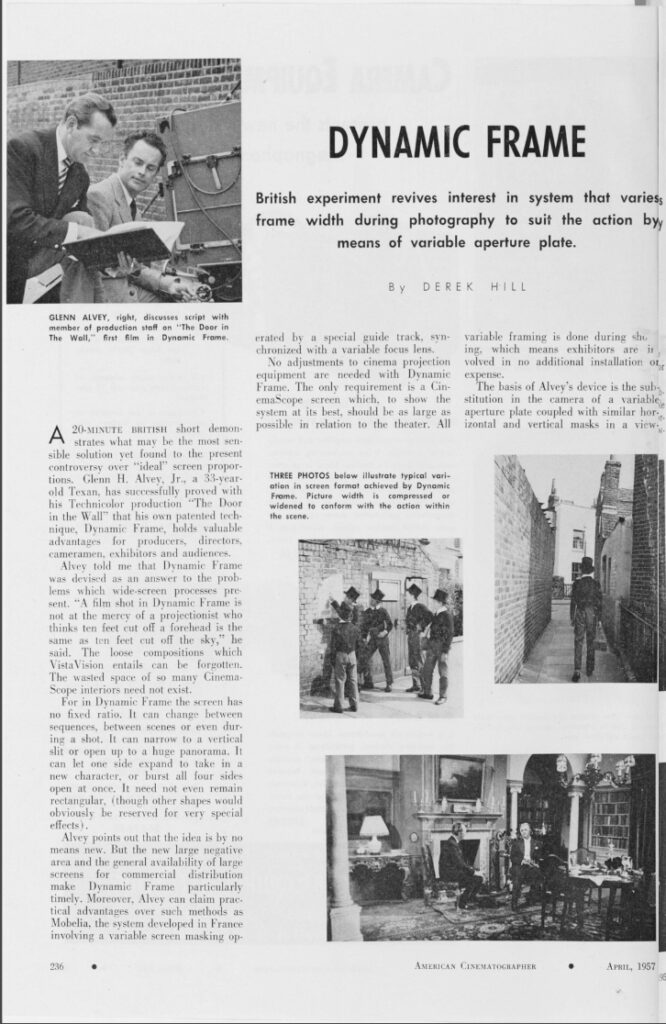
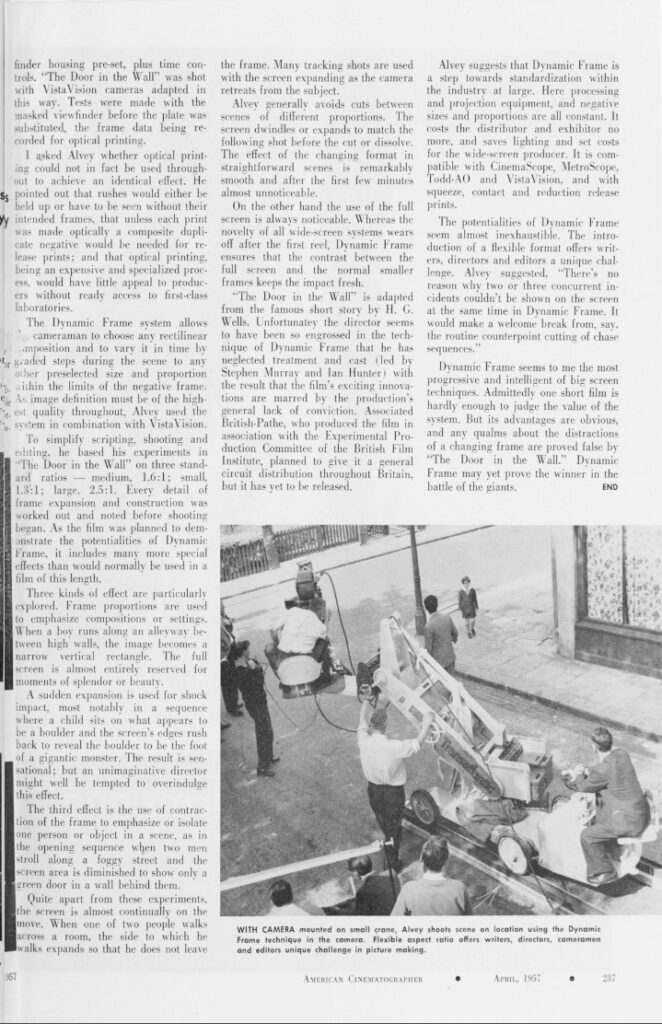
Last year’s award-winning Oppenheimer (Christopher Nolan\Hoyte van Hoytema, ASC, FSF, NFC) and Maestro (Bradley Cooper\Matthew Libatique, ASC, LPS) made good use of multiple formats within a single framework. To once again remind us that there’s very little left that hasn’t already been shown in some form or another, below is an article from the April 1957 issue of American Cinematographer.
What’s interesting is that despite all of us continuing to use tried and true techniques, someone always finds a way to make them seem new.
That, my friends, is the sign of true genius!
Great post!
Reminds me of EXPO ’67 in Montreal. The film presentations used unusual frames and in some cases there were multiple images on the screen at the same time. If I recall correctly, American Cinematographer had an article about the visuals and after reading it, I decided to drive to Montreal. It was well worth it.
http://cinemaexpo67.ca/
https://macm.org/en/activities/expanding-cinema-original-films-from-expo-67/
The challenge has almost always been at the projection end when planning to mix aspect ratios. There was a 1926 format called “Magnascope” where the projectionist switched to a wider-angle lens, enlarging the screen image, and theater workers would pull back the screen masking to let the image fill up as much space as the architecture allowed, meaning that the 1.33 image would often end up more like 1.66-ish. “This is Cinerama” famously begins in 1.33 and then the curtains open up for the full 2.66 image. The problem today is that most theaters have been set-up for 1.9 : 1 DCPs where 1.85 is taller than 2.40, so we no longer have the effect of the screen opening up wider for widescreen movies — we go taller for effect!