
Prior to the arrival of Garrett Brown’s Steadicam in the mid-70’s, options for moving the camera smoothly from Point A to Point B were limited to the use of dollies or cranes, all of which were cumbersome and required time and expertise to use. Skipping the indulgence of a well-financed production, low-budget shows often drafted whatever rolling platforms they could find, sometimes to reasonably good effect: wheelchairs, shopping carts and so on. Of course, hand-holding was always a way to get across the room, but the results of that were not quite unwrinkled, either. They were…hand-held.
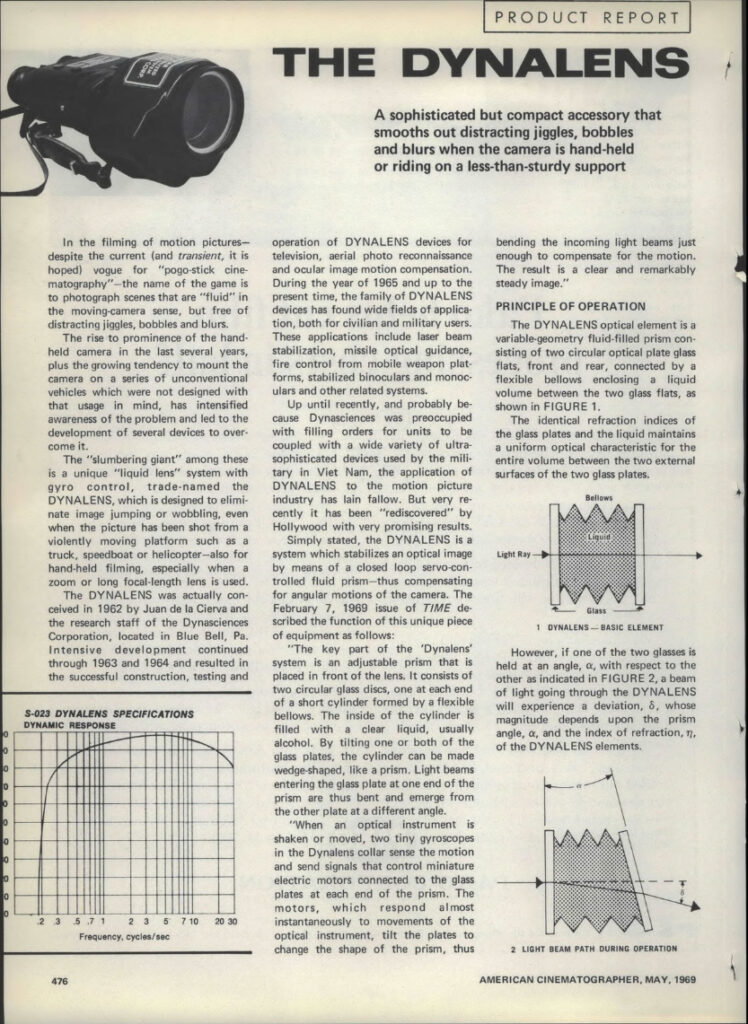
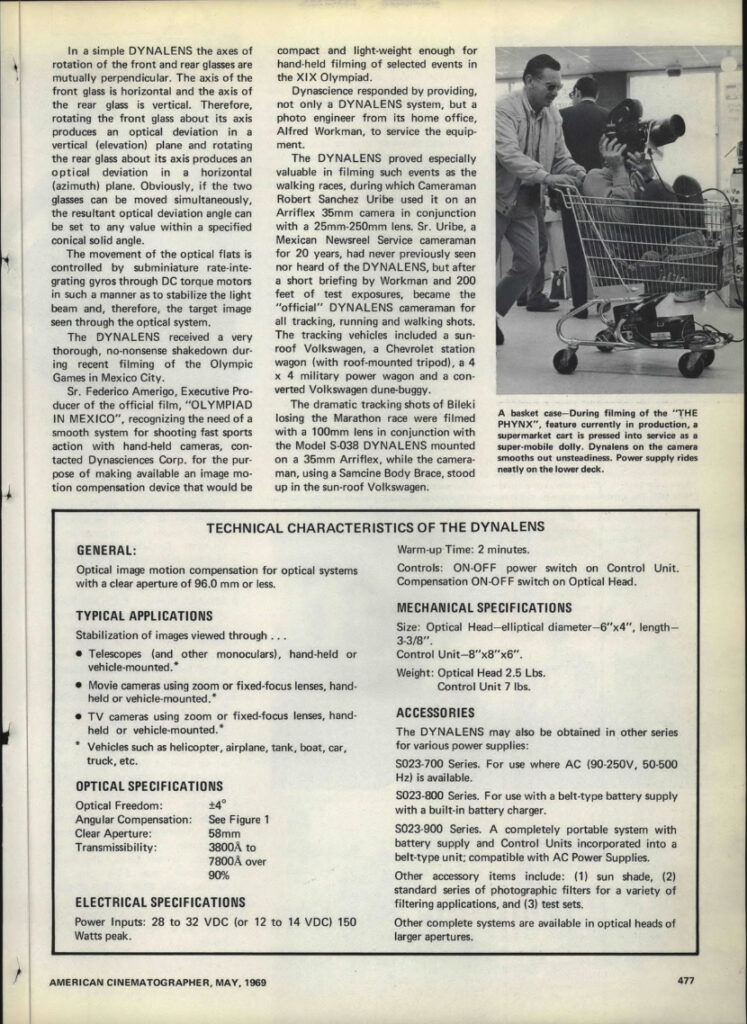
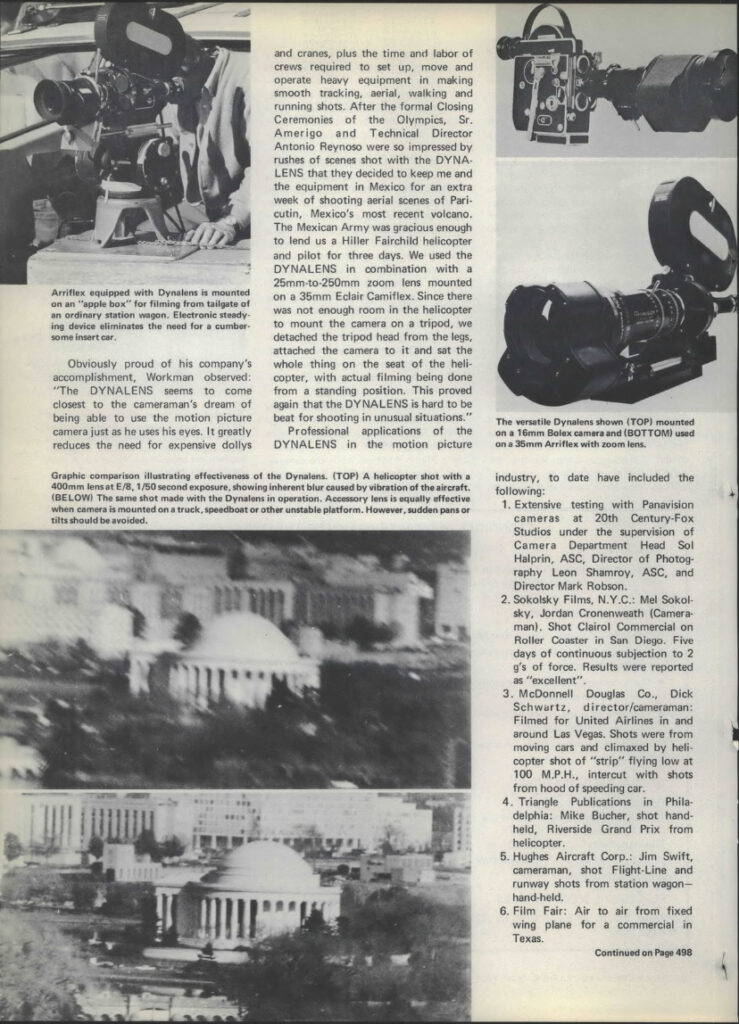
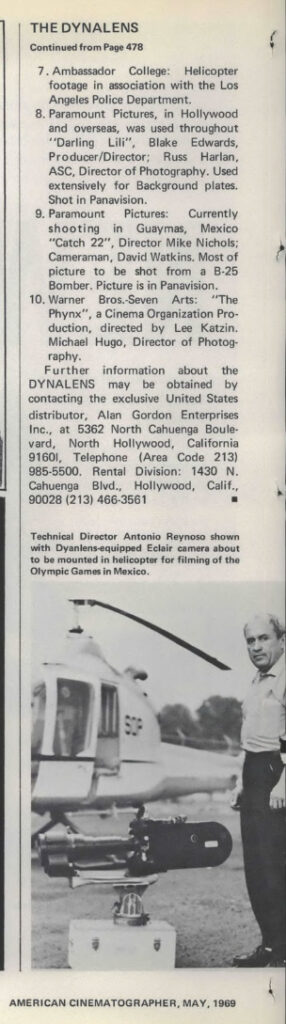
Nonetheless, by the late-60’s an instrument appeared that solved most of the problems associated with transporting the camera. For reasons I don’t understand, The Dynalens never caught on in a significant way and has seemingly disappeared into the mist of time. As described in a Product Report article that ran in the May 1969 issue of American Cinematographer, the device was…
…a unique “liquid lens” system with gyro control, which is designed to eliminate image jumping or wobbling, even when the picture has been shot from a violently moving platform such as a truck, speedboat or helicopter – also for hand-held filming, especially when a zoom or long focal-length lens is used.
I’ll let the full piece fill in the details (see below). Note that it fails to mention the high-pitched whirring caused by the system’s gyro, which negated sync-sound recording at close range. At further remove though, it seems to have worked fabulously well. Have a look at the way Gordon Willis, ASC used it on a Western dolly (no track!) to traverse the famously uneven pavement of New York’s Upper East Side in Woody Allen’s Manhattan (1979).
Under the right circumstances, The Dynalens remains a viable tool today. I wonder if a stray unit might be found in the depths of some obscure rental house…
Note well: I’ve included only a short piece from a moving shot that continues unbroken for two minutes…an enormous testimony to the efficacy of The Dynalens!
Rich, Thanks for reminding me of the Dynalens. I used one while at the USAF Audio Visual Center at Norton AFB, San Berdoo, early 70’s. I recall it was used mostly in helicopers when the Tyler mount was either not available or practical. Today’s Sony Digital Video camera like the FX-9 has an antivibration tool built in.
SONY STATES IN A PROMO OF FX-9
Stable, shake-free handheld footage
Advanced image stabilization information means even handheld footage can be transformed with Sony Catalyst Browse/Catalyst Prepare software* in post-production to look as smooth as if it were shot with a gimbal. Unlike in-camera or lens stabilization, metadata combining FX9’s built-in gyro and lens information allows you to creatively choose the balance between the level of shake-compensation and the resolution of trimmed 4K imagery. This feature requires Sony E-mount lens and allows for far faster processing than conventional NLE stabilization workflows.**
In Belgium we get a lot of cycling races on TV, captured and broadcast live with ENG style cameras from the back seat of motorcycles. They us a Canon ENG style lens (Canon HJ15EX8.5B KRSE-V), commonly referred to over here as a ‘VAP lens’, that has elements floating in liquid to stabilize the image. The results are astoundingly stable and I’m always in awe of the operators that make it seem effortless to bring these 5-6 hour long races on our TV screens in such a brilliant way. It blows my mind seeing them hanging of the back of the bike when you catch them in the frame of a colleague on another motorcycle or the helicopter shot.
Sven – How interesting about the ‘VAP lens.’ I’ve never heard of it before and would love to see one…
I just came across this article looking for information on the Dynalens. My father worked on the Dynalens gyro control circuit at Dynasciences in the 1960s. A VAP lens is a Variable Angle Prism, the Dynalens system. When the lens shifts, the prism changes shape to compensate. He told me a while back that Canon and Sony used the technology after the original patents expired.
Steve – It’s good to hear from you and thank you for your reply! The Dynalens was the industry standard for a short period and remains an extremely valuable tool in the right situation today.