

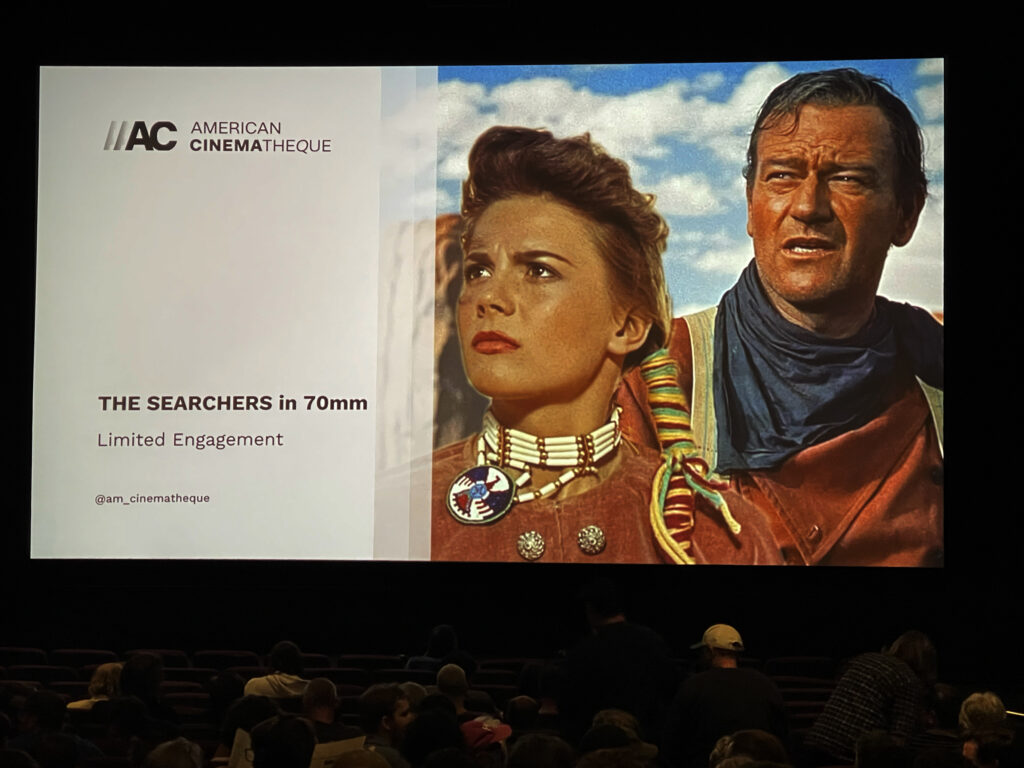
A few weeks ago, I enjoyed the rare privilege of attending a screening of John Ford’s classic western, The Searchers (1956) at the Aero Theater in Santa Monica. Along with the fabled Egyptian Theater in Hollywood, this venue is part of the American Cinematheque, an organization that since 1985 has brought enthusiasts a wealth of film programming and related in-person discussions and events. Clearly, the staff at both spots are fans as well. They always deliver a wonderful presentation and this night was no exception.
Wherever he may be right now, I’m certain that cinematographer and Past-ASC President Winton Hoch is smiling. His work was exquisite. The brand-new film print had been screened on just two prior occasions and boasted a special pedigree of its own. Struck from a new 65mm negative that had been scanned in 13K resolution from the original 35mm VistaVision negative, it positively glowed in its delivery. Plenty of information is available regarding this short-lived format, but the key takeaways are these: During production, the film ran horizontally through the camera and exposed an area stretching to eight-perfs in width. That’s a lot of real estate to play with, and the results showed the best of it.
Hoch used the 1.85 frame with taste and consistency to meet every challenge the expansive narrative threw at him. If anyone’s interested in seeing how convincing day-for-night photography can be, The Searchers offers several prime examples. Hoch didn’t hew too closely to the traditional rules for achieving the effect. Rather than shooting early or late in the day in predominantly back- or three-quarter backlight, he often shot in high, mid-day sun. Yet, his results were perfection. That he wasn’t nominated for an Academy Award that year is a travesty. He’d already taken the trophy on three occasions – Joan of Arc (1948; Victor Fleming), She Wore a Yellow Ribbon (1949; John Ford) and The Quiet Man (1952; John Ford; shared with Archie Stout, ASC). But his work here is superior in every way.
If you have the chance to see this incredible movie – really, the only Western you’ll ever need – don’t miss out. Hats off to the folks at Warner Brothers Motion Picture Imaging for the restoration work. Senior Colorist and ASC Associate Member Jan Yarbrough also deserves special notice for his efforts in reviving this classic.
For more information, follow the link:
https://www.in70mm.com/presents/1954_vistavision/1956_searchers/restoration/index.htm
I was privileged to work with Constance Towers on a film I directed a few years ago titled, “The Storyteller.”
She worked with John Ford on “The Horse Soldiers” and “Sergeant Rutledge.” She called him Pappy and had a lot of stories about working with Ford and John Wayne.
According to Connie, John Ford’s favorite film he made was, “The Quiet Man.”
She also talked about working on “Sergeant Rutlege” and talked about the racism in the south at the time they shot. When the shoot wrapped, the crew took a bunch of gifts and things they had left over from the shoot to give to the black community. The KKK met them there and escorted the crew out of town.
She also talked about Yul Brynner and doing “The King and I” on Broadway. She is a great storyteller – Hollywood royalty.
Richard – This one of yours was so gooood, a special one indeed… Nice job! I always enjoy your reads, but this one shined! I was sad to learn about this 70mm screening, for I had no idea about this opportunity – a rare treat that I missed… Alas… But I got to taste this from reading your article… Thank you! Big hug! May the passion always remain… Crescenzo Notarile, ASC
Thank you, Crescenzo! This one was a real treat…
You could teach a class about composition just by using Ford’s movies…
David – Totally true… And that class would be best taught by showing the students the film on the big screen!
The master of compositional study, is KUROSAWA…
Crescenzo – Him too, for sure.