
Now that the holiday season is really kicking in, I’ve got more free time than I know what to do with. That can be a recipe for disaster, but I’m fortunate to have a long list of movies and episodics I need to catch up on. I started an Outer Limits binge while away on location this fall, and returned home determined to finish the job. To be clear, I’m talking about the original series of the early ’60’s, not the inept revival of the mid-90’s. I’ve never been much of a science fiction fan, but I’m almost done and am happy to have made the commitment.
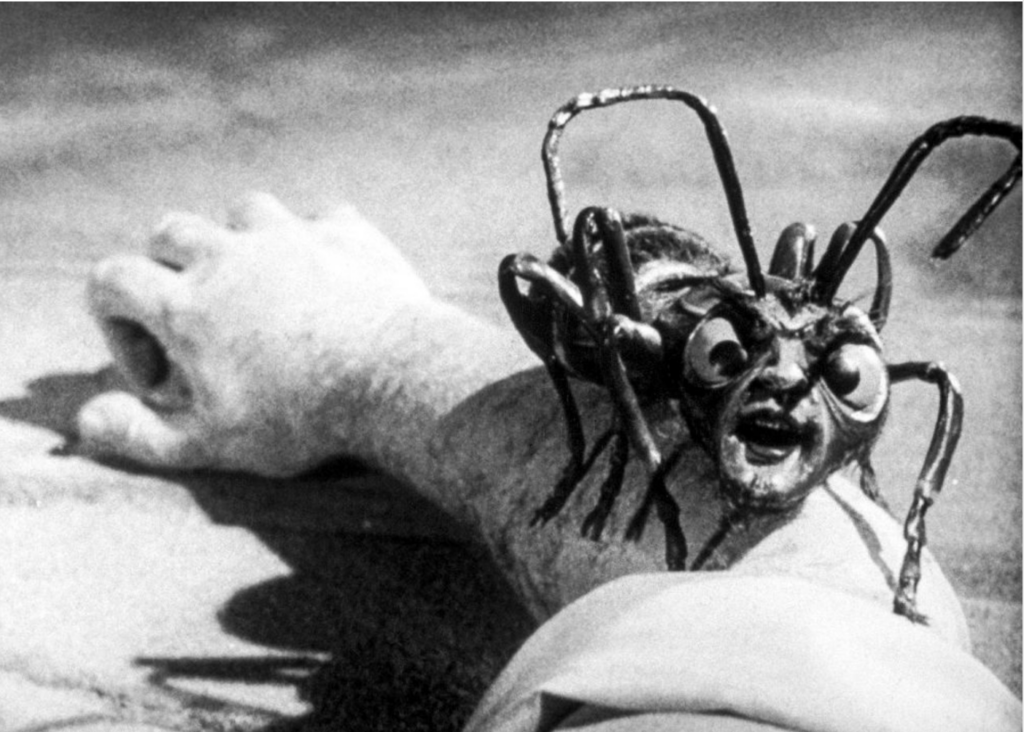
I have vague memories of this program as a very small child; all of them are associated with having the hell scared out of me. While I’m not so easily affected these days, there’s definitely something unsettling in the claustrophobic atmosphere evoked by each episode. Maybe that’s a byproduct of the pathetically cheap production values. For some reason, the notion of real people struggling to put the story across under threadbare conditions enhances the fright factor. Though most of the narratives are straight-forward, during moments when the mechanical effects or monster’s make-up go overboard, I find myself asking: How can something be so cheesy yet still be so disturbing?
On the other hand, the makers of The Outer Limits weren’t just going for the low-hanging fruit. The shocks were often cloaked in philosophical, moral and behavioral themes that remain sophisticated to this day. One episode that caught my attention, titled Nightmare (S1\E10, aired 12\2\63), concerned a group of soldiers pitted against one another by an alien being. Without skimping on the fear factor, its sharp examination of interpersonal relations would be seen as ahead of its time if only we had a similar reference in 2024.
Along with the music (courtesy of prolific composer Dominic Frontiere), the greatest contributing factor to the show’s discomfiting effect was its stark, black and white cinematography. Split up among future ASC members Kenneth Peach, Conrad Hall, John Nickolaus, Jr. and Fred Koenekamp, its deeply-shadowed, high-contrast look keeps the viewer off-balance and suspicious of what might happen next. That a predominance of shadow helped cover up any budgetary shortcomings was of secondary concern. For them, it was all about maintaining the mood. It’s no surprise that watching each episode anew awakened my child-like anxiety. It was akin to hearing a strange noise in a dark room while fumbling for the light switch. Never a reassuring sensation.
Some inside cinematography trivia: Hall once told me that he got the job on The Outer Limits thanks to a recommendation from his mentor, Ted McCord, ASC. Backing him up were a couple of future ASC all-stars, camera operator William A. Fraker and 1st AC Bobby Byrne. I can imagine the laughs they had photographing foam-rubber spacemen and all-manner of high school science experiments gone awry. If only that dolly could talk…
Written by series creator Leslie Stevens and co-producer Joseph Stefano, the Nightmare episode was directed by John Erman, who at this early stage of his long TV career was only twenty-eight years old. Stevens, by the way, wrote the script for Incubus, a film discussed in a post dated October 18 of this year, while Stefano wrote the script for Hitchcock’s Psycho. Somehow, they and the rest of their staff kept up the suspense for forty-nine episodes – each fifty-two minutes in length – before being canceled at the end of season two. Many plots were hung on the threat of nuclear annihilation. Considering the current state of the world, it might be time for a revival of this great show…hopefully done the right way.
Until then, I’ll still be having nightmares about the S1\E14 offering, The Zanti Misfits. Having just watched it, I’ll tell you this much – it scared the crap out of me as a kid…and it still does now!
First off, I completely agree with your assessment of the Outer Limits.
What I wanted to comment on how naive and ill informed I was in my days of handling the dailies at Technicolor for Connie Hall, Bill Fraker, and Bobby Byrne. When I met Cinematographers back then, there was no IMDB to easily look up someone’s credits and accomplishments. Maybe it’s just as well, as I would have become nervous had I known in advance of their pedigree!
I first met Billy Fraker right after he became President of the ASC for the first time, at a Saturday morning ASC tour of Doug Trumbull’s effects facility in Marina Del Rey (I was aguest of my boss Skip Nicholson) during Star Trek the Motion Picture’s VFX work. Had I known Billy had shot “Bullet” I may have been a bit more awe struck (I did of course learn that later).
Yet even with IMDB available to me, I didn’t realize until I just read your piece that Conrad, Bobby, and Billy had all worked on “Outer Limits.” I love learning that; many thanks Richard.
Hey Rob – IMDB is indeed a help in certain areas, but so much of what they list is wrong. I warn everyone off my credits page. Half of what I’ve done isn’t there and much of what is there I never shot. Despite many attempts to correct the record, they make it impossible, so I’ve given up on them! I direct people to my personal website instead. http://www.richardcrudoasc.com
By coincidence, I just watched the episode “The Man Who Was Never Born”, shot by Conrad Hall and starring Martin Landau. Some great work by Hall on that show!
Hello Richard,
The Outler Limits as well as the Twilight Zone were such shows of my
youth. They both explored the dark side of life I didn’t quite understand
as a child. Lately I’ve been binge watching the Alfred Hitchcock Presents
series from the late 1950s to mid 1960s. I’ve come to realize how masterfully
creative these episodes were. Mainly murder mysteries with an unexpected accented twists at the very end. So many major stars of the golden age of
film appear in these episodes from Joseph Cotton to Claude Raines.
The shows were directed by a multitude of directors which adds to its richness.
They were produced by Joan Harrison through Hitchcock’s Revue Production Company and I believe presented by MCA television. I highly recommend watching these episodes. It’s very addictive!
Have a Very Merry Christmas!
Thank you and Merry Christmas to you and yours as well, Ken! Those shows from that period seem so far ahead of anything we see today.