
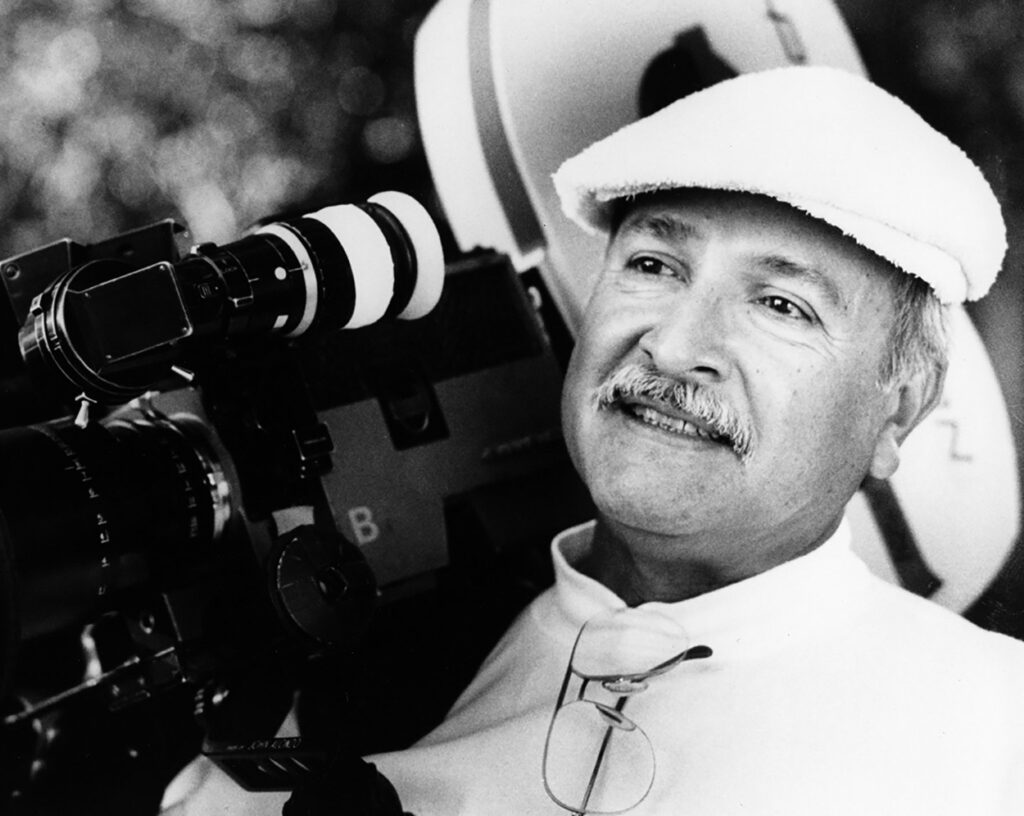
For yet another post, I offer full disclosure: John Alonzo, ASC will always hold a tender place in my heart. During the mid-’90’s, he was the first prominent cinematographer to speak up on my behalf as a potential candidate for ASC membership. It was a different time, and for those of us who were aspiring, we never dreamed such a thing could happen; standards were rigid and the bar for entry was high. Flipping through the latest issue of American Cinematographer, it’s hard to imagine that the entirety of the organization’s roster – including Associates – was then listed on a single page! Fortunately, Alonzo had seen some of what I’d been doing and thanks to his advocacy – along with that of Sandi Sissel and Stevan Larner – I received an invitation to join that rarefied group on December 10, 1999, which has remained a holy day for me. Looking back, I’m proud that I qualified by virtue of my work on film and that I made it in time to be part of the century whose images will always be remembered in celluloid.
Born and raised in Dallas, Alonzo began his career in the early-’50’s as a stagehand at WFAA, a local TV station. While there, he teamed up with actor Hank Williamson to create a comedy act that introduced cartoons on a kid’s variety show. After their schtick was picked up by station KHJ in Hollywood – where it lasted only one season – Alonzo remained in Los Angeles and studied still photography while seeking work as an actor. He actually met with some success in that capacity, appearing in substantial roles on such shows as The Twilight Zone, Combat!, 77 Sunset Strip and The Alfred Hitchcock Hour. He also made it to the big screen, most notably in The Magnificent Seven (1960; John Sturges). That might’ve remained a forgotten footnote save for one important factor: his on-set exchanges with cinematographer Charles Lang, ASC would shift him to an entirely different path.
Within a few years, Alonzo was shooting documentaries all over the world for such entities as National Geographic, Jacques Cousteau and the David L. Wolper Company. Back home, a chance encounter with James Wong Howe, ASC – who would become another mentor – brought him a job as an additional camera operator on the 1966 film, Seconds (John Frankenheimer). Graduating to First Cameraman with the Roger Corman flick Bloody Mama (1970), he was off and running. A small listing of his feature work reads like a survey of cinema’s last Golden Age: Vanishing Point (1971; Richard Serafian), Harold and Maude (1971; Hal Ashby), Sounder (1972; Martin Ritt), Lady Sings the Blues (1972; Sidney Furie), The Fortune (1975; Mike Nichols), The Bad News Bears (1976; Michael Ritchie), Black Sunday (1977; John Frankenheimer), Norma Rae (1979; Martin Ritt), Blue Thunder (1983; John Badham), Scarface (1983; Brian De Palma), Steel Magnolias (1989; Herbert Ross) and Internal Affairs (1990; Mike Figgis).
Alonzo adapted his style to whatever the script demanded. Though he was a hand-held enthusiast, he was never showy or self-conscious in his compositions or lighting. He was also quite forward-looking, garnering a Prime-Time Emmy nomination as the first to shoot HD on a television film (World War II: When Lions Roared; 1994; Joseph Sargent). He also originated on HD for the CBS remake of Fail Safe (2000; Stephen Frears), snaring a second Emmy in the process. His first Emmy came in 1999, for his work on Lansky, which was directed by John McNaughton.
Other honors included AMPAS and BAFTA nominations for perhaps his most notable title, Chinatown (1975; Roman Polanski). Interestingly, Alonzo was not the first choice as the movie’s cinematographer. Old-time studio-era stalwart and ASC hard-case Stanley Cortez was the starter, and he did not mix well with the talented, opinionated young director. Alonzo replaced him just a few days into the job, and he once confided in me that Cortez insisted they would be sharing the credit. Fortunately, sensible heads prevailed and they didn’t.
On a personal note, I was privileged to know the man. In many ways, he was a trailblazer, being the first Mexican-American member of IATSE Local 659 (forerunner of today’s Local 600) as well as the first Mexican-American member of the ASC. He was kind, gentle and polite, and smoked long, thin cigarettes in a plastic holder. He always wore a white terrycloth cap, which along with his SoCal style of dress gave him an air of someone who just returned from vacation. During the ’90’s I lived in Brentwood, several blocks from the home he shared with his lovely wife Jan and their three hilarious Black Labs. We enjoyed many drinks and meals there, and it always cracked me up as the dogs would nearly jump over their five-foot high garden fence whenever I came to visit. He was always generous to me with his technical knowledge, practical wisdom and advice for living, all of which I soaked up like a sponge. To this day, he was the most important influence upon how I’ve shaped my career.
Alonzo died of cancer at the way-way-too-young age of 66, and believe me, that was a loss for us all. If I had the chance to speak to him one more time, I’d simply say, “Thank you…for everything.” Absent that unlikely occurrence, I trust that wherever he is, he’s well aware of my gratitude.
Such a lovely tribute to an amazing artist. You are indeed lucky to have had John as a friend and mentor.