
In August I posted my take on an execrable film that nonetheless scared me senseless as a child – Terror from the Year 5000 (1958; Robert J. Gurney, Jr.). Since then, I’ve learned that I might’ve been a little harsh on its cinematographer, Arthur Florman (1917-2001). Though I stand by my assessment of his work, I have nothing but praise for what he did after the conclusion of his career behind the lens.
When I started my first job in the industry as a camera PA on a commercial in November of 1978, I had no idea what an important role the rental house he created with partner John Babb would soon play in my elementary education. F&B Ceco (acronym for Florman & Babb Camera Equipment Company) was a New York City institution for many years. As concerned an aspiring AC at the time, there were very – very – few outlets from which to learn. You could depend on only two sources of knowledge if you wanted to get ahead: working professionals (an almost impossible relationship to access unless you were born to one) and the generosity of staff members at equipment rental facilities.
Every time I dropped into Ceco’s storefront operation at 315 West 43rd Street (formerly 68 West 45th), the employees were friendly and accommodating to me, a kid from Brooklyn who didn’t know shit from shinola. Depending upon how busy they were, if I wanted to learn how to load an old Mitchell mag (simplest of all!) or how to operate a geared head, they would generously accommodate my queries. I’ve always believed that the tone is set at the top of every operation, and Ceco was no exception. I recall a brief exchange with Florman as he crossed the lobby with coffee in hand early one morning. I sensed that he had no hope for me, but he was friendly and polite, and letting me hang out there was encouragement enough.
What strikes me most is how those brief encounters and quiet kindnesses shaped so many people like myself. Ceco and a few other places like it were more than just equipment suppliers. They were classrooms, proving grounds and sometimes even sanctuaries for young aspirants who were eager to learn. Florman may not have been the one directly teaching us, but his foresight defined his company. As part of my amended opinion, I’ll hereafter associate his legacy not with a lousy sci-fi film, but with the doors he opened – doors that made a career possible for someone who at the time had more ambition than skill.
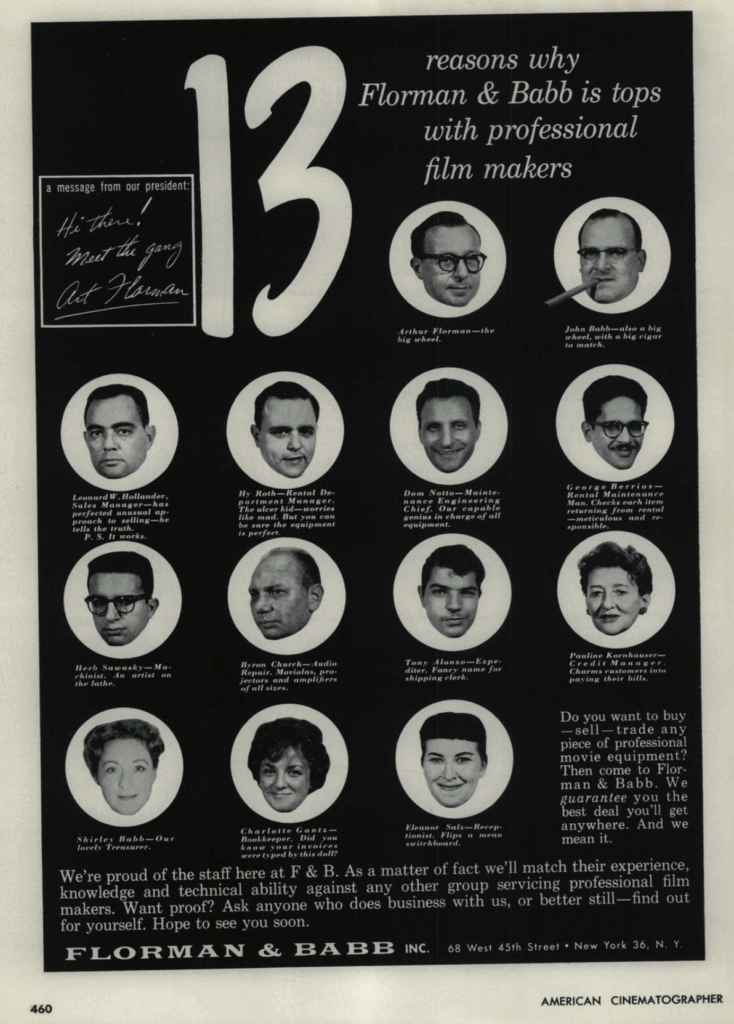
Note Arthur Florman at the top of the scorecard. George Berrios, batting sixth, later became a busy First Assistant Cameraman. He was a great guy too and I was fortunate to work with and learn from him on many occasions.
I had a similar experience at Birns & Sawyer — after years of shooting my own stuff in Super-8, I convinced someone to let me shoot a music video in 16mm — and then promptly ran into Birns & Sawyer to ask how to load a 16mm Arri-S (which I would be renting later from them.) They gave me a dummy load and showed me how it was done.
Great post!
Thank you for telling the history of F&B CECO Richard and your professional development and insights gained at that company. You are right on the mark, we could be shutout from the very industry we work in if it was not for those rental houses. Denny and Terry at Clairmont Camera, plus Bill Muir and David Rivera at Gunner Camera were my go to people and rental houses in Southern California. Fantastic customer service and just a darn awesome family environment at both places. I remember getting called on a Thursday morning to day play, substitute for a first assistant that had gotten hurt. The film was shooting with the newer Arriflex 535A camera. I called up Gunner Camera and they let me work with that system for half a day Thursday and all day Friday. I was ready for Monday morning, a bit internally nervous at the 6am call time, but the 16 hours of hands on 535A practice put me on the track for success. God Bless the rental houses!