
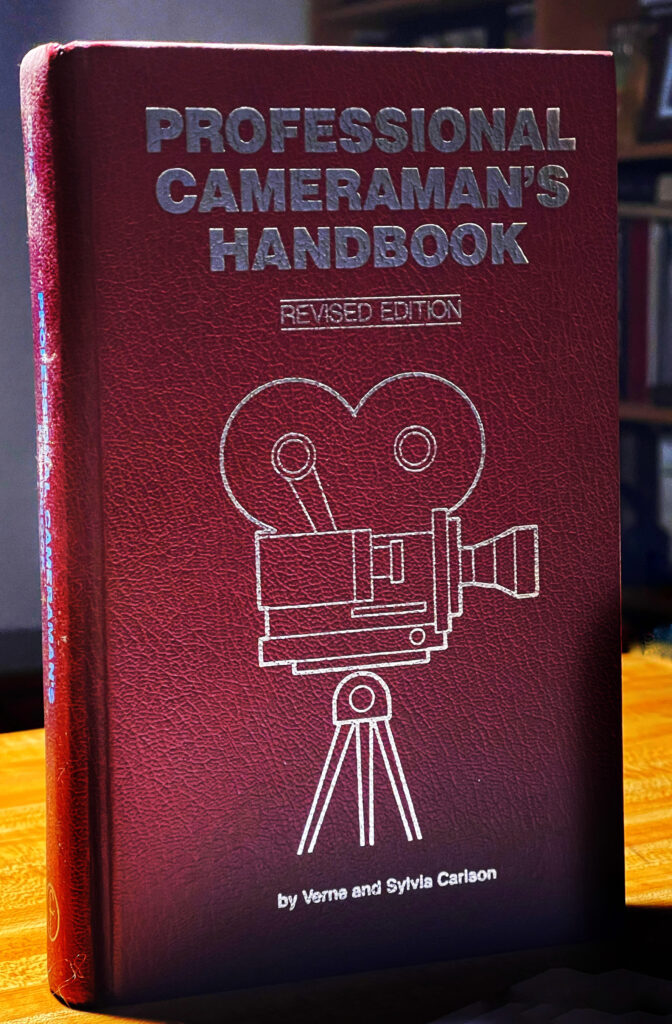
I envy the aspiring cinematographers of today. They have more educational resources within easy reach than prior generations could have imagined. When starting my climb through the ranks as an assistant cameraman in the late ’70’s, information was hard to come by. Like so many others, I was super-motivated in my search for bits of intel but the state of things sent me down as many blind alleys as fruitful ones. The New York equipment houses were generally hostile to inquiring youth. On set, colleagues were hesitant to share knowledge for fear of creating a competitor. There was no internet, hence no YouTube videos or manufacturer’s instructionals. Lectures, panels and other appearances by qualified directors of photography were few and far between. And film schools existed in a nether-world which had little to do with the professional environment.
But where there’s life, there’s hope. A small island of encouragement existed in the form of the 16mm\35mm Cameraman’s Handbook, a later edition of which appears in the photo above. Co-authored by Verne and Sylvia Carlson, it contained reams of explanations and procedures impossible to find anywhere else. Combined with the venerable American Cinematographer Manual, it was an essential text for the AC on the rise. I recall inhaling the contents while prepping for IATSE Local 644’s written and practical exams; to this day I can recite blocks of it verbatim. In addition to so much else, this book taught me how to thread a 16mm Bach Auricon Super-1200 sound-on-film camera, as well as the Cinema Products XM35 (though I’ve never seen either one in real life). What could be better testimony to the clarity of the Carlsons’ presentation? When I bought my first copy, I thought I’d hit the jackpot!
I wonder if the young people of 2024 experience the same thrill of discovery, of chaining together bits of knowledge to spark a leap forward and of committing with a full heart to their passion. If they don’t, it’s their loss. It would also remind us of another part of the cinematographer’s experience that has been sadly worn away by progress.
Having shot in the pre-digital age, I remember the lack of communication and fear that drove many interactions. Today, the ease of information gives everyone permission to be whatever they want, whenever they want. I guess it’s both good and bad, right?
I have this same edition. My copy belonged to documentary cameraman Jimmy Taylor. It was his father’s and I stole it from Jim like it was a dirty magazine or a secret code book. Jim was one of the first people who opened the door for me. He loaned me his Bolex, taught me to load it and “loaned” me that book. When Hurricane Sandy flooded our offices that book is one of the things I managed to save. Years later I somehow had it with me while meeting Werner Herzog. I presented it for him to sign and he loved that it was mostly full of German cameras. He looked at me and said “there is truth in this book”. Today I have my original stolen copy and a second one which I loan to our camera dept. Interns. We still have a Bolex which I show them how to load. I hope and pray that cinematography will always be a craft which dedicated people find joy in sharing.
When I was at UCLA as an English Lit student (1982-84) who wanted to make films, I spent all of my time in the library pulling down books, which is how I was able to read every issue of “American Cinematographer” going back to 1920. But I also read the few textbooks that had been written — by Freddie Young, Kris Malkiewicz, Lenny Lipton, etc. The interview book “Masters of Light” was gold to me, I read it so many times it fell apart and I had to buy it again! Even earlier, in high school, the first film book I got was “The Making of 2001” along with the “Superman” issue of “American Cinematographer” that I picked up at a science fiction convention. Today we can all chat with each other online, read websites, watch YouTube clips, post in forums, and use search engines — it’s amazing. But the value of a book is that the information is organized under a subject, the facts inside are less random and out-of-context. And it’s there to return to as needed. Over time, it becomes a historical record on filmmaking at the time of publication. And I worry often about information online disappearing, whether it is ephemeral. Look at Marty Hart (now deceased) and his American Widescreen Museum website — will it be around forever? Will all these cinematography podcasts be available twenty years from now?