
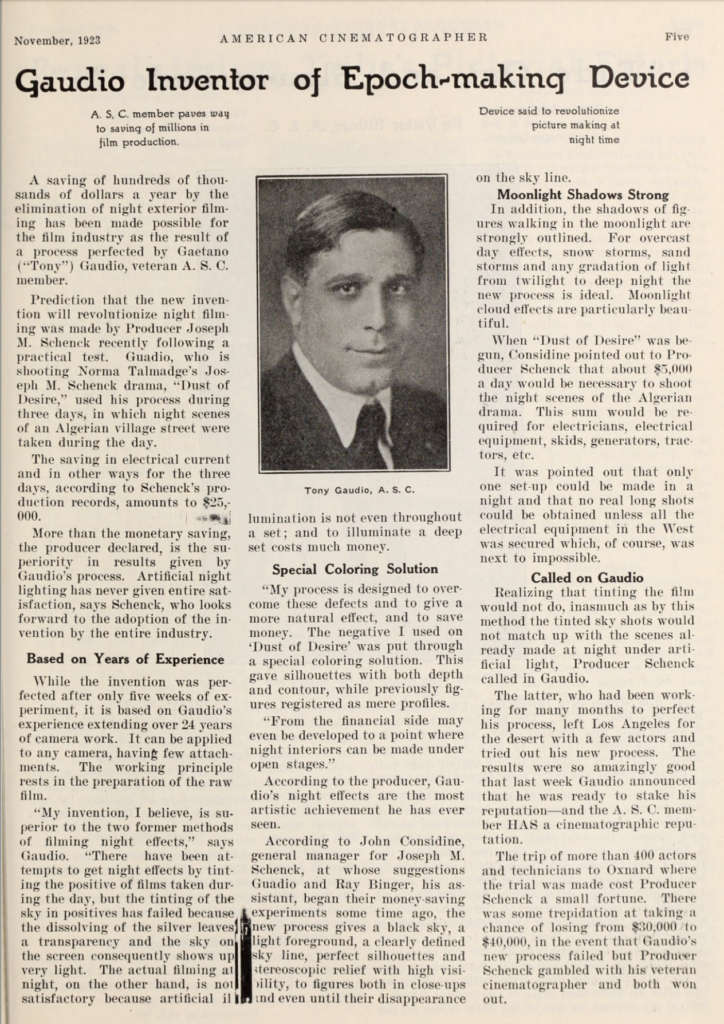
Epoch making? Really?
After several readings of this short article from the November 1923 issue of American Cinematographer, I’m still not sure what Gaudio’s process entailed. It supposedly rendered a convincing day-for-night effect, but in a proprietary stroke the piece fails to deliver much useful information. We learn that the Schenck organization thought it was terrific and that it saved money – and that’s about it.
Shooting day-for-night was nothing new by the early ’20’s. Cinematographers had been experimenting with the approach to varying degrees of success all through the silent era, though none of them established precedence across the industry. In D.W. Griffith’s Intolerance (1919), the legendary Billy Bitzer created a series of DFN sequences that remain impressive to this day. Given Gaudio’s understandably grand descriptions of his work on Dust of Desire (1923; Chester Franklin & Frances Marion), I still can’t imagine it exceeding what Bitzer did four years earlier.
The last thing I need is a fresh obsession that will lead me down another rabbit hole, but Gaudio’s mysterious exercise has really put the hook in. I’ll be sure to report my findings as soon as the information comes in.
Note that before its release, Dust of Desire was retitled Song of Love. It starred Norma Talmadge and Joseph Schildkraut and at one time was available from Kino Lorber on Disc Six of their Pioneers: First Women Filmmakers box-set. Reviews at the time were mixed and none of them mention anything about Gaudio’s photography in the general sense, let alone as related to day-for-night break-throughs. Combined with the fact that his innovation never caught on with other cinematographers, I’d assume the results were underwhelming, at best.
We can still respect Gaudio’s pluck, however. A hundred years later, Hollywood’s penchant for hype is as strong as ever. And attempting to shoot day-for-night remains a fascinating adventure for us all.
Hi Richard,
In June I joined the HBA* at a Barco hosted screening of the biopic, “The Lost Legacy of Tony Gaudio”, directed by Alessandro Nucci. I enjoyed the film very much. I believe it is still in search for a distributor. Some of his descendants were in the audience and are promoting the film. It was a touching tribute of one of the earliest members of the ASC and was a very accomplished cinematographer. Here is an addition to your story which I excerpted from the announcement of the screening:
https://en.wikipedia.org/wiki/Tony_Gaudio
“Gaetano (Tony) Gaudio, A.S.C. (20 November 1883 – 10 August 1951) was a pioneer Italian-American cinematographer of more than 1000 films. Gaudio won the Academy Award for Best Cinematography for Anthony Adverse, becoming the first Italian to have won an Oscar, and was nominated five additional times for Hell’s Angels, Juarez, The Letter, Corvette K-225, and A Song to Remember. He is cited as the first to have created a montage sequence for a film in The Mark of Zorro. He was among the founders of the American Society of Cinematographers, and served as President from 1924 until 1925.”
*HBA = Hollywood Beer Association. Wednesday’s thirsty industry gatherings at noon at Jamesons Irish Pub in Hollywood. Some sponsored lunches with vendors. Fun!
It’s a mystery to be sure. The year before the first feature shot on panchromatic film came out, “The Headless Horseman” (1922), about the Sleepy Hollow legend and shot, ironically, by someone named Ned Van Buren, and it has one the first day-for-night shots using panchromatic film allowing a dark sky with white clouds in it. Maybe Gaudio’s “invention” incorporated the new panchromatic stock and red filters?