
American Cinematographer, March 1956
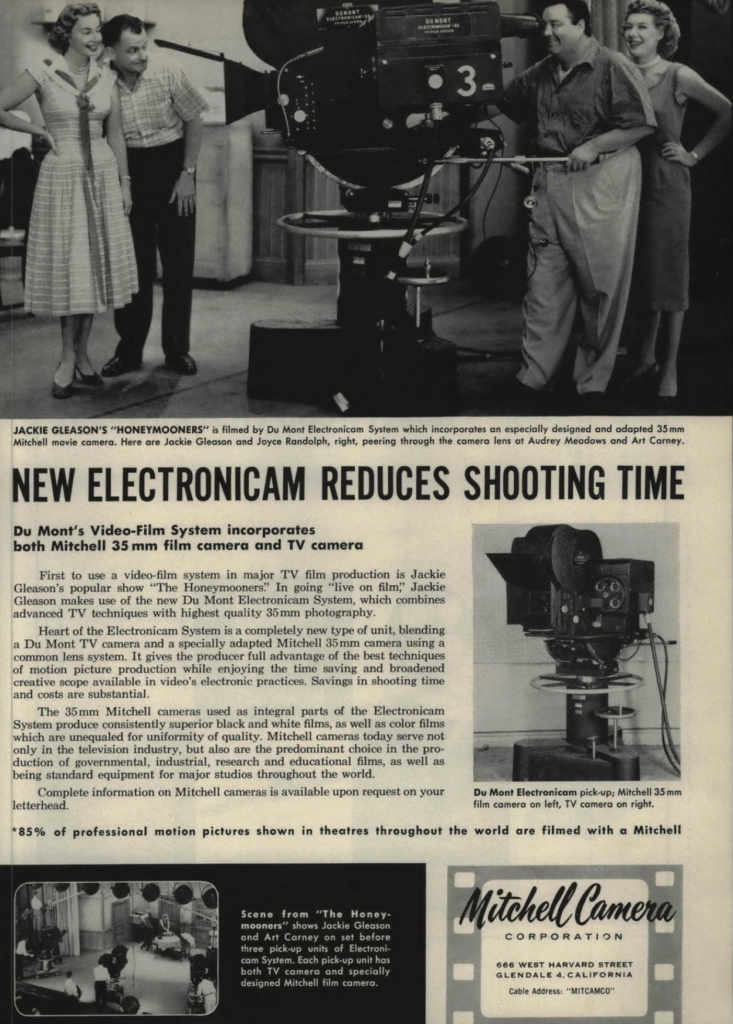
DuMont’s Electronicam was a hybrid TV/film camera system that allowed the recording of a live television production simultaneously on motion picture film. Designed and used by the DuMont Television Network in the mid‑’50s, it combined a standard live video camera (image orthicon tube) and a 35mm or 16mm film camera behind a common lens; a beam‑splitter\mirror apparatus sent the image to both mediums at once. Prior to that, the dominant method was the kinescope, which filmed a live TV monitor. Electronicam offered a big step up in quality and it quickly earned its place in the industry.
Because the Electronicam rig carried full-sized TV and 35mm cameras on one dolly, the units were unwieldy, which made complex blocking and fast repositioning difficult. On multi‑camera shows, the control room carried out a live video switch that was recorded by kinescope as a reference cut, while each Electronicam’s film negative was exposed continuously for later editorial conform to that guide.
After giving up on coax/microwave networking in favor of distributing finished film prints to affiliates in 1955, DuMont adopted Electronicam for most of its studio‑based programming. Its best‑known application is the thirty-nine episode run of Jackie Gleason’s The Honeymooners (1955–56 season for CBS). Shot with three DuMont Electronicam units before a live audience, the result was a high‑quality 35mm element that was used for reruns (and much later, home video).
The end credits on those Honeymooners episodes carry an Electronicam notation, which is one of the few visible legacies of the system today. British producer J. Arthur Rank briefly tried the system in the U.K. the following year but was dissatisfied with the results. The real death blow came shortly thereafter. Ampex’s 2‑inch quadruplex videotape recorder debuted in 1956, making it possible to record live video directly to tape for near‑instant playback and editing without the complexity and cost of a synchronized film camera. Meeting the same end that all filmic technology eventually does, the Dumont Electronicam – revolutionary for a moment – became a victim of fast-moving progress.
Editing 2-inch tape from the Ampex machine was not as easy as one would imagine. During playback in the control room, the edit point was located from a reference to the video monitor and the machine was then stopped. By manually rocking the tape over the playback heads the almost precise point was found, then came the hard part. Using a microscope, some iron filings were brushed onto the tape to locate sync pulse and make a physical cut of the master tape. What I described is what we did at WTVS Ch 56, Detroit in about 1965.
The following is a summary from the ‘net:
Editing 2-inch quadruplex videotape in the 1960s was a precise, physical process often requiring cutting the tape with a razor blade. Editors used magnetic developer to reveal the magnetic tracks, located the edit pulse under a microscope, and used a splicing block for the cut, or later relied on electronic editing to shift from playback to record, as shown in this 1960s BBC TV video.
Key Aspects of 60s 2-inch Tape Editing:
Physical Splicing: For years, the primary method involved physically cutting the 2-inch tape, which was often done using special adhesive tape and a guillotine-style editing block.
Locating Edits: Because video signals are invisible, editors brushed a magnetic powder (iron particles suspended in Freon) over the oxide side of the tape to reveal the vertical edit pulse.
Electronic Editing (Mid-60s): Introduced by Ampex in 1961, electronic editing became more common later in the decade. This involved “assembling” scenes by controlling VTR machines to switch between playback and recording at specific moments, avoiding the need to cut the master tape, according to a 1961 video about Ampex Electronic Editor and a 2-inch Quad video.
The Quadruplex Issue: Because Quad tape recorded signals transversely (vertically across the tape), a physical splice required a very precise cut to prevent visual disruptions (the “flash” or “glitch” often seen at edit points).
Time Consuming: Unlike modern digital editing, this process was slow, costly, and required immense skill to ensure that the program was not completely ruined.
Greg – That seems so insane…using a microscope and iron filings to find a precise cutting point. I can’t even imagine!