
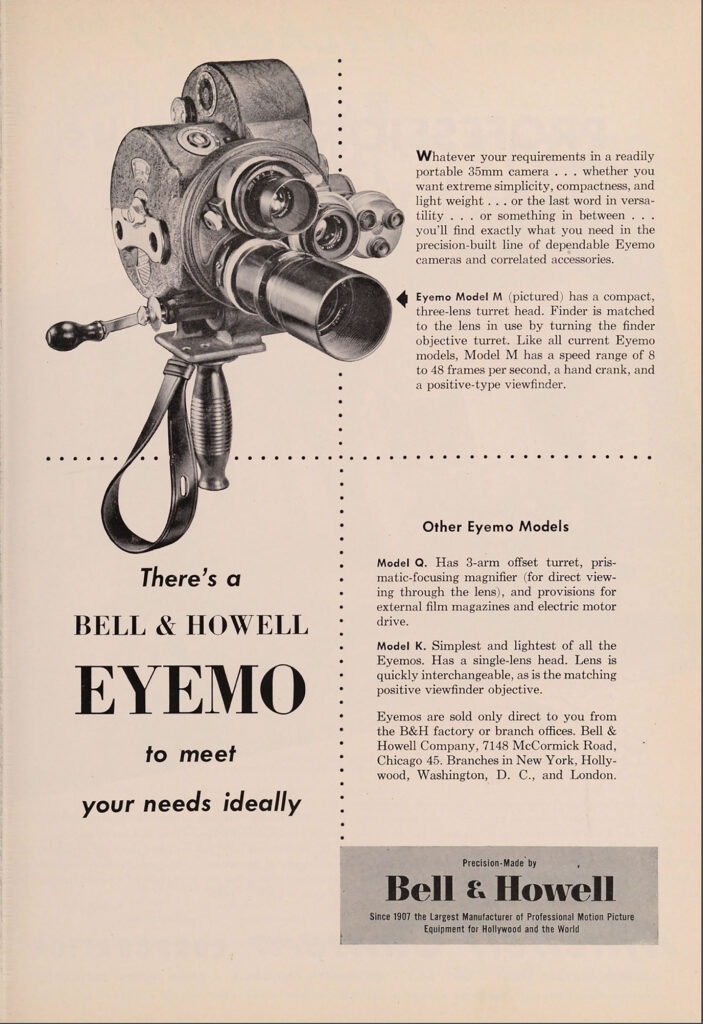
An ad from the March 1948 issue of American Cinematographer…
How can you not love the Bell and Howell 35mm Eyemo…? Introduced in 1925, it remains a viable tool for cinematographers who want the ultimate no-frills motion picture camera. If you don’t need to shoot synch-sound, it can deliver high-quality images within its many other applications.
Consider some of its specs:
– three-lens turret
– behind-the-lens filter slot
– variable speeds up to 48fps
– clockwork movement powered by a wind-up spring (no battery necessary!)
– takes a 100′ film spool which can be loaded in daylight
The Eyemo’s parallax viewing system might seem impractical by today’s standards, but its matching\interlocked set of objective lenses makes it easy to use. A longtime staple of Hollywood, newsreelers, documentarians and film students, it served with distinction from WW II through Vietnam, bringing home millions of feet of perilous footage from the front. Its cast-iron construction made it a versatile tool, as was reflected in the military’s manual – which decreed its use as an improvised weapon, should the need arise. The Eyemo’s value and durability also demanded its destruction by grenade, to prevent it from falling into enemy hands. Having used one as a crash camera on numerous occasions over the years, I’m not so sure a grenade could do the job!
Eyemos have become something of a collector’s item recently, especially among hipsters who get off on the retro vibe. Subsequent iterations added electric motors, external magazines and speeds up to 60fps. A 16mm version was introduced in 1927 and enjoyed a similar level of popularity, but for me, there’s nothing like the stripped-down, elemental, essential, 35mm original. The overwhelming influence of technology on modern cinematography can sometimes blind us to the shortest distance between two points. Which leads to the question: Does anyone really believe we’ll be talking with such passion about a digital camera in ninety-nine years? I think not…!
Thanks, Richard.
As a camera assistant, I spent many days and nights on “Eyemo duty”.
I always enjoyed tinkering with mechanical items, and when I was first introduced to the Eyemo’s war time history, I was hooked.
Many other assistants shied away from the quirkiness of the camera, but I always volunteered if I could ,enjoying going out on my own, with a bag and finder, setting up shots for the DP to review.
The eyemo crash dailies were always the highlight of the reel!
Denny Clairmont’s retrofitted electronic eyemo was the last and the best; featuring crystal controlled motor and a Nikon lens mount.
I bought one complete setup from him, when he sold off his inventory.
I don’t know why, but I wanted to have a piece of history.
Someday, hopefully it will be used again.