
This just hit the streets yesterday, courtesy of author Carolyn Giardina in The Creative + Tech Orbit. Scroll down a bit for the good stuff…
Virtual Production: ‘June July’ Filmmakers Test New “VidViz” Technique
The feature-length Western is also a case study for a developing workflow aimed at indie filmmaking. “We’re in a new Hollywood,” says director Daniel Thron.
With the belief that Hollywood is poised to enter a new stage of indie filmmaking, Chaos Labs’ director of special projects Chris Nichols and director Daniel Thron have teamed up to make a feature-length Western, titled June July, through their Monstrous Moonshine production banner, which will simultaneously be used as a test bed for a workflow dubbed video visualization, or “VidViz,” incorporating Chaos tech.
They came up with the idea while Chaos was experimenting with how to use its new Vantage Arena renderer, which uses real-time ray tracing, for virtual production (including test short Ray Tracing FTW whose cast includes a string of VFX vets from Sebastian Sylwan to Scott Ross.) “Then we started to think about the whole unified production process, specifically based on how can we be more efficient as filmmakers and enhance creativity,” relates Nichols.
They also had a Western concept that had been germinating and embarking on this production, they feel, underscores the state of Hollywood. Says Thron, who is directing, “There’s a kind of rebel filmmaking that happened in the ‘70s that had a very interesting, strong story process. Audiences wanted to see different kinds of movies and more adventurous movies. And it was sort of the great independent films that led to the great ‘70s Hollywood. We feel that we’re now in the same position. We’re in a new Hollywood.”
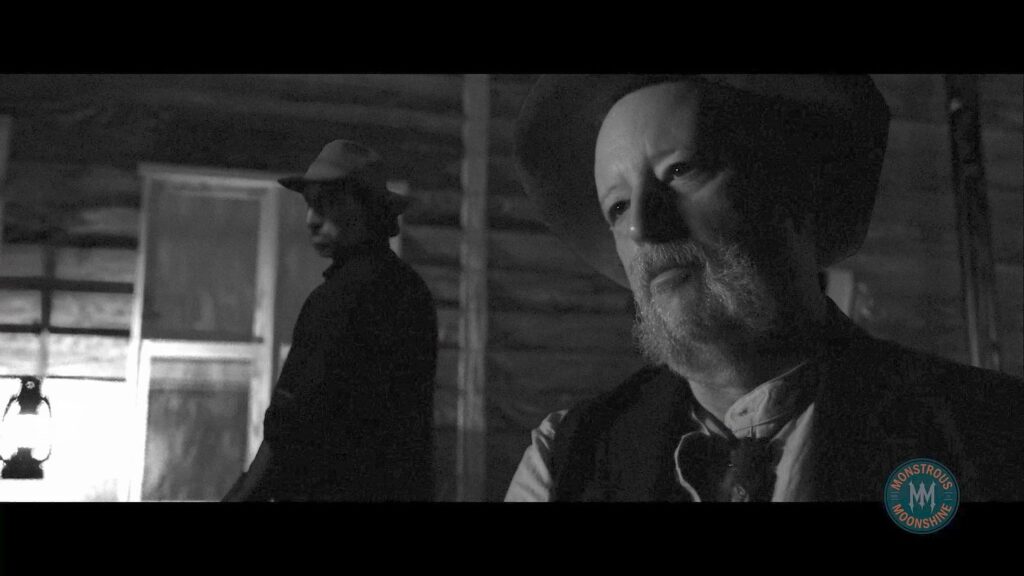
(June July VidViz. Photo credit: Monstrous Moonshine LLC)
There are, of course, many ways that virtual production-type techniques are now being employed, from studio tentpoles to indies, as the lines between preproduction, production and post continue to blur. Their workflow is aimed, at least for now, at the indie filmmaking community, with a goal of making the process cost effective (June July’s budget is still TBD) and creative by providing more time to rehearse and plan.
Nichols – who in addition to producing the feature will wear his Chaos hat for the developing Chaos Innovation Labs workflow – relates that in making the previous Ray Tracing FTW, they took final assets and put them right into virtual production. For this film, they took that notion further, and expect to use the same digital assets through prep, production and post. In formulating the idea, he reasoned, “What if instead of using an LED wall, I just use a bluescreen. Very simple. And what if instead of using a previs where I have to have animations of actors moving around and doing camera inside a computer, what if we just used a real actors and film it in a very sort of rough way?”
This formed the basis of their VidViz process: In the previs stage, they rehearse with stand-ins or actors and craft rough shots in front of a bluescreen (in this case, driven by Chaos Vantage), as their way to plan before proceeding to more expensive shoot days on a volume. (A June July VidViz clip can be found here).
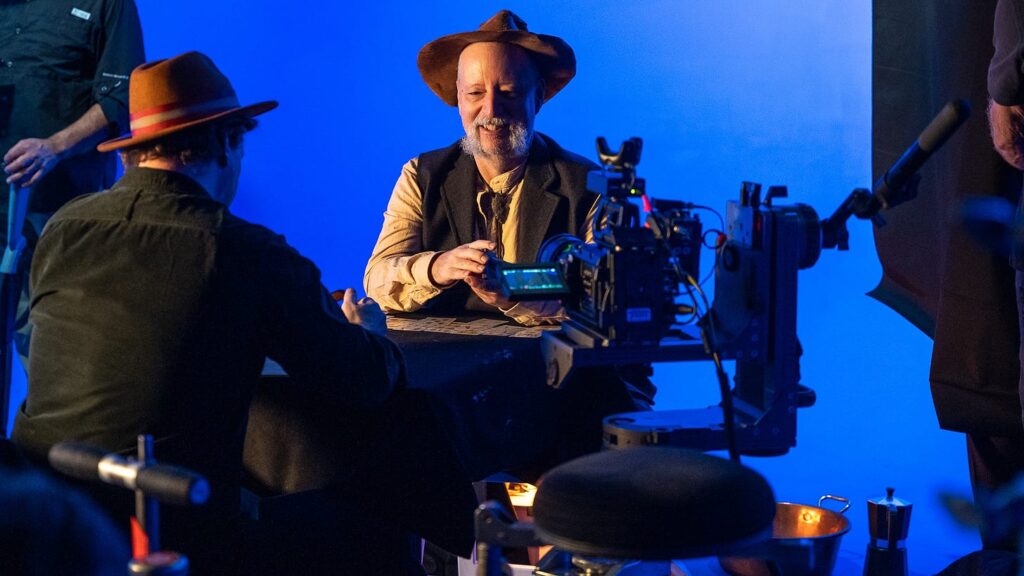
(June July VidViz. Photo credit: Monstrous Moonshine LLC)
Making the Movie
Inspired by ‘70s Westerns such as McCabe and Mrs. Miller as well as the films of Sergio Leone, June July tells the story of a woman in her ‘70s who goes on a revenge tour when she learns a villainous posse had killed her son. “She’s sort of killing her way up the chain of command and it gets more and more concerning; the movie is focused on the sheriff that is trying to hunt her down, and how he is struggling with the fact that he thinks what she was doing was right, but the longer she goes, it seems to be more wrong,” Thron says. “It has a good old-fashioned action, dark revenge, Western quality to it. But I think the central character is a richer one than you would normally get out of that kind of story.”
June July is currently in the VidViz stage and Thron is enjoying the process of working with actors and crew, noting, “…the less technology gets in the way, the easier it is for us to stay in the moment and communicate as fast as we need to.”
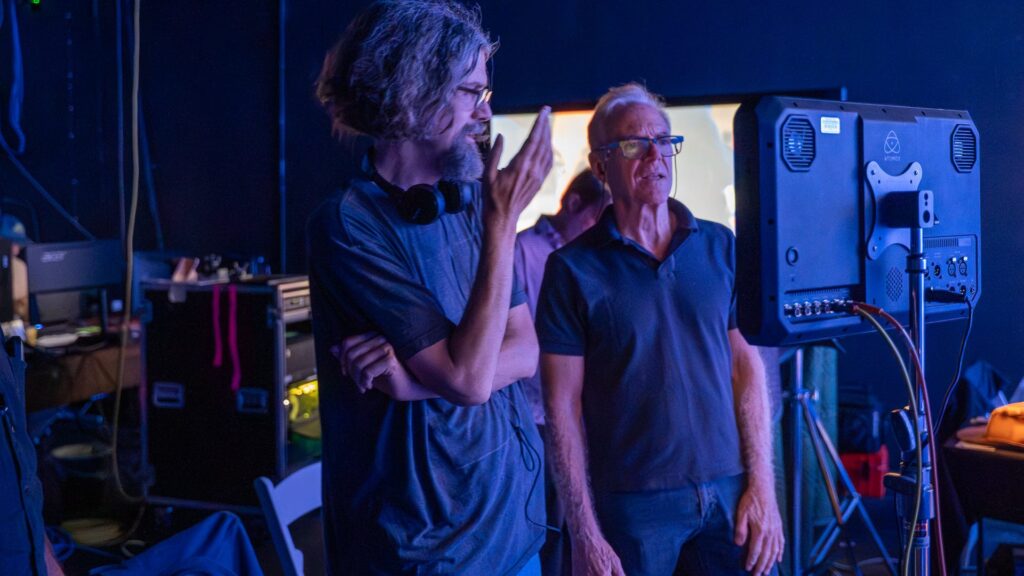
(From left: Thron and Crudo. Photo credit: Monstrous Moonshine LLC)
It also involves the cinematographer in their visualization process. June July’s veteran cinematographer, Richard Crudo, ASC, is able to move the camera and light, while watching the vid vis in real time on a monitor. “It triggers a different way of thinking about the image as you’re creating it. You see the results of moving a source instantly, so it expedites a more fruitful communication with Daniel.”
Editor Cody Wasson also participates in VidViz, offering notes with an eye toward making editorial go smoothly.
Later, production will include additional cutting-edge techniques. “We’re going to probably shoot some of the exterior shots as live action, but we’re also going to do a Gaussian Splat (The Orbit’s Gaussian Splat explainer and series) of the set so that we can use that insert in virtual production. And we’re probably going to have a CG element on top of the Gaussian Splat,” says Nichols, a producer on June July. “So, we’re going to use everything that we can to try to pull this off, but we know what we need to do based on having already done the vid vis.”
Reflecting on the films of the ‘70s, he adds, “Films like Network are so great because they got to rehearse with these actors and rewrite the script concurrently during production, so it got sharper and sharper. It really is saying what you want to say. And that’s not something you do nowadays, because the cost of doing that has been so prohibitive.” Nichols hopes that in making June July, they develop another option.
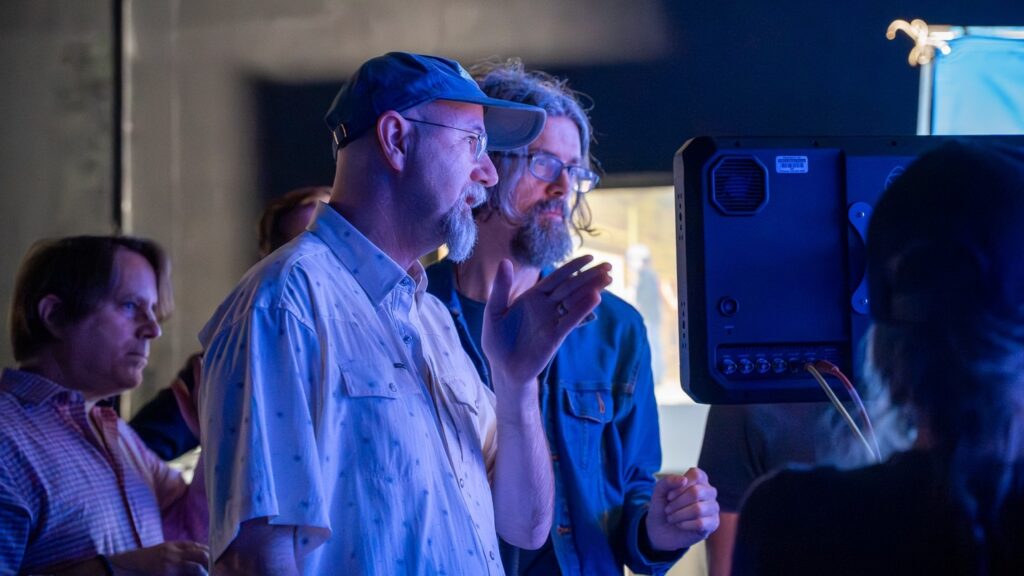
(From left: Nichols and Thron. Photo credit: Monstrous Moonshine LLC)
Great article! These guys, and you, are brilliant. Can’t wait to see the feature you all do.