
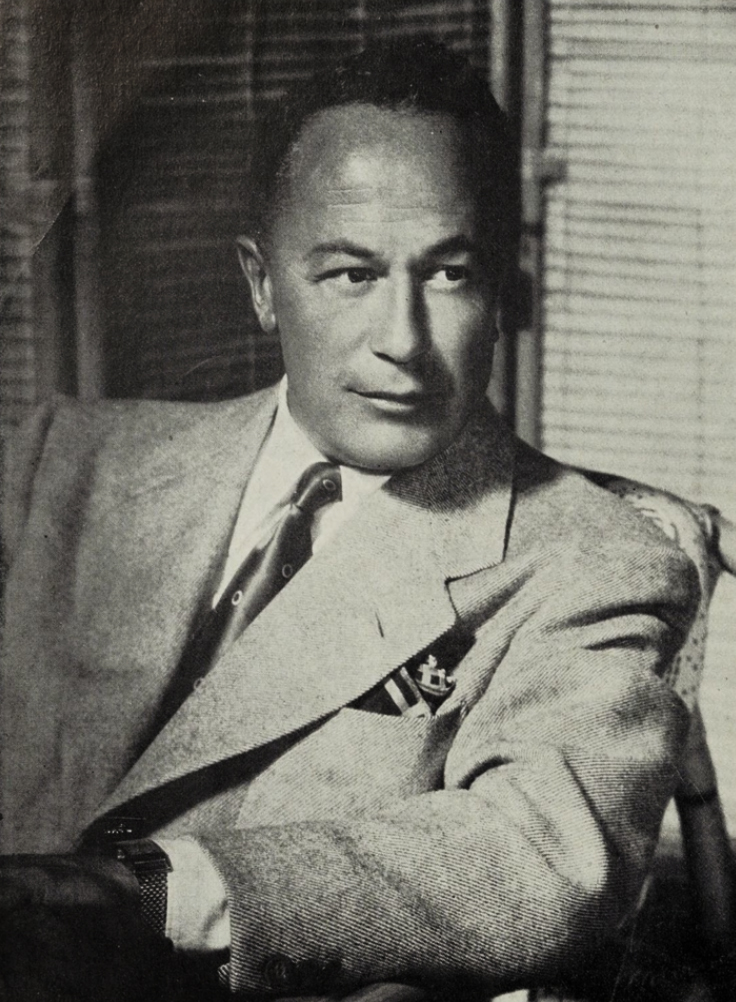
Have you ever heard a name more befitting a Hollywood cinematographer of the studio era? And check out that dapper portrait. You can almost see him in a booth at the Brown Derby, clinking martini glasses with some burgeoning starlet close beside him.
John Peverell Marley’s origins would never give way to such fantasy. Born in San Jose, CA, after declining college he entered the industry in 1920 as an assistant to Cecil B. deMille’s cameraman, Alvin Wykoff, ASC. His passion for the job saw him promoted to the top spot in three years, and a long collaboration with deMille began with Feet of Clay (1924). The first scene he shot was quite the baptism of fire: It involved eight cameras, six-hundred extras and a harbor-full of yachts. Other titles with the great director included The Road to Yesterday (1925), The Volga Boatman (1926), King of Kings (1927), The Godless Girl (1928) and Dynamite (1929).
Having won twenty-two trophies as a youth, Marley’s interest in dancing was revived during a vacation in 1930; he joined the vaudeville circuit, where he remained for several months. His return to Hollywood saw him pick up right where he left off. Among the notable movies he proceeded to shoot were Rowland V. Lee’s The Count of Monte Christo (1934) and The Three Musketeers (1935), The House of Rothschild (1934; Alfred L. Werker), Henry King’s In Old Chicago (1938) and Alexander’s Ragtime Band (1938) and The Hound of the Baskervilles (1939; Sidney Lanfield). Later in his career, he photographed a film in 3-D, House of Wax (1953; Andre de Toth) as well as Serenade (1956; Anthony Mann), The Spirit of St. Louis (1957; Billy Wilder) and The Left-Handed Gun (1958; Arthur Penn). His final credit was for the TV series, General Electric Theater in 1962.
Among his many achievements: Marley was the first to use a sound-blimped camera (on deMille’s Dynamite). While shooting in Budapest, he introduced process photography to European filmmakers. During World War II, he served in the Army Air Corps. He earned two Oscar-nominations, for Suez (1938; Alan Dwan) and Life with Father (1948; Michael Curtiz). His hobbies included fishing, dancing, golf, swimming, and as a licensed pilot, flying. He is one of six cinematographers to be honored with a star on the Hollywood Walk of Fame. It was unveiled on December 31, 1969 and can be seen in front of 6819 Hollywood Boulevard.
Marley was married and divorced three times: To Lina Basquette (1929-30), an actress who appeared in deMille’s The Godless Girl; to Virginia Ruth McAdoo (1934-40), and most memorably, to movie star Linda Darnell (1943-1951), with whom he had a daughter, Charlotte Mildred.
He died at the young age of sixty-four in Santa Barbara and was interred at the Hollywood Forever cemetery in Los Angeles.
When you look into the lives of Marley or his contemporaries, it’s hard to imagine how they crammed so many incredible experiences into such short lives. There aren’t many who compare today, though the pace at which we now live would exhaust even a young person of the 1920’s. This constant doing doesn’t mean we’re accomplishing more than they did. But those folks were definitely on to something…and for all the fun they seemed to be having, maybe we should cop a page or two from their book!
Thanks for this fascinating reminder, Richard, and the philosophical musings, too. I’m going to revisit King of Kings!
Another one to learn from. Thanks for the lesson!