
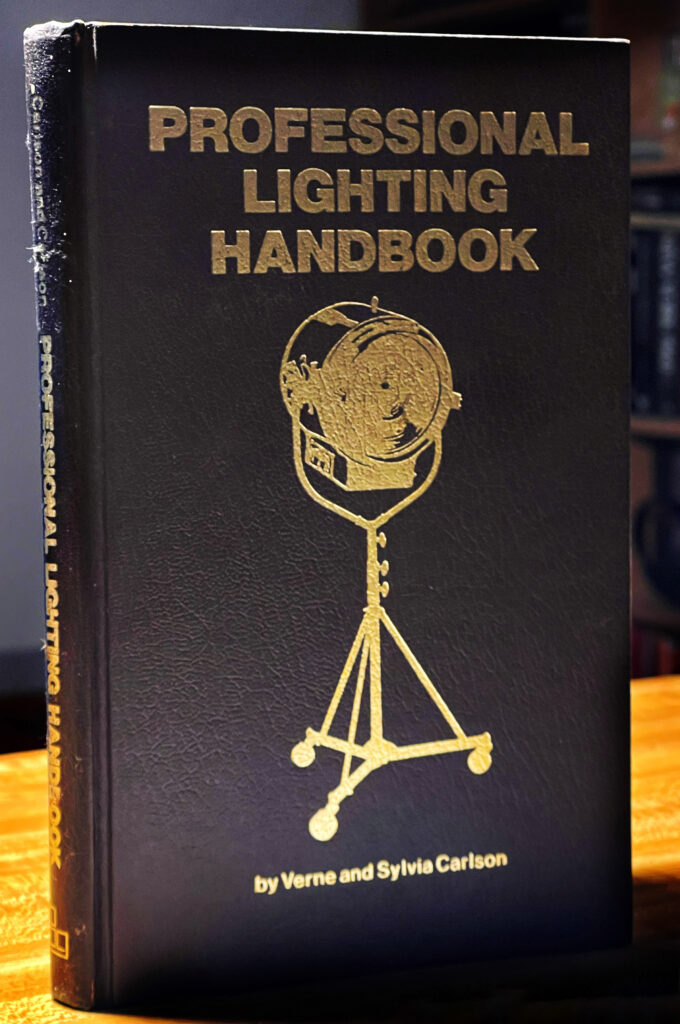
Last Friday’s post professed my appreciation for Verne and Sylvia Carlson’s 16mm\35mm Professional Cameraman’s Handbook. While rooting through yet another obscure storage space, I came upon this companion publication, written by the same authors and whose title anticipates its contents. Don’t let it fool you, though. It’s pretty much devoid of lighting techniques and is oriented more toward members of the electrical department. While that was certainly not my area of interest as a young AC, I felt it was important to know something of this material and gobbled it up voraciously.
Despite the book’s 1985 provenance, most of what it says about the function and maintenance of various lighting units remains useful today. Obviously, there was no examination of LED’s or DMX systems and such, but I would still recommend it to someone just starting out. I was in a developing phase back then and found a lot of useful information between its covers.
Sober decision-making was perhaps the most important part of what I learned. Proof of that comes with my choice to work exclusively with smart, talented gaffers and lamp operators. Leaving any aspect of their jobs to me would be a mistake. Leafing through this book again after many years, I was reminded that the only thing I really know about electricity is how to shock myself.
Both essential books.
Without the cameraman’s handbook, I would have been immediately fired from my first 2nd unit job.
For many years the three books I brought with me on every shoot were The American Cinematographer Manual and these two. Today, almost 40 years later, I still carry the American Cinematographer’s Manual.
As a young still photographer’s assistant in 1993, I somehow came across the ASC manual. I studied that guide through and through. I used to give myself exercises, using the lighting diagrams in the AC magazine, and backwards engineering how much power I’d need, what exposure I would get, and which ND I’d need to generate that image. Years later, I’d go back and try to figure out what lighting ratios were created by each diagram. While unsure if my results were accuate, it was a great way to get the brain thinking, and most likely let to my path to DP through G&E.