
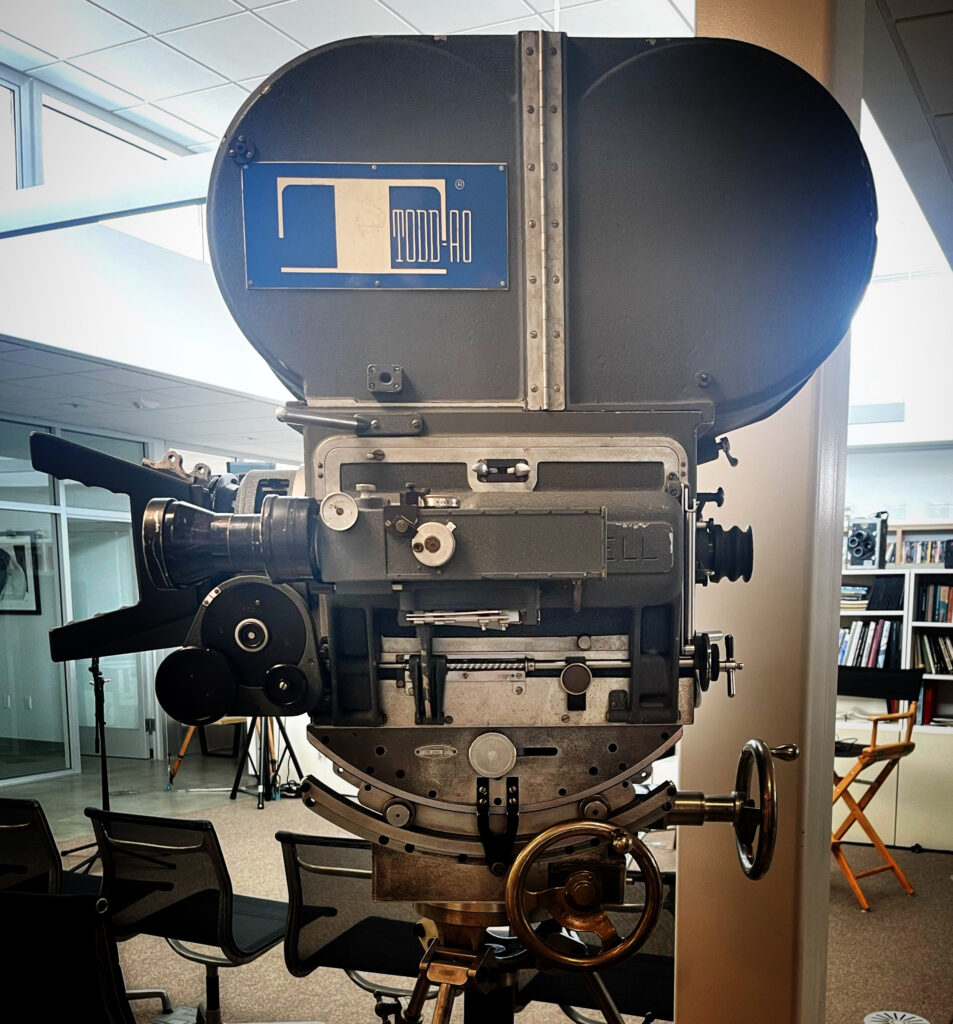
This Todd-AO camera is among the newest additions to the ASC’s collection of historically significant items. Generously donated by multi-Oscar winner and special effects legend Richard Edlund, ASC, it’s in pristine condition and is a fascinating relic of a time when Hollywood’s studios were doing their best to think big.
Dating back to the early ’50’s, originator Mike Todd wanted to create a simpler widescreen replacement for Cinerama. While Cinerama used a complex arrangement of three lenses and three strips of film to simultaneously photograph the action, Todd-AO required only a single lens and strip of film. Tack sharp and strikingly life-like in 70mm, it established a precedent of excellence that remains impressive to this day.
The first two movies produced in this process – Oklahoma (1955; Fred Zinneman\Robert Surtees, ASC & Floyd Crosby, ASC) and Around the World in Eighty Days (1956; Michael Anderson\Lionel Lindon, ASC) – were shot and projected at 30 frames per second. As of 1958, all subsequent movies were shot at the standard 24fps.
Other notable titles that were originated in Todd-AO include Porgy and Bess (1959; Otto Preminger\Leon Shamroy, ASC), The Alamo (1960; John Wayne\William Clothier, ASC), The Sound of Music (1965; Robert Wise\Ted McCord, ASC), Those Magnificent Men in Their Flying Machines (1965; Ken Annakin\Christopher Challis, BSC), Hello, Dolly (1969; Gene Kelly\Harry Stradling, ASC), Airport (1970; George Seaton\Ernest Laszlo, ASC) and Baraka (1992; direction and cinematography by Ron Fricke).
But perhaps the most notable of them all is Cleopatra (1963; Joseph L. Mankiewicz\Leon Shamroy, ASC). The camera pictured above – which, by the way, is marked Serial #1 – was the primary device used to shoot this overblown epic whose cost overruns and failure at the box office nearly destroyed Twentieth Century Fox. Sadly, Mike Todd was killed in a plane crash in 1958. That his at-the-time wife Elizabeth Taylor played the title role provides a fascinating irony.
A wealth of information is available regarding the particulars of Todd-AO. This link provides a good place to start.
https://www.in70mm.com/presents/1955_todd_ao/library/about/beginnings/uk/index.htm
Thanks, Richard.
Todd-AO is my favorite W I D E S C R E E N process from that era.
The distortion free clarity sets it apart.
The third 65mm Todd-AO film was “South Pacific” in 1958, at which point Michael Todd had sold his interest in the company just before he passed away. 20th Century Fox made the decision to switch the process over to 24 fps from 30 fps. I don’t know if Elizabeth Taylor had a financial stake in Todd-AO but she was the one who insisted that “Cleopatra” be shot in that process. To avoid paying fees to Todd-AO, the studios had Panavision create a copy called Super Panavision — Panavision had already created Ultra Panavision for MGM at this point (1.25X anamorphic 65mm) so making a spherical 65mm version was easy.