
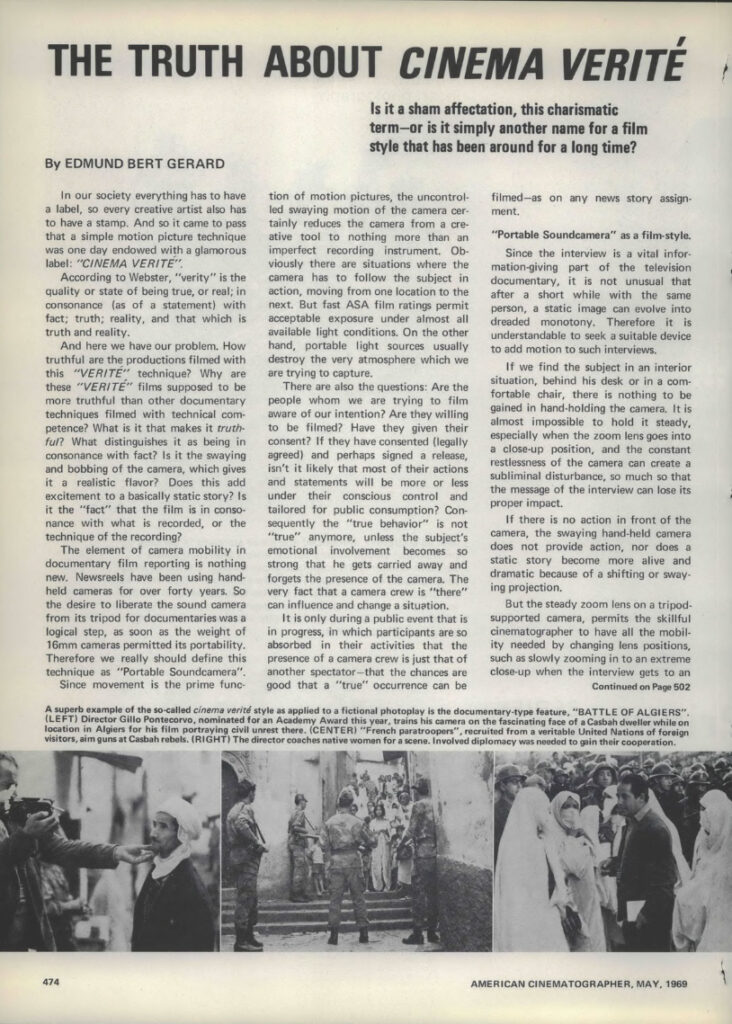
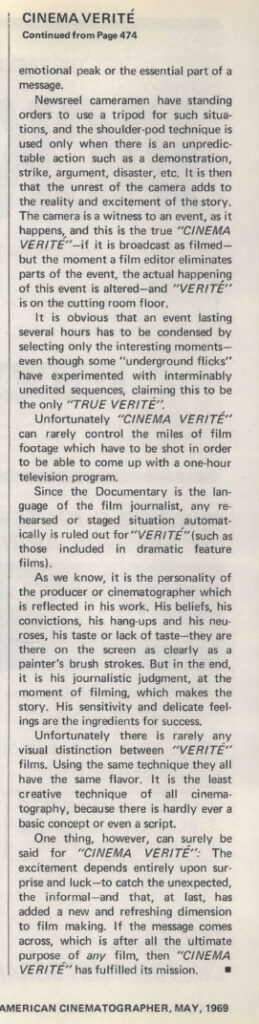
The cinema verité documentary movement that reached its height in the 1960’s had broad-reaching effects on all of moviemaking, some to its benefit while others not. Its most well-known practitioners – Robert Drew, Richard Leacock, Albert and David Maysles and D.A. Pennabaker – produced some interesting work, but I’ve always felt the premise was built on sand. Self-consciousness and pretentiousness rarely make for good films of any kind, especially when they purport to be seeking the truth.
This article, drawn from the May 1969 issue of American Cinematographer, shows just how much the theory was in the air at the time. Though I don’t agree with all of the author’s opinions, he certainly isn’t shy in expressing them.
I remember going to a seminar with documentarians including Werner Herzog about the use of historical recreations in documentaries, to which most on the panel objected to, but Herzog said “I’m not interested in an accountant’s version of the truth.” He felt that as long as you were being truthful about the subject matter from a big picture standpoint, then cinematic devices could be used to reveal that reality.
David – I can just hear Herzog relating that sentiment in his distinctive voice and accent…and to a certain extent, I agree with him!
Interesting thoughts…and interesting article from Edmund Bert Gerard.