
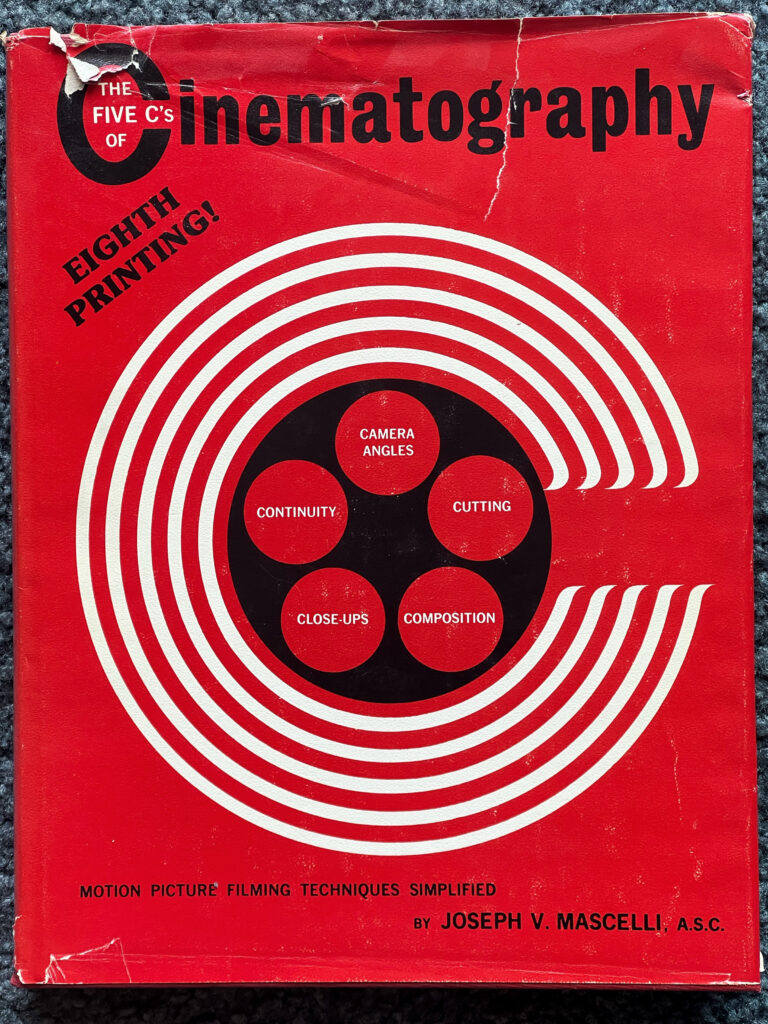
To my knowledge, The Five C’s of Cinematography: Motion Picture Filming Techniques Simplified is the only book ever written that explains the fundamentals of angles, composition and cutting continuity from a camera-centric perspective. Written by Joseph V. Mascelli, ASC and published in 1965, it presents a comprehensive examination of the basic rules needed to assemble a competent set of images.
Though some of its concepts seem dated to our modern, impatient sensibilities, they remain valid and provide a solid grounding for every aspiring cinematographer, director, editor and continuity person. Many people tend to forget – if you want to break the rules, you need to know them first. This book represents a critical step in that direction.
Back in the pre-Amazon days, I acquired my copy through an ad in the Sunday New York Times Book Review. I forget the guy’s name, but he ran a service that I often used to track down obscure volumes of cinematographic reference. I probably paid through the nose, but reading it from cover to cover made it worth every dime!
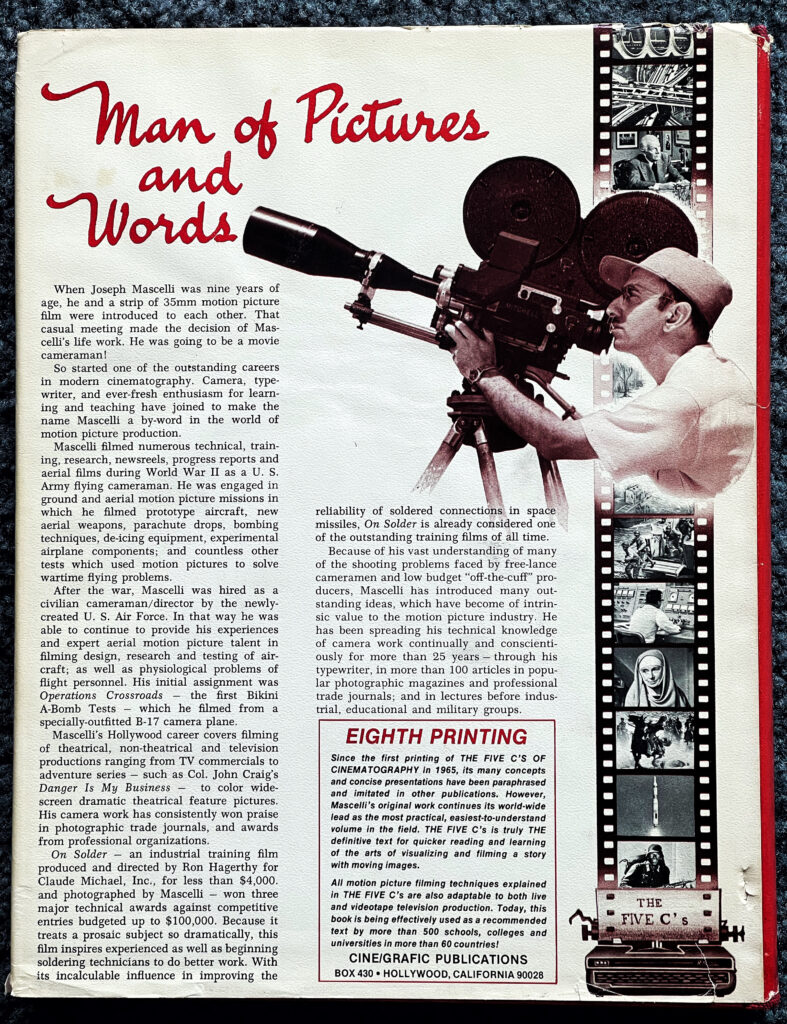
Apart from his book, Mascelli is pretty much a ghost in the history of the ASC. He seems to have worked a decent amount, but none of his shows have withstood the test of time. His bio, featured on the back cover, is interesting enough despite the tone of the publisher’s hype.
A little inside cinematography trivia: A feature he shot – wait for it – The Incredibly Strange Creatures Who Stopped Living and Became Mixed Up Zombies (1964; Ray Dennis Steckler) was notable for something more than its convoluted title. Its camera operator was none other than a young Vilmos (billed as ‘William’) Zsigmond, while the assistant cameraman was an equally youthful Laszlo (billed as ‘Leslie’) Kovacs. Kovacs also played a bit role as ‘Man at Carnival,’ which judging from the name changes must’ve described the state of that production.
It’s a great book by being so concise in addressing the basic tenets of cinematography.
He’s perhaps the only ASC member to have directed a movie shown in “Mystery Science Theater 3000” (“The Atomic Brain”) though I could be wrong…
David – I somehow recall MST 3000 tearing up ‘Santa Claus Conquers the Martians.’ That was shot by David Quaid, ASC. But I could be wrong about that, too…
There will be a tribute to another author of cinematography technique, Douglas C. Hart, at the NY office of Local 600 on the 29th of this month. Doug wrote three books about cinema, the most famous being The Camera Assistant: A Complete Professional Handbook. He also taught and/or mentored thousands of eager young filmmakers over his four decade long career as a top technician and union activist. Join us if you can or send me your thoughts and I will share them with those in attendance.
somewhere I still have the original edition which was in a plastic covered hard folder with he book as a bound insert, and it came with a plastic magnifying glass(why?), an erasable black marker and a plastified cardboard slate. Somewhere in a box of ancient items…
Tom – Doug was truly one of the greats, with an influence that extended far beyond the confines of the camera department. I owe him many thanks and urge everyone who benefitted from his generous nature to attend the tribute.