
From the Nothing New Under the Sun Department…
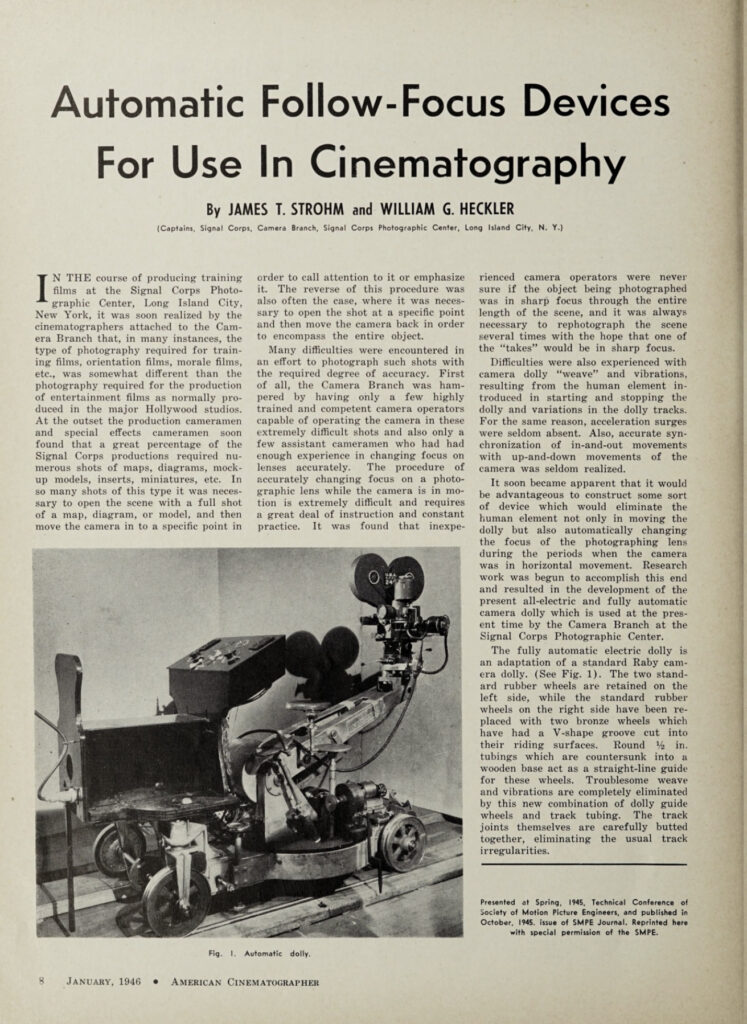
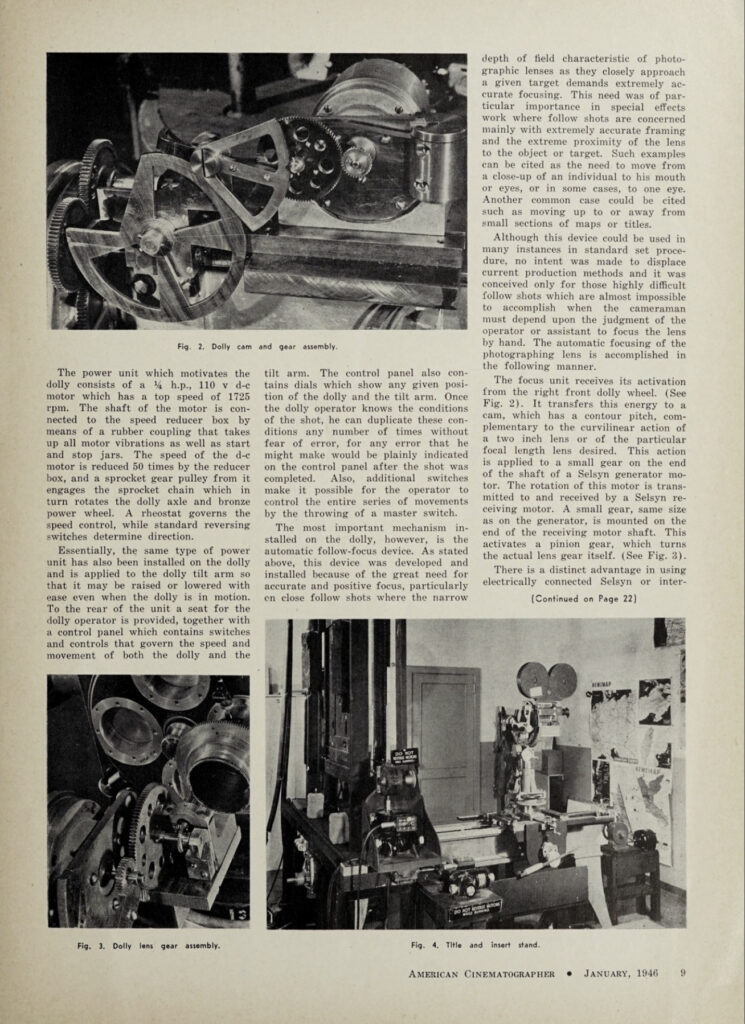
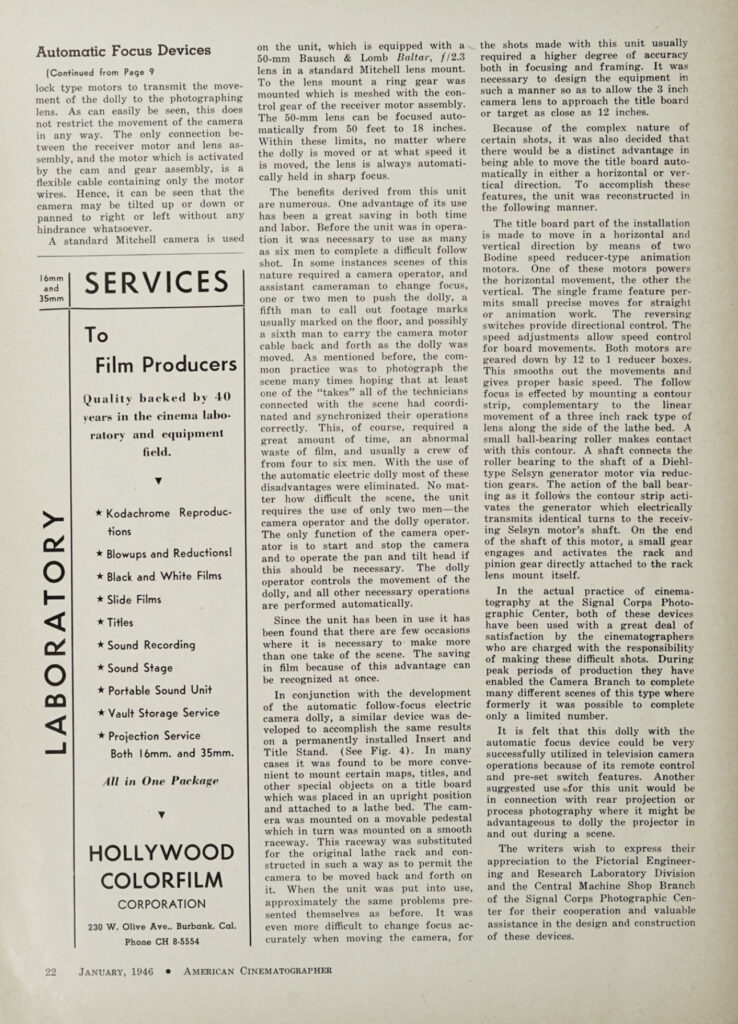
This article, found in the January 1946 issue of American Cinematographer, addresses the design and build of an automatic follow focus device for use with motion picture cameras. As a creation of its time, the story of this Rube Goldberg-like machine is an interesting one. Though this capability has long been a standard part of the stills world, the idea never caught on with Hollywood. The choice of where and when to place focus in a moving image is too important a creative tool to be left to the roamings of a dispassionate algorithm.
First AC’s are fond of using a variety of gadgets to keep things honed. Visit any set and you’ll find them scrutinizing the action on a high-def monitor, carefully working a wireless handset to guide and maintain focus. But none of that is automatic. The technology still requires someone to make decisions and physically manipulate controls to affect the shot. This’s also true for such aids as Howard Preston’s Light Ranger, which is remarkable in the way it helps attain tack-sharp results under the most challenging of conditions.
There have been a few clever attempts to reinvent that wheel over the years, but none really came to fruition. Best-known is the Lytro light field camera, which allowed the focus point to be set after photography was completed. By recording the direction and position of the light rays reflecting from an object (the ‘light field’), it combined and overlapped those images to create a new one with the desired object in focus. I attended a private Lytro demo a few years ago at the NAB convention in Las Vegas and was seriously underwhelmed by it. Apart from the dodgy aspects of how it translated focus, the massive size of the camera made its use impractical. Also, the tech was non-transferrable, i.e., you couldn’t use it on an Arri or a Red. This was an instant deal-killer, no matter how good the focus was.
Recently, DJI introduced the Focus Pro. Their Youtube video (https://www.youtube.com/watch?v=L6u-qLfRiZA) seems promising, but I’ll hold comment since I’m yet to have any experience with it. The on-screen presence of the human touch as focus rolls in and out is as important as the efficacy of the technology used to do it. I’d be curious to see if they’ve conquered this sticky problem.
Until then, I’ll be recalling my early days in the camera department, when all a focus puller had to work with was their eyes, a measuring tape and a knob beneath the lens. Somehow, we got the job done quickly and efficiently. And sharply. If anyone suggested our job should be automated, we would’ve taken it as an insult! Now, I think most AC’s would opt for the automation.
Once again, I can’t resist saying it: Times sure do change, don’t they?
There is a recent device that does auto-focus after user input on who or what to focus on. It’s called the Moon Smart Focus and is made by a Swedish company and it works beautifully with many ways to keep focus on the desired person (their eyes) even when a solid object passes in front of them. It’s worth checking out.
The Army Pictorial Center is now Kaufman-Astoria Studios.
http://www.armypictorialcenter.com/what%20was%20apc%20scpc.htm
Thank you, Roberto…I’d never heard of this device until you mentioned it today at the Clubhouse. Sounds interesting. I’ll have to check into it.
I love seeing this contraption! There is a very early “auto pilot” Glenn Curtiss had which looks equally amazing.
My team and I are still teaching interns to pull focus by standing off to the side of the camera and triangulating. Not sitting at a monitor. Our AC’s and Motion Control Ops often pull focus by hand and we record the motion for repeat takes. It is a key part of the look and feel of the work, made by humans for humans…